Triffin’s Dilemma: The Privilege and The Curse of the Dollar As World Currency
Posted on: March 28, 2025
Following our series about academic research, today I will write about Triffin’s Dilemma, a theory proposed by Dutch economist Robert Triffin in the 1960s.
The theory postulates that the country that owns the world’s reserve currency will inevitably face a persistent trade deficit that will imperil the confidence in that currency.
The theory was originally tied to the Bretton Woods Accord after World War II, where the US dollar was pegged to gold, and the rest of the world’s were pegged to the dollar. In 1971, President Nixon announced the de-pegging of the dollar from gold, effectively, making the dollar a fiat currency that the government could “print” as much of as they wanted.
This is an exorbitant privilege that other countries do not enjoy. By this, I mean that no matter what problems our country faces, we can print our way out of trouble. The oversupply of the dollar would normally cause hyperinflation in our country, but since ours is the world currency, we can export our surplus dollars to the rest of the world by running a trade deficit.
Exporting dollars is a great business to have, since instead of goods, which requires costly manufacturing, dollars can be created by simply adding an entry into the Fed’s computer system. However, a side effect is, that nobody wants to invest in manufacturing and no young people want to work in factories. All smart kids want to be in finance, the industry that is closely related to money creation, allocation, and management. This has led to overfinancialization and the gradual deindustrialization of the country (See chart below.)
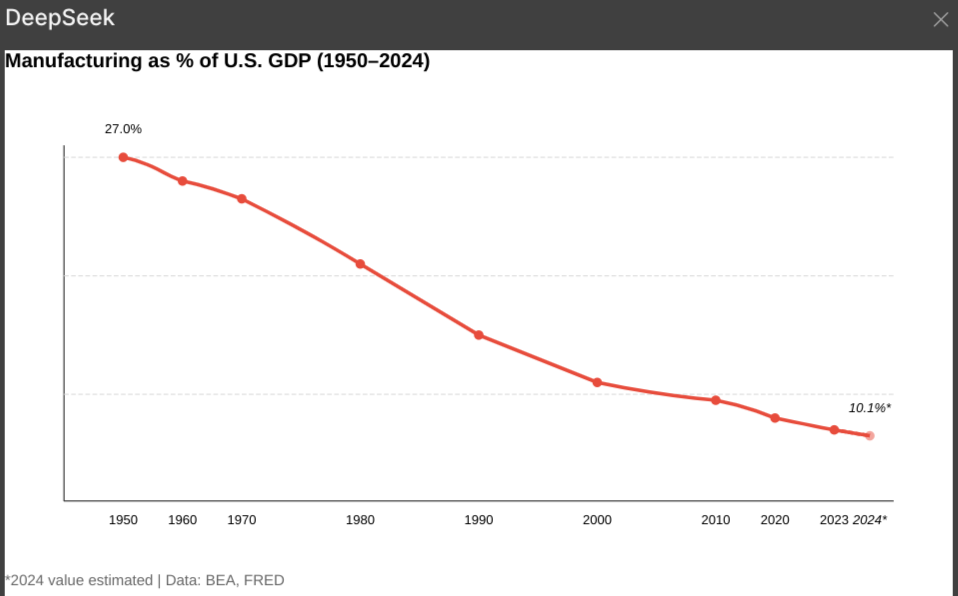
One of President Trump’s policy goals was to revitalize US manufacturing, and his policy tool was to raise tariffs on imports. Another policy goal was to maintain the dollar as the dominant world currency, and his policy tool was to punish countries that don’t use the dollar for trade with 100% tariffs. If Triffin’s dilemma is valid, he can’t achieve both policy goals at the same time regardless of tariffs.
Get informed about wealth building, sign up for The Investment Scientist newsletter

 The Investment Scientist
Leave a comment