The Economic Impact of AI: A Nobel Laureate’s View
Posted on: November 19, 2025
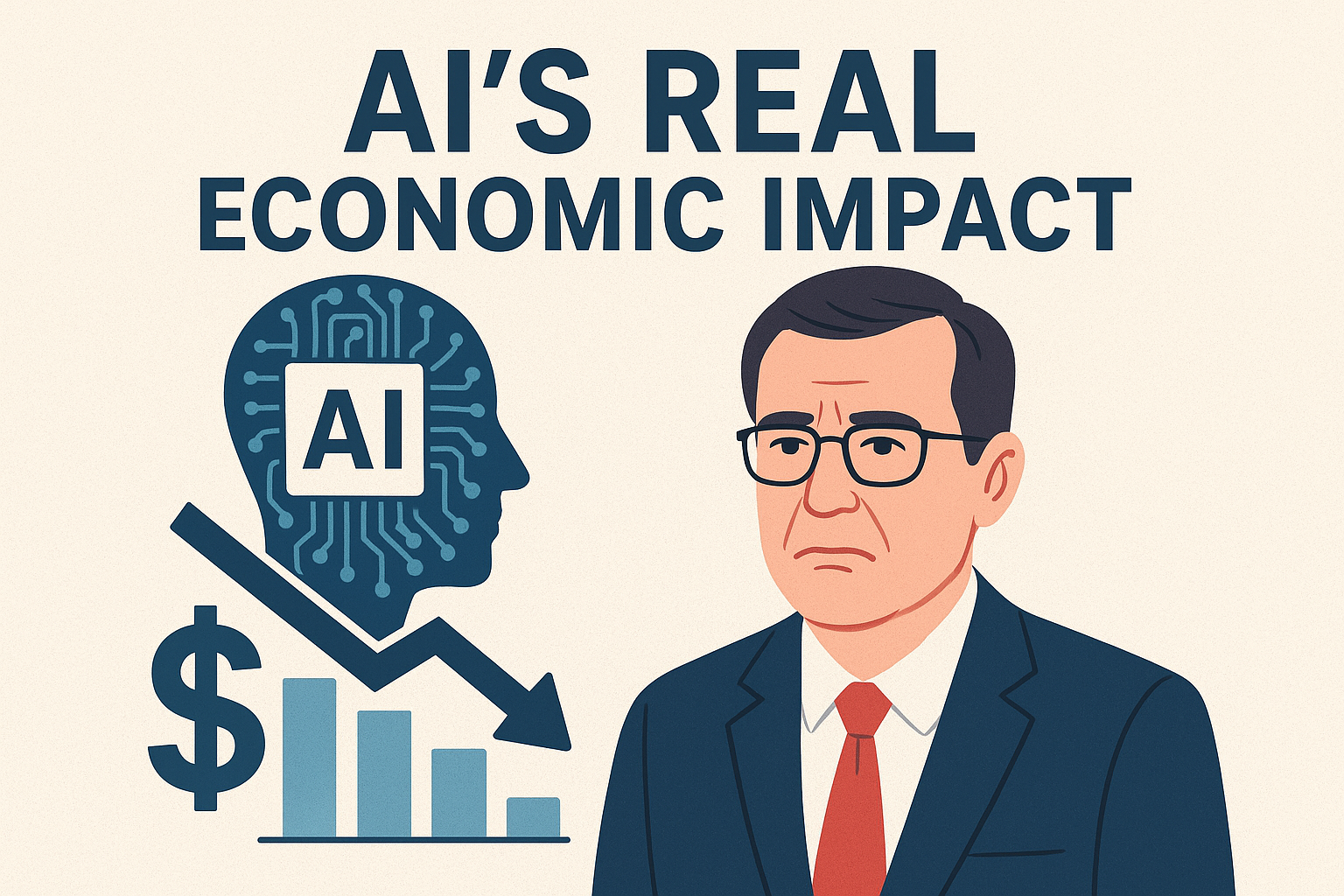
Today I am writing about a paper by MIT professor and 2024 Economic Nobel Laureate Daron Acemoglu titled “The Simple Macroeconomics of AI”.
Unlike the bullish projections of AI’s transformative impact on economics, Acemoglu’s view is much more measured. Given the overwhelming media coverage favoring maximalist views on AI, his perspective offers a necessary counterpoint.
Acemoglu argues that over the next ten years, AI will likely automate only 5% of tasks and increase the GDP by about 1%. He explains that while AI excels in specific tasks with clear truths, most real-world jobs involve complex, tacit, contextual knowledge and social intelligence that AI can not easily replicate and replace.
His paper also makes these important points:
- AI may raise GDP numbers but reduce overall welfare. Imagine more deepfake videos. Those add to the GDP, but do they enhance our well-being?
- AI will likely aggravate inequality. Workers are unlikely to get a raise from the implementation of AI, rather, the economic benefits of AI will accrue to capital owners.
- AI can be used to create new tasks for workers (as opposed to replacing them) in general, particularly for low-income workers.. This would lead to a more favorable social outcome. (However, I don’t believe this is a likely outcome since the owners of AI, Sam Altman and others, couldn’t care less about the social outcome of their technology.)
In conclusion, Acemoglu presents a very measured and nuanced view of AI’s impact. This contrasts sharply with the viewpoint of Sam Altman, CEO of OpenAI, who announced plans to invest $1.4T to build more AI infrastructure. If his spending were a country’s economy, it would rank just behind South Korea and Mexico. When challenged by one of his investors asking how a company that is losing billions of dollars can spend trillions, here is his passive-aggressive response: https://www.youtube.com/watch?v=WEnBCfzsgyE
It is also worth noting that these types of cautious and measured views are rarely disseminated in the media. Acemoglu never gets the kind of attention that people like Jensen Huang or Sam Altman get. This raises some questions: Why is a certain view being widely disseminated, and the counterview is seemingly being kept under cover? How does this disparity affect our investment decisions? And to what end?
Get informed about wealth building, sign up for The Investment Scientist newsletter

 The Investment Scientist
Leave a comment