Archive for the ‘Investor Behavior’ Category

Facebook Winners’ Curse
Back on April 9, Mark Zuckerberg announced that Facebook had agreed to acquire Instagram for a jaw dropping $1b.
What is Instagram? It is an iPhone app that allows people to swap photos with friends. The one and a half year old company has about 16 employees and its revenue is a cool zero.
Most commentators said that Zuck was either trying to pre-empt a potential competitor or to expand in the mobile market where Facebook is weak. There is nothing Instagram does that Facebook cannot replicate, make available to its 900 million users, and instantly kill Instagram. Why pay $1b for something that is essentially worthless?
Share this:

Why you should avoid hedge funds
Posted on: August 15, 2012

Hedge fund managers take their cut
There is a new book about the hedge fund “industry” by former insider Simon Lack. Its title says it all – The Hedge Fund Mirage – The Lesson of Big Money and Why It’s Too Good To Be True.
Not everybody has time to read books like this, but if you are ever approached by a hedge fund peddler – I get calls every week about an amazing alternative investment opportunity – at least look at the table below before you part with your money.
Between 1998 and 2010, hedge fund fees totaled $440 billion versus $9 billion total profits for investors.
Share this:


Brain collage
I received this question from a subscriber to my monthly newsletter. To answer it, I must take a detour to our human brain structure.
We actually have three brains in our head!
In the center is the reptilian brain that we share with fishes, birds, and reptiles. It deals mostly with “housekeeping” and instinct, such as body temperature and hunger. The fight-flight-freeze fear response is handled here as well.
Share this:

While reading USA Today at Panera Bread, I came across an article with a headline that blared: “Managed commodities can counter volatility.” You should have seen the chagrin on my face; you would have thought I was a facial contortionist.
How could such an uninformed article ever get published by a major newspaper? Just imagine the large number of people who will be misled by this article to put money into a financial product they don’t understand.
The claim of this article is based on a comparison of a managed futures index and the S&P 500 index. The managed futures index was compiled by a private firm called Barclay Hedge, basically a marketing arm of the managed futures industry. Read the rest of this entry »
Share this:

Stocks On Sales
Posted on: June 6, 2012
This is a client communication letter I wrote on June 1st. One week after i wrote this, the market closed out its best week in 2012.
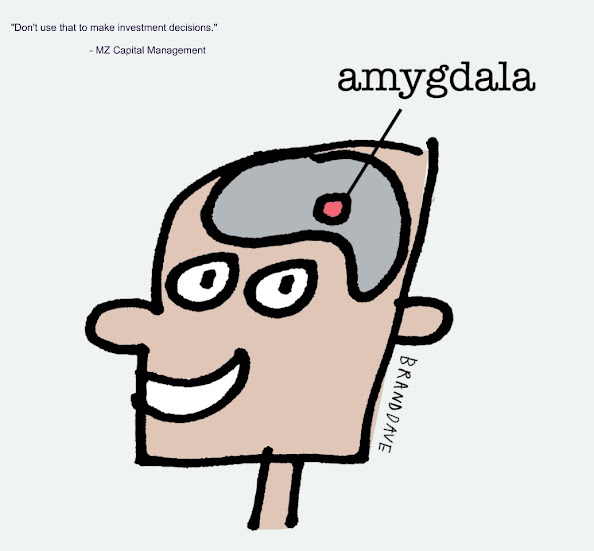
Don’t Use Amygdala to Make Investment Decisions
As I am writing this, the markets are falling like a rock. The Dow has entered negative territory for the first time this year; Nasdaq, which was up 20% a mere two months ago, is up only 5% for the year. The S&P 500 has lost close to 10% of its value since its April 1 peak.
I wrote the above paragraph using typical financial press lingo. This type of language has the tendency to cause amygdala hijack.
The amygdala is a part of our brain that processes threats. When we perceive a threat, the amygdala takes over the whole brain. fMRI scans show that blood supplies are literally commandeered from other parts of the brain for the amygdale. The amygdala is not sophisticated; it only knows three responses: fight, flight, or freeze.
Share this:

Facebook Scam Hits Close to Home
Posted on: May 14, 2012

Facebook Scam
Two months ago, I got a call from client of mine, who asked my opinion about an opportunity to invest in pre-IPO Facebook shares. He explained that he and his business partner were offered the opportunity to invest in a private fund that will hold Facebook shares.
I know nothing about these funds, but I told my client to stay away. As a general principle, I always steer my clients away from private funds unless they run the funds themselves. The reason is very simple: these are unregulated vehicles where there is no government oversight and there is no transparency whatever. You don’t know what monkey business they do with your money. Most business people intuitively grasp that if the private deal is about starting a restaurant; but once the deal is about buying Facebook shares, many of them throw caution to the wind.
Share this:


Old Age
Believe it or not, you are a stranger to yourself. That’s the finding of Hal Ersner-Hershfield et al. in their published research detailed in Social Cognitive and Affective Neural Science.
This unconscious assumption of a different self in the future is demonstrated graphically by brain scans. In their study, Ersner-Hershfield et al. found that when people think about their future selves, the same brain region lights up as when they think about strangers. The implication for saving behavior? Saving for the future instinctively feels like giving money away to a stranger. No wonder only 9% of Americans are saving enough for their retirement.
Share this:

 I am not a big fan of IPO shares. Research has shown that IPO shares usually underperform seasoned shares by about 2% a year. Business owners tend to time their IPOs at the optimal time for them, not for the future shareholders.
With Facebook (FB), there are so many people chasing so few shares that the IPO will create a “Winner’s Curse” effect – whoever wins the shares will end up overpaying for them.
Share this:

Can You Retire?
Posted on: February 27, 2012

Financially Secure Retirement
According to Shlomo Benartzi, a University of Chicago economic professor, 50% of Americans don’t save for retirement. Of the other 50% who do save, only 11% save enough, according to their own estimates, which are probably optimistic.
This is not surprising to this financial advisor. For nearly all of my clients, I have created a savings and investment plan for them. The plan is designed so that they can live the lifestyle they desire in retirement. They are all committed to the plan. But while the commitment is there, the will power is not. When it comes time to implement the plan, they can always find important spending that justifies putting off saving to another day.
My clients are all very educated and highly intelligent. Why do even they have a hard time saving enough for a secure retirement? It all boils down to two words: instant gratification.
Share this:

Last year, while the S&P 500 was largely flat, small cap value and emerging markets were down significantly. No wonder some clients of mine got a bit edgy.
What a change one month has made! As of Feb. 5, these two asset classes have roared back with a vengeance. See the table below.
| 2012 Year to Feb 5th | 2011 | |
| DFA US Small Cap Value | 12.74% | -9.74% |
| DFA Emerging Mkts Value | 19.44% | -26.50% |
| DFA Intl Small Cap Value | 12.74% | -19.41% |
The lesson here: when we see big losses like -19%, -26%, we can view them as a financial Armageddon or as a buying opportunity. The latter position is mentally much harder to take, but it almost always pays off.
Get my white paper: The Informed Investor: 5 Key Concepts for Financial Success.
Get informed about wealth building, sign up for The Investment Scientist newsletter

Share this:

Last month, I was approached by a plastic surgeon whose money was with Morgan Stanley Smith Barney. He was looking for someone who could beat the market: not just promise to beat the market, like his financial advisor, but actually deliver.
I told him that I can’t beat the market, I can only help him capture the market. I could see a wisp of disappointment flash across his face.

Share this:

 Today is the last trading day of 2011. The S&P 500 closed at 1257, exactly the same close as in 2010! So, if your goal is wealth preservation, the market just did it for you.
Or did it?
From January to April, the market staged a four-month rally of 8.5% to peak at 1364 on April 29. For the next six months, it collapsed nearly 20% to bottom at 1098 on Oct. 3. Then, it staged a late rally to close the year at 1257.
Share this:


Credit: behaviorgap.com
In my previous article, “The perils of chasing hot fund managers,” I showed that the average investor in a mutual fund run by “star” manager Bill Miller would be better off buying and holding an S&P 500 index fund.
There is only one problem. Most index fund investors are not immune to the buy high and sell low tendency, as illustrated by the table below. Between 1991 and 2005, the Vanguard S&P 500 Index Fund (VFINX) returned an annualized 11.51%, but the average VFINX investor only earned a return of 7.96% during the same period.
| 1991 to 2005 annualized | |
| VFINX fund return | 11.51% |
|
VFINX investor return |
7.96% |
Share this:


Bill Miller’s Legg Mason Value Trust
On November 17, Bill Miller announced that he would step down as manager of Legg Mason Capital Management Value Trust (LMVTX).
From 1991 to 2005, under Miller’s stewardship the fund outperformed the S&P 500 index for an astounding 15 straight years. Since then, the fund has underperformed the index in all but one year, and by a significant margin.
So what’s the problem? The problem is many investors bought the fund only after Miller had become a mutual fund rock star, just in time for his hot streak to end. They missed much of his upward ride, but were fully onboard when the fund went down the toilet. See the table below. Read the rest of this entry »
Share this:

Staying in Your Seat
Posted on: November 18, 2011
[Guest post by Tom Warburton] Who could forget the recent World’s Series? Man, was that sixth game otherworldly or what!

The day after the sixth game a buddy wandered in – remorseful that he, while watching the Cards vs Rangers, had gotten up out of his seat to go out in his backyard with his dogs (to do who knows what) only to return to his seat and discover that he had missed the walk-off Home Run by Freese – arguably the climactic play of the season!
Share this:

Is the Sky Clear Enough Yet?
Posted on: November 9, 2011
[I wrote this two weeks ago.]

Clear Sky
On September 12, a client of mine called me to get out of stocks altogether.
He used a vivid analogy: “The storm is raging; I will wait until the sky clears before I get in again.” The storm he referred to was the European debt crisis. Judging by my many interactions with investors, he is not alone.
This morning, I woke up to great news: the Europeans have finally hammered out a debt deal in which Greece only needs to pay 50% of what they owe to the banks. With this debt reorganization, it looks like we will not have a Greek default (even though this is really a default by another name, but that’s the subject of another piece).

 The Investment Scientist