Archive for the ‘Investor Behavior’ Category
Retirement investment bookmarks
Posted on: April 17, 2008
Richard Conniff of MSN Money wrote about “How fear can make you lose millions.”
Blind trust in pundits could wipe you out as well. Alice Gomstyn of ABC News asked “Should you stay away from Jim Cramer?” (My answer is yes.)
Bob Klosterman explained life insurance in wealth management.
Greg Mankiw examined Barrack Obama’s tax return, he found Obama is not a fan of retirement saving.
Get informed about wealth building, sign up for The Investment Scientist newsletter
Share this:

Investor sentiment is at its lowest since 1990 and second lowest since the American Association of Individual Investors (AAII) sentiment indicator began in 1987. On 2/7/08, the 8-week moving average bull/bear spread reached the low of -25% and has since hovered below -20%. What does it mean for investors that the bull/bear spread stands at -25%? And what is the bull/bear spread?
Are you bullish, bearish, or neutral?
That’s the question asked by the AAII who has been conducting weekly market-outlook surveys of its members since 1987.
The bull/bear spread is the bullish percentage of the answers minus the bearish percentage of the answers. For instance, if 30% are bullish, but 50% are bearish, then the bull/bear spread would be 30%-50%=-20%. Since investor sentiment is very votalile, the 8-week moving averaging is used to smooth out the kinks. The AAII has 20 years of data with which we can study the relationship between investor sentiment and stock market return.
Current low investor sentiment is significant because there were only six instances (excluding this one) when it was below -15%. And only two instances when it was below -20%.
How does bearish investor sentiment relate to stock market return?
I used the small sample of six prior occasions when the bull/bear spread was below -15%. I then studied the subsequent one-year returns by the S&P 500 and the Fama/French Small Cap Value Benchmark Portfolio. The result is displayed in the table below.
| Time (8 weeks ending on ) | 8 week MA bull/bear spread | S&P 500 one year return | Small Cap Value one year return |
| 11/2/1990 | -37% | 25% | 46% |
| 2/7/2008 (this time) | -25% | ?% | ?% |
| 10/23/1992 | -21% | 12% | 40% |
| 3/13/2003 | -18% | 40% | 82% |
| 7/2/1993 | -15% | 0% | 11% |
| 7/20/2006 | -15% | 23% | 23% |
| 3/16/1990 | -15% | 9% | -2% |
| Average | -20% | 18% | 33% |
Data sources: AAII, Kenneth French data library
History shows that the worst decline is over once the indicator shows a reading of -15% or below.
One-year returns for the S&P 500 ranged from 0% to 40%, while those for the Fama/French Small Cap Value Benchmark Portfolio ranged from -2% to 82%. To the extent history repeats itself, the risk rewards of stock investing is heavily skewed toward rewards.
Warren Buffet put it best when he said: “Be greedy when others are fearful.”
Get informed about wealth building, sign up for The Investment Scientist newsletter
Share this:
We’re already in a recession. Or, that’s what the pundits say. They may well be right. But what will you do about it? Will you follow common wisdom and seek relative safety of large cap stocks? After all, large cap stocks are safer— right?
That’s what I had thought too, until I studied the S&P 500 and the Fama/French Small Cap Value benchmark portfolio in all nine recessions going back to 1950.
My study looked at time periods of one year and three year returns into a recession. Surprisingly, results show small cap value stocks to have both higher returns and lower risk than the S&P 500.
Here’s what happened in the one-year period from the start of all nine recessions. The S&P 500 declined three times. Yet in the same period, the Fama/French Small Cap Value benchmark portfolio was down only once.
Three years after the start of all nine recessions, the S&P 500 was under water one time. However, the Fama/French Small Cap Value benchmark portfolio fared much better by being firmly on dry land.
Get informed about wealth building, sign up for The Investment Scientist newsletter
Share this:
In the three month period between Oct 19th, 2007 and Jan 18th, 2008, the S&P 500 index fell 14.1% and the Russell 2000 Value Index fell 19.5%. To understand what is likely to happen next, I studied the top 10 worst three-month-sell-offs since 1950. These sell-offs ranged between -13% to -30%. I found that in 8 out of the 10 occasions, the S&P 500 index rebounded by more than 20% in one year. Small Cap Value stocks did even better. The Fama & French Small Cap Value Index rallied more than 30% in one year in 8 out of the 10 occasions. In the other two occasions, it increased 6.6% and 24.1% respectively. (See Table below.)
A market sell-off is not a risk
As Demonstrated by history, most of the worst market sell-offs were followed by a substantial rally within a year. Many investors panicked and fled to cash at the nadirs of the sell-offs. By the time they mustered enough courage to get back in, they had missed the rallies. If you want to achieve long-term investment success, treat a market sell-off as an opportunity, instead of a risk.
Table: One-year returns after the worst 3-month sell-offs
| 3-month period ending | 3-month decline | Subsequent S&P 500 12-month return |
Subsequent Small Value 12-month return |
| Nov 1987 | -30% | 23% | 32.7% |
| Sep 1974 | -25% | 38% | 42.4% |
| Jun 1962 | -21% | 31% | 37.9% |
| Jun 1970 | -18% | 42% | 55.4% |
| Sep 2002 | -17% | 24% | 41.4% |
| Sep 2001 | -15% | -20% | 6.6% |
| May 1962 | -14% | 23% | 30.6% |
| Oct 1990 | -14% | 34% | 49.6% |
| Oct 1957 | -13% | 30% | 50.5% |
| Nov 2000 | -13% | -12% | 24.1% |
Data sources: Fidelity MARE group, Prof. Kenneth French data library.
Get informed about wealth building, sign up for The Investment Scientist newsletter
Share this:
What you need to know now the recession is here
Do you ever get that feeling that you’d rather just stay in bed? This morning was one of those mornings. We woke up to the painful news of stock market collapses across Asia and Europe. And then, more surprising, a sudden action by the Fed cutting the interest rate by three-quarters of a percentage point (75 basis points). We never know for sure whether we’re in a recession until National Bureau of Economic Research (NBER) makes it official. That could take up to six months. But the only conclusion I can draw from the immediacy of reaction from the Fed is that if we are not in a recession right now, it’s about to happen.
So what can we expect the stock market to do during a recession-and after it? I may not have a crystal ball to see the future, but I have made an in-depth study of all nine recessions since 1950. Even if history won’t repeat itself, looking at the past half-century should give us some perspective.
Things look gloomy now, but the future is not
How long does the average recession last?
Since 1950, a typical recession lasted for ten months. The shortest one lasted for six months and the longest one lasted for 16 months. (See column 2, Table 1 below.)
What have been typical returns during past nine recessions?
Five of the nine recessions saw the S&P 500 index increased during the downturn (See column 3, Table 1 below). The average index return during recessions was 3.14%.
One year into the start of a recession, the S&P 500 index, on average, increased an anemic 2.95%. (See column4, Table 1.) Yet there are only three instances during this period when the index dropped, and the largest of these was by a painful 27%. However, the remaining six first-year periods saw the index increase. The best of these was by 25%.
By the third year of the start of a recession, the S&P 500 index on average increased 28%, which is slightly below the normal rate of return for the index. There was only one instance when the index was below the start of the recession. (See column 5, Table 1.)
Ten years into the start of a recession, the S&P 500 index on average increased 139.6%. There were no instances of the index being below the start of such a long recession. It’s worth noting 139.6% for ten years is still below the normal rate of return for the S&P 500 index. (See column 6, Table1.)
Table 1: S&P 500 returns during and after recessions
| Recessions | # of months | During R | 1 year | 3 year | 10 year |
| Jul 1953 – May 1954 | 10 | 17.94% | 25% | 100% | 179% |
| Aug 1957 – Apr1958 | 8 | -3.94% | 6% | 26% | 107% |
| Apri1960 – Feb 1961 | 10 | 16.68% | 20% | 28% | 50% |
| Dec 1969 – Nov 1970 | 12 | -5.28% | 0% | 28% | 17% |
| Nov 1973 – Mar 1975 | 16 | -13.13% | -27% | 6% | 73% |
| Jan 1980 – Jul 1980 | 6 | 6.58% | 13% | 27% | 188% |
| Jul 1981 – Nov 1982 | 16 | 5.81% | -18% | 15% | 196% |
| Jul 1990 – Mar 1991 | 8 | 5.35% | 9% | 26% | 302% |
| Mar 2001 – Nov 2001 | 8 | -1.80% | -1% | -3% | |
| Average | 10 | 3.14% | 2.95% | 28.20% | 139.16% |
| Current recession started Dec 2007 | 18 | -34.8% | -39.2% | -9.9% | ? |
Get my white paper: The Informed Investor: 5 Key Concepts for Financial Success.
Small cap value stocks will do better, if history repeats itself
I’ve used the Small-Cap Value Index constructed by Fama and French to study the effect of recession on small cap value stocks for the last nine recessions since 1950.
On average, the Small-Cap Value Index returned 11.39% during a recession. During those recssion periods, the returns of the Small-Cap Value Index ranged from barely dropping (-2.17% in the ’69 recession) to strongly rallying (38% in the ’81 recession). (See column 2, Table 2 below.)
One year into the start of a recession, the index on average returned 13.21% with only one instance of index decrease. (See column 3, Table 2.)
Three years into the start of a recession, the index on average returned 76.21%with 31% being the worst return. (See column 4, Table 2.)
Ten years into the start of a recession, the index on average returned 506.26% with 312% being the worst return and 1183% being the best. (See column 5, Table 2.)
The reason I recommend my long-term approach and staying with small cap value stocks is because of these results.
Table 2: Small cap value returns during and after recessions
| Recessions | During R | 1 year | 3 year | 10 year | |
| Jul 1953 – May 1954 | 10.11% | 21% | 100% | 362% | |
| Aug 1957 – Apr 1958 | -0.56% | 18% | 63% | 517% | |
| Apr 1960 – Feb1961 | 21.72% | 32% | 46% | 343% | |
| Dec1969 – Nov 1970 | -2.17% | 7% | 31% | 312% | |
| Nov 1973 – Mar 1975 | 17.81% | -13% | 86% | 1183% | |
| Jan 1980 – Jul 1980 | 3.11% | 15% | 96% | 499% | |
| Jul 1981 – Nov1982 | 38.29% | 0% | 95% | 387% | |
| Jul 1990 – Mar 1991 | 5.52% | 9% | 83% | 448% | |
| Mar 2001 – Nov 2001 | 8.68% | 31% | 86% | ||
| Average | 11.39% | 13.21% | 76.21% | 506.26% | |
How shall we learn from history?
We can take the short view. In the last six months, the S&P 500 has dropped more than 15%. The Small-Cap Value Index has dropped more than 25%. Should we conclude that at this rate, all investment in stocks will be lost in two to three years?
Should you panic now?
The answer is no. But that’s precisely what many investors are doing now by taking money out of the market or rotating them to stocks they perceive to be safer. There is a better way to learn from history.
Take the long view
If you want to sleep well while building your wealth for the long term, you must take the long view of history. Then you’ll be more like Warren Buffet and John Bogle who see the current market madness as normal and transitory. William Shakespeare could well have been talking about the emotional turmoil of the market when he wrote,
It’s like a tale told by an idiot, full of sound and fury, but signifying nothing.
Sleep well, take the long view.
Get my white paper: The Informed Investor: 5 Key Concepts for Financial Success.
Get informed about wealth building, sign up for The Investment Scientist newsletter
Share this:
Do you know that the top three one-day drops in Dow Jones happened in October? On the 19th of October 1987, Dow Jones fell nearly 23%, making the day the worst day in the US stock market history. It was followed by the 24th and 29th of October 1929, when Dow Jones fell 13.5% and 11.5% respectively, ushering in the Great Depression. These events are commonly remembered as the crash of 29 and the crash of 87.
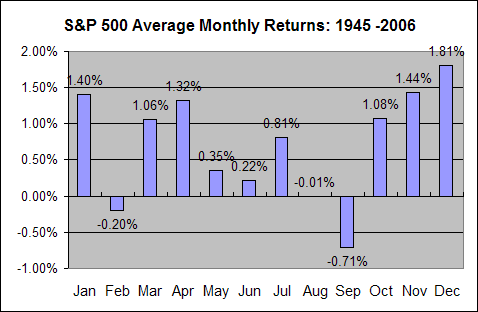
Despite boasting the top three worst days in the market history, October is not the worst month for the stock market. That distinction belongs to September. (See Chart) In fact, summer (from June to mid October) is usually the most volatile and least productive season for stocks. Economists can not quite account for it, but this seasonality is very persistent. So much so that there is a Wall Street folklore that says “buy in November and sell in May”.
The title of my June Newsletter is “Stock Market Seasonality “. This is a good starting point to understand the “What” of this topic. In this article however, I will attempt to discuss the “Why” of stock market seasonality through the prism of Nobel Laureate Daniel Kahneman’s behavioral theories.
Information Accessibility
Some information is more accessible to human minds than others. For instance, visual images are more accessible to human minds than statistics. Deers kill approximately 600 times more people in the US than alligators. Yet if you ask people which of the two animals is more dangerous, nearly all would pick the alligator. Why so? Because alligators look more dangerous and the Chinese said:”An image is worth a thousand words.”
In the case of those big stock market crashes, the most accessible information to ordinary investors is the calendar information – in October they happened. The reasons, the dynamics and the consequences of the crashes are simply quite difficult to comprehend. Take the crash of 87 for example, dynamic hedging and program trading were the culprit. Because the crash was not triggered by economic fundamentals, the market recovered very quickly. Teaching of dynamic hedging belongs to PhD curriculum. It is just too difficult for ordinary investors to understand.
Anchoring
In the words of Kahneman and Tversky, “people rely on a limited number of heuristic principles which reduce the complex task of accessing probability and predicting values to simpler judgments.” One of the heuristic principles is anchoring, which is relying on the most salient or accessible information, rightly or wrongly. In the case of the crashes, the most salient and accessible information is that they both happened in October, and ordinary investors may intuitively judge that to be the plausible cause of the crashes. More thoughtful investors may suspect that both crashes happening in October is a mere coincidence, and they may mentally attempt to correct the initial intuitive judgment. According to Kahneman and Tversky, however, “the correction is likely to be insufficient, and the final judgment is likely to remain anchored on the initial intuitive impression.”
Explanation of Stock Market Seasonality
The vast majority of investors may very well anchor their understanding of the crashes on the calendar and incorrectly judge October to be the month with a very high likelihood of another crash. To hedge this imagined risk, some of them may take their money out of the market entirely in September or earlier and just wait for October to pass, causing the market to go down in summer and in particular in September. The rest who keep their money in the market would become very vigilant and may tend to interpret information more negatively than it is, causing the market to be very volatile. After October however, money would return and vigilance would be replaced gradually by holiday spirits and we get our usual year end rally.
Reference:
Daniel Kahneman’s Nobel lecture in 2002, “ Map of Bounded Rationality”
Share this:


I am an amateur pilot. I remember vividly an episode happened during one of my training classes a few years ago.
That was a very windy day. Up to that point, I had only experience flying in calm weather. As soon as my Cessna took off, I immediately felt the difference. My plane was tugged and pulled in all directions by cross winds. I felt like I was losing control of the plane, and fear swelled up from the bottom of my spine to the top of my head. I sat stiffen in the pilot seat and my sweaty palms grabbed tightly at the control handles like a sinking person grabbing onto a straw.
My trainer sensed my tenseness and she asked: “Are you OK?”. Not willing to acknowledge my fear, I asked her instead: “Is it more dangerous to fly in turbulent weather like this?” The trainer smiled and said: “It is not more dangerous to fly in turbulent weather. The plan was built to withstand any turbulences. But occasionally, an amateur pilot would lose his cool and do something stupid. That’s the real danger.”
The instruction given to me by my trainer is equally valid for investors who are piloting through this turbulent stock market. If you are like all other investors, you would be caught up by fear and anxiety. What should you do? Should you dump stocks and move to bonds? Should you abandon the small cap value style of investing? Should you rotate to “quality” (an euphemism for large cap growth stocks)? If you turn on the TV or open a newspaper, you would be bombarded with advices to do some or all of the above. My recommendation is to do nothing and just stay the course. Anything you do at this time are more likely out of fear than out of reason. If you allow yourself to be driven by fear (and greed), then it is truly to your detriment.
Paraphrasing my pilot trainer, the turbulent market is not more dangerous. Don’t lose your cool and do something stupid. (You can start by stopping listening to the cacophony of market punditry.)
Share this:


On July 17th, the S&P 500 reached its peak after breaking a string of records. In a two week time however, both the S&P 500 and the Nasdaq Composite have lost 7.7%. The index that represents smaller stocks suffered a bigger loss of more than 10%. Are you feeling any pain and anxiety? I know I am.
Before I talk about how I deal with the pain and anxiety arising out of the market tumble, I’d like to first talk about the Equity Premium Puzzle and the Myopic Loss Aversion. These are weighty academic terms, but they would help us understand our psychology and how it could drive us to do stupid things.
Let’s suppose that John Doe has a 10 year investment horizon. He has $100k to invest. Should he invest in treasury bonds yielding 5% a year or in a S&P 500 index fund with long term average return of about 11%? If the money is invested in treasury bonds, 10 years later, John Doe will have $163k for sure unless the US government goes bankrupt. If the money is invested in the S&P 500 index, then John Doe can expect to have $284k. However, this is not sure money. He could end up with more or he could end up with less. The volatility of the S&P 500 is about 15% a year, so with 95% probability, John Doe’s money will be between $189k and $379k. There is a less than 2% probability that investing in treasury bonds will yield more in 10 years. If John Doe is rational, he should invest his money in a S&P 500 index fund.
What economists found out however is that the average John Does in America invest more of their money in treasury bond type fixed income securities. The economists call this the Equity Premium Puzzle, which can loosely be translated into “why on earth would any rational person look past the much better stock return to invest in bonds?”
The term Equity Premium Puzzle was coined in 1985. In 2002, psychologist Daniel Kahneman won the Nobel Prize in economics for his Prospect Theory which was developed decades earlier. Prospect Theory is a theory of how humans perceive gains and losses and how human decisions are driven by these perceptions. What Kahneman found was that the pain from losses is much stronger than the joy from gains of the same magnitude. For instance, when a baby is born, no doubt it is a joyful moment for the parents; but when a baby dies, the anguish felt by the parents is much stronger than the joy of birth. For another example, if you make $1000 in the stock market, you will be happy and excited; if you subsequently lose $1000, you will feel worse.
In 1995, Shlomo Benartzi and Richar Thaler used the Prospect Theory to explain the Equity Premium Puzzle. Here is my interpretation of their work. Regardless of his investment horizon, John Doe’s perception is instantaneous. An immediate gain in the stock market (which may not last) will elicit instantaneous joy and an immediate loss (which may not persist) will elicit instantaneous pain that is stronger than the joy. John Doe may be aware that over the long run, he will be ahead with stocks, but that long run result is unlikely to be in his mind. What is likely in his mind is the fear of the pain of losses he might suffer today or tomorrow. This fear is called Myopic Loss Aversion and it drives our investment decisions. For instance in the last two weeks, the 10 year treasury yield has dropped to 4.75% and blue chip stocks have fallen less than the broader market. These are evidences that people are rotating into bonds and blue chips out of the fear.
Do we want our investment decisions to be driven by fear? How do we harness the fear and even turn it to our advantage? Warren Buffet once said:” Be greedy when others are fearful, and fearful when others are greedy.” Daniel Kahneman also suggested that we looked at our investments quarterly instead of monthly. It would serve us well remembering their wisdom.
Share this:

Market Sentiment and Stock Returns
Posted on: July 31, 2007
Someone asked:”Do you know of any researches/studies carried out that help predict possible upward/downward movements of equity markets?” The following is my answer.
Investors are driven to a large extent by greed and fear, and usually they are driven to the wrong directions. Warren Buffet once said:”Be fearful when everyone else is greedy; and be greedy when everyone else is fearful.” In real life, not many people can do that.
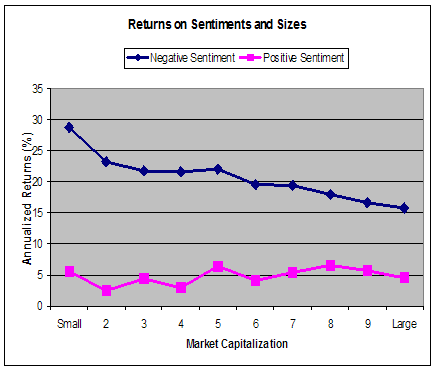
Professor Baker of Harvard and Wurgler of NYU did a study relating investor sentiment and future stock returns. They found when investors are optimistic, the subsequent one year returns are lower; when investors are pessimistic, the subsequent one year returns are higher. (See Chart) They also found small cap stocks are more influenced by investor sentiment than large cap stocks, extreme value stocks and extreme growth stocks are also more sensitive to investor sentiment. Here is their paper – https://pages.stern.nyu.edu/~jwurgler/papers/wurgler_baker_investor_sentiment.pdf
Share this:

An Overdue Correction
Posted on: June 5, 2007
Yesterday morning, I read the news about the overnight 8.6% drop in Shanghai Stock Exchange Composite Index (SSEC). As I just finished the reading, I got a call from a client of mine who just returned from a trip to Shanghai. Here is what she told me. While she was in Shanghai, her brother, who was (and mostly likely still is) knee-deep in the stock market, told her to dump all her stock investments in the US and move her money to Chinese stocks instead. She was very tempted. Then she got on the flight back to the US, took a long sleep, and got a call from her brother. In addition to making sure she is safe and sound, he also told her that he had just lost 50% of his money in the stock market correction. What a difference 24 hours can make!
Just 20 days ago, I wrote “The unbearable lightness of Chinese stocks“. The article was to make a case that there is a bubble in the Chinese stock market. Chinese investors had the blind faith that the government would not let the market fall leading up to the 2008 Olympics, which will be in Beijing. By then the bubble would be so big, the repercussion of its bursting would be in the same magnitude of the Great Depression. Shortly after I wrote that, 10 days to be exact, Alan Greenspan came out with the same warning. (See the BBC report here.) Apparently, some Chinese officials took heed of Greenspan’s warning and the “stamp” tax for stock transactions was promptly raised to 0.3% from 0.1%, ostensibly to stamp out stock flipping. The action also sent a signal to the market that the government would not necessarily support stock prices leading up to the Olympics. In a country where government intention is still paramount, that signal took the wind out of the sail of the stock market, at least for the moment.
Since the tax hike, SSEC has corrected close to 20%. This is well overdue. As a matter of fact, the sooner the air is taken out of the bubble, the better. A prolonged correction of another 20% might bring some balance to the market and some sense to the investors. Should the market recover lost ground within one or two months, that would be a bad sign. We might have to steel ourself for an eventual 70% to 80% crash!
Get informed about wealth building, sign up for The Investment Scientist newsletter
Share this:
On May 13th, the Shanghai Stock Exchange Composite Index (SSEC) for the first time crossed the 4000 level. In just this February, when the index crossed the 3000 level for the first time, it promptly dropped 9%, causing a worldwide correction in stock prices. Who would have thought, in the short 3 months that followed, it would have crossed another milestone.
Indeed the whole country of China is swept into stock investment hysteria. By the end of April, there were 96 million brokerage accounts in the country, three times the number there were last April. New brokerage accounts are opened at the rate of 1 million every 3 days. If you get into a taxi in Beijing or Shanghai, you will likely get a free lecture on stock investment along with the ride; street vendors will offer you free stock tips as you shop and even grandmas and grandpas can’t resist dabbling in and out of stocks with their life savings. (The picture below is a grandpa before a screen of stock prices. The coloring convention is the opposite of the US. Red means profits and green means losses.)

Miracle stories abound as well. There are the usual overnight success stories of somebody (names published in newspaper) who made over a million dollar in one day. There are even stories of chronically sick patients who recovered after winning big in the market.
These anecdotal stories of mania are worrisome enough, they are further corroborated by the unsustainable high average P/E ratio of over 50 in the Chinese stock market.
That’s why I see dark clouds gathering even while many people still see green. Stock market crashes of significant magnitude (> 40%) are never caused by economic problems alone, they are usually preceded by a period of unbridled optimism. The optimism in China now is at a hysterical level and it is unlikely to abate leading up to the 2008 Olympics. What I am afraid will happen is that after the 2008 Olympics or shortly before that, smart money will exit the market. A massive exit could trigger a run in the Chinese market that would spread globally.
What can we in the US do about it? First, don’t panic. The ship that is the US financial system is very solid and resilient, storms (even one coming out of China) will shake it but will not sink it. Second, it would be prudent to raise the cash level of your investment leading up to the Olympics. In case you don’t know, the opening ceremony will be on 8/8/2008, still 445 days away. Third, it is wise to invest in defensive stocks.
As a matter of fact, it is always wise to invest passively.
Get informed about wealth building, sign up for The Investment Scientist newsletter

 The Investment Scientist