Archive for the ‘Wealth Management’ Category

On Dec 17th, 2017, that’s one year and some days ago, BTC (bitcoins) punched through
the $20,000 level, peaking at $20,042.91. Only twenty days earlier BTC reached $10,000 and it was during this 20-day period that I got the most intense client pressures to get their money into BTC and other cryptocurrencies. I am glad I kept them away from it, since as of today, BTC is at $3700. That’s a loss of 81.5% in a year.
BTC is not a stock since it’s not even a real business. Here’s how some stocks that were red-hot a mere few months ago have been faring …
Apple, the perennial darling of the investment world, just lost nearly 40% from its peak after today’s close. That’s a whopping $460 billion loss. The loss itself is larger than the market capitalization of all but four publicly traded companies.
Share this:

 Investors are extraordinarily good at hurting themselves. They all plan to buy low and sell high, and yet what they all end up doing is buying high and selling low.
They do that by 1) piling onto the market when it is riding high and bailing when it is dropping low; 2) chasing the immediate past “winner” whether that is gold, emerging market stocks or the S&P 500 only to see the winning streak fizzle. Basically, they are systematically overpaying for assets.
If that sounds like you, well you are not alone. But here is the good news. I am going to give you a simple trick that can help correct your destructive tendency and thereby make you a much better investor.
So are you ready? Drum Roll, please …..
Treat your investment portfolio the same way you would treat your wardrobe.
What are you talking about? Are these two even comparable?
For simplicity’s sake, let say you acquire your entire wardrobe from Neiman Marcus. If Neiman Marcus has an across-the-board 50%-off sale, would you throw up your hands in despair and say,“Darn it, my entire wardrobe just lost half of its value. I better sell it all at the flea market or I will lose everything?”
Share this:

Who Should Use HDHP with HSA
Posted on: September 17, 2018
 In my last newsletter I wrote about how a Health Saving Account (HSA) is the best retirement saving vehicle with triple tax benefits. However, not everybody can have a HSA – you must have a High Deductible Health Plan (HDHP.) Those of you who have traditional PPO/HMO health insurance are not eligible.
This begs the question, who should use the HDHP with a HSA? Here are the simple answers followed by a discussion.
- High income folks especially those in top three tax brackets of 32%, 35% and 37% should use a HDHP.
- Healthy folks should use a HDHP.
- Low income folks who are frequently sick should stay with PPO/HMO.
Share this:

 Many successful families use irrevocable trusts for tax mitigation, wealth transfer and asset protection. In the last few articles, I discussed how an investor with a concentrated highly appreciated position can use a irrevocable charitable remainder trust to diversify concentrated risk, save taxes and benefit a charitable cause.
The caveat with irrevocable trusts is that granting families have to give up a measure of control. The trouble is that many families give up too much control than they need to. The result: they potentially put their goals at risk.
A physician client of mine created a irrevocable life insurance trust (ILIT) years ago to benefit his children. He named his sister, who loved his kids, as sole trustee. Unfortunately over the years, they became estranged and now she does not even return his calls. His trust is effectively in limbo.
What could he have done to avoid this situation?
Share this:

 After my last article, “How to Deal with ConcentratedHighly Appreciated Position,”a reader asked me exactly how much he can save in taxes.
I’ll use him as an example. He owns an investment property that he bought many years ago for $200k that is now worth $800k.
If he sells his investment property outright, he will need to pay a capital gain tax of the amount (800-200)*20% = $120k.
He can set up a CRT (charitable remainder trust), put the property in it , so when he sells it, the capital gain tax is exempt. That’s a savings of $120k right there.
But does he need to give all of that to charities? The answer is no. In fact he can take out money from the trust for his personal use.
Depending on how he takes out money, a CRT can be either a CRAT (charitable remainder annuity trust) or a CRUT (charitable remainder unit trust.)
Share this:

Ameriprise Caught by SEC! Now What?
Posted on: March 2, 2018

It just caught my attention today that buried deep in the CNBC website was this headline:
Ameriprise Puts Retirement Savers at Disadvantage in High-Fee Funds, Says SEC
As the consequence of getting caught, the billion dollar company agreed to pay a fine of $230,000. If this is not a slap on the wrist I don’t know what is. Is it going to deter Ameriprise or any other brokerages from ripping off their clients? Nah, I don’t think so.
In a statement, Ameriprise pointed out “… It’s important to note that this is a long-standing industry topic and numerous firms have settled with SEC and FINRA on similar matters.”
This is actually a very honest statement that makes it clear that the dishonest practice of costly hidden fees is quite prevalent in the industry. I only take issue with their use of the word “topic” as if no harm has been done.
Share this:

Bitcoin $10,000: My Two Cents
Posted on: November 29, 2017
 The Origin
Bitcoin was invented by a Japanese man named Satoshi Nakamoto. Or was it? He has been in radio silence since 2011, and nobody has seen him or has been able to verify his existence. To say the least, the origin of Bitcoin is shrouded in mystery.
The Technology
The underlying technology of Bitcoin is called Blockchain. It is legitimate and it is being adopted by companies as diverse as Alibaba and Walmart. The technology ensures high security and prevents counterfeiting. However, the technology is in the public domain, meaning that anybody can create an alternative to Bitcoin. In fact, there are more than 1300 “cryptocurrencies” out there as I write this.
The Early Adopters
The early adopters of Bitcoin were anarchists who hate governments and who think fiat monies issued by governments are just means for control and wealth expropriation. They like the fact the Bitcoin is not issued by any governments and is not managed by any “trusted” third party.
The Next Adopters
Money launderers and criminals were the next adopters of Bitcoin because it is anonymous and untraceable.
Share this:

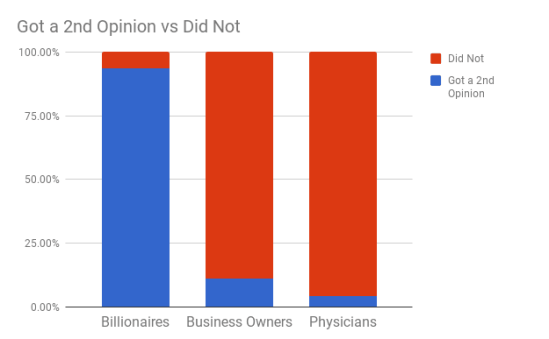
According the book “Becoming Seriously Wealthy” by John Bowen and Russ Alan Prince, in a study of 199 billionaire families, 186 of them had stress-tested their family finances in the last five years. In other words, they had brought in outside experts to examine every facet of their financial situation to make sure everything was done right. That’s a full 93.5%!
Similar surveys of business owners and physicians have shown that these people are much more careless about their hard-earned wealth. Only 11.1% of business owners and a measly 4.3% of physicians have obtained a second opinion about their financial situations. See the figure below.
Share this:


Equifax, one of the three credit agencies, had their computer system hacked. As a result, 143 million Americans (and some Canadians and Britons) had their sensitive personal information, such as their name, address, birthday, social security number and credit card information compromised. You should assume you are one of the victims and take the following steps to protect yourself:
Step 1: Sign up for AnnualCreditReport.com
By law, you are entitled to one credit report per year from each credit agency. Since there are three credit agencies (Equifax, Experian and Transunion), you may stagger your requests and get one credit report every four months. AnnualCreditReport.com is a website jointly operated by the three credit agencies that provides a centralized location for requesting your annual free credit reports.
Share this:

 Recently, I shared a true story in which I set up a client’s 401k plan five years ago with periodic (bi-weekly) contributions and equal investments into both a US stock index fund and an international stock index fund. Despite the fact that the US index (fund) has outperformed the international index (fund) by a huge margin: 86% vs 29% over the last five years, my client now has more money in the international fund than in the US fund. What gives? I invited my readers to think about it and give me their explanations. Now it’s time to reveal the answer: it’s dollar cost averaging!
Let me show you a stylized example in a three time-period world. There are two indexes. Index A goes from 100 to 105, then 110. Index B goes from 100 to 80, then 100. It’s clear that index A dominates index B since the total return of index A is 10%, that of index B is 0%. Yet an investor who makes equal $100 periodic investments in both index A and B will have more money in B at the end. Here is the math …
Share this:

Is the Market Over-Valued?
Posted on: February 21, 2017

Read the rest of this entry »
Share this:


When I was in California last week, I met with a prospective client and did a second-opinion financial review of his situation. He has $5mm in his company’s ESPP (employee stock purchase plan.) I can’t help but feel a bit dizzy, that feeling you get when you’re standing on the edge of a tall building without any protection.
I have a friend who was a senior engineer at MCI Worldcom. He also participated in this company’s ESPP. In only a few years, Worldcom went from being a no-name, little known company to acquiring the second largest telecom at the time – MCI, and its stock price went up tenfold. The value of my friend’s ESPP account went from $300k to over $3mm and he looked extremely smart by not diversifying at all.
The rest of the story you all know. MCI Worldcom filed for chapter 11 in 2002 due largely to corporate fraud committed by their executives. Its stock price plummeted to zero and my friend lost every dime in his ESPP.
So what exactly is an ESPP?
An ESPP enables a company employee to purchase company stock through payroll deduction.These kind of plans are very popular among high-tech companies because they are considered a very effective way to align the interests of the employees and the firm. Read the rest of this entry »
Share this:

Recently, I did a portfolio analysis of a prospective client who has a Wells Fargo “financial advisor.” Here is the result …
| Symbol | Expense Ratio | Load | Turnover |
| CAIBX | 0.59% | 5.75% | 63% |
| CAPCX | 1.66% | 1% | 89% |
| FEVCX | 1.90% | 1% | 15% |
| MIQBX | 1.30% | 5.25% | 29% |
| OIBIX | 0.57% | none | 111% |
| WAFMX | 2.25% | none | 34% |
| WFPAX | 1.24% | 5.75% | 58% |
Let me explain …
Load is the initial kickback (coming directly from your account) the fund gives to the broker for directing money to the fund. There are so many no load funds out there, you shouldn’t be paying load. A broker only does that to line his pocket, there is no benefit to you whatsoever.
Expense ratio is what the fund charges every year. As my rule of thumb, any expense ratios higher than 0.5% are too high. Any expense ratios higher than 1% are exorbitant. As you can see, all the fund expense ratios here are either too high or exorbitant! The broker who directed your money to these funds gets to share a portion of the loots ever year. Can you see a conflict here?
Turnover is how often the fund manager churn the investments. The higher the churn rate, the higher the costs to investors. Typically, a 100% turnover translates into about 1.2% in return reduction. As my rule of thumb, any turnover higher than 10% is too high, a turnover higher than 100% is exorbitantly costly! Read the rest of this entry »
Share this:

Why I Don’t Pick Stocks
Posted on: August 18, 2016

Between 2000 and 2002, I worked as head weather derivative trader at PG&E National Energy Group. On the side, I also traded stocks for my personal account.
By the time the Enron Debacle happened, I had already become the third largest weather derivative trader in the country. Given another year, I am quite sure I would have become #1 in this field. Well, that’s a story for another time.
My stock trading, however, was a lot less successful. All the stocks I picked lost money, except for one. The one exception was PCG, the company I worked for. Granted, the time between 2000 and 2002 was a time of market collapse due to the burst of the dotcom bubble, but there is still an important lesson I learned and that I want to share with you.
The lesson was about information advantage.
Though I was not in management and therefore was not privy to any material insider information, just from the ambiance noise of the trading floor I know so much more about my company than folks outside of the company.That’s why I was able to make money on PCG. That’s also why I didn’t make money in all those other stocks – I didn’t have any information advantage. Read the rest of this entry »
Share this:

According to research by Dimensional Fund Advisors, Inc, only 33% of mutual funds that outperformed the market in the last five years continue to do so in the next five years.
Schedule a Discovery review with me, or get my white paper for free: The Informed Investor: 5 Key Concepts for Financial Success.
Share this:
Double Your Return … What I Learned!
Posted on: June 3, 2016

On May 27th, 2005, I started MZ Capital Management as a hedge fund with “Double Your Return” as my first marketing tagline.
Shortly after the Enron debacle, Congress passed the Sarbanes-Oxley Act, which requires company insiders to report their trades to the SEC electronically within a day of the trades taking place. I created a computer program to query the SEC’s database in real time. So as soon as, for example, IBM’s CEO reported that he bought 10000 shares of IBM, I would know it right away.
On a typical working day, I would be half naked lying on the beach of Palm Beach and I would get a text on my dumb cell phone (sent to me by my computer working hard on my desk.) I would call my broker right away to follow the trade. Then the news would get to the WSJ one week later, the price of IBM would pop and I would sell for maybe a 5% to 10% gain.
Just like that I was making 20% to 30% return every month!I calculated that at this rate of compounding, I would become a trillionaire in about 10 years. I was so confident, I started the hedge fund to share the wealth.
Lest you don’t know yet, I did not become a trillionaire hack, not even a billionaire. So what went wrong?
A few months into my hedge fund, I noticed a small website, where for a $20 a month Read the rest of this entry »

 The Investment Scientist