Archive for the ‘Economics & Markets’ Category
Why you should avoid hedge funds
Posted on: August 15, 2012

Hedge fund managers take their cut
There is a new book about the hedge fund “industry” by former insider Simon Lack. Its title says it all – The Hedge Fund Mirage – The Lesson of Big Money and Why It’s Too Good To Be True.
Not everybody has time to read books like this, but if you are ever approached by a hedge fund peddler – I get calls every week about an amazing alternative investment opportunity – at least look at the table below before you part with your money.
Between 1998 and 2010, hedge fund fees totaled $440 billion versus $9 billion total profits for investors.
Share this:

Crises and opportunities
Posted on: August 13, 2012

Is Refinancing Right for You?
Do you see any evidence of superior investment strategy for the last five years? Seems all is correlated and all is going nowhere.
This is a question I got from a reader of my newsletter.
I hate to be impolite, but I think he is focusing on the wrong thing. Yes indeed, over the last five years, the market has given us one disappointment after another – first the financial crisis in the US and now Europe.
There is a silver lining in all of these crises, though. Mortgage rates are at an all-time low. Five years ago today, the 30-year mortgage rate was 6.75%; now it is 3.5%. If you have a $400k mortgage on your house, do you know how much you save if you refinance?
Share this:

The Story of the Dow
Posted on: August 3, 2012
My name is Dow. I was born in May 1896 to my father Charles Dow.
In 1900/1/1, I was 66. No, that was not my age, but my level. People care about my level since the higher it goes, the richer they get.
In the first two decades of the 20th century, I wobbled around: 100% up and 50% down was the norm of the decades. Nevertheless, I ended the two decades at 108.
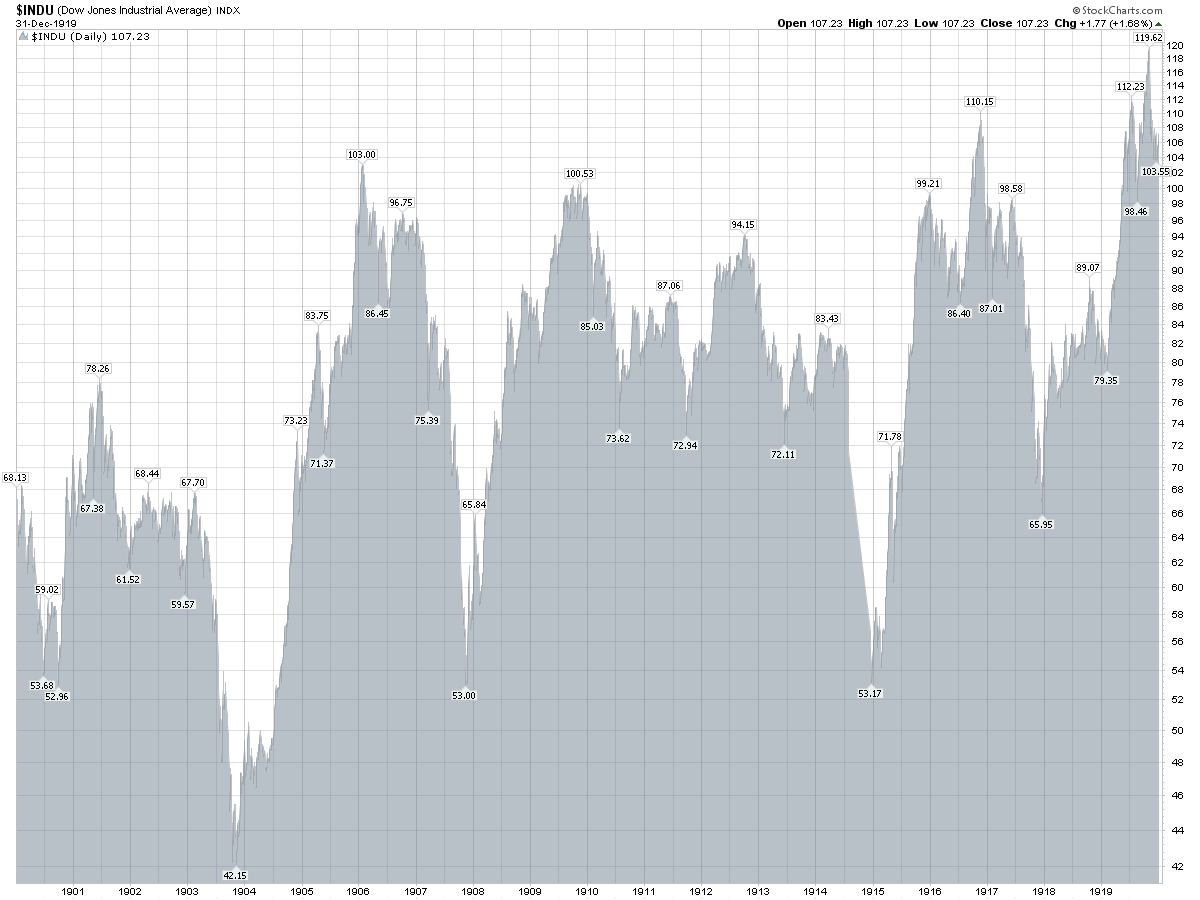
Dow 1900-1920
Share this:

This is an article I wrote in middle of May that was published on Morningstar.
Half way into May, major market indexes have all fallen more than 5% from their peaks reached in late March. The Nasdaq has fallen close to 10%. It looks like the ancient stock market folklore “Sell in May and go away” is quietly unfolding right before our eyes.
To get a better understanding of this phenomenon, I did two things recently: 1) I studied the historical returns between May 1 and Sept. 30 and 2) I pondered a plausible explanation of stock market seasonality and its implication on investment. Today, I will report to you the results of my intellectual exercises.<
Historical returns
Using data retrieved from Yahoo.com, I calculated the average S&P 500 index return between May 1 and Sept. 30 to be -0.3% over the past 20 years. As a comparison, the average index return between Oct 1 and April 30 is 7.2%. Clearly the five months starting in May are unproductive for stock investment, historically.
Share this:


1. Facebook is a great service to help you keep in touch with friends and family. But a great service does not equal great investment.
2. When was the last time you clicked on a Facebook ad? I can’t recall when I ever did. The click-through rate for Facebook ads is 10% that for Google ads, for good reason. Google ads are delivered at the moment you have actionable intent, while Facebook ads are delivered when you don’t want any distraction.
3. As more and more people use mobile devices to access Facebook, this will present a big challenge since it is nearly impossible to display distracting ads on tiny mobile screens.
Share this:

Juggling Investment Odds
Posted on: March 6, 2012
Investors crave certainty, but the future is never certain. Prudent investment requires juggling odds. Here are the types of odds that go into my decision making process.
January Barometer Effect
When the market records a positive return in January, the odds that it would record a positive return for the rest of the year are 90%. If not, the odds drop to 50%. This January, the market had a positive return.
Seasonal Effect
Share this:

Morgan Stanley Smith Barney
Recently, a number of people came to me for advice with one thing in common: they all had a financial advisor from Morgan Stanley Smith Barney. These advisors all promised them that they could beat the market because Morgan Stanley, as a major institution in Wall Street, has extraordinary investment research resources.
I am just amazed how the financial industry (not just Morgan Stanley) uses the same trick to seduce people. Unfortunately, people fall for it over and over without fail.
If Morgan Stanley’s research is so good that it can beat the market, why can’t the company use some of that research to help its own stock price. I did a comparison of Morgan Stanley’s stock (MS) and the S&P 500 and found the following: Read the rest of this entry »
Share this:

Last year, while the S&P 500 was largely flat, small cap value and emerging markets were down significantly. No wonder some clients of mine got a bit edgy.
What a change one month has made! As of Feb. 5, these two asset classes have roared back with a vengeance. See the table below.
| 2012 Year to Feb 5th | 2011 | |
| DFA US Small Cap Value | 12.74% | -9.74% |
| DFA Emerging Mkts Value | 19.44% | -26.50% |
| DFA Intl Small Cap Value | 12.74% | -19.41% |
The lesson here: when we see big losses like -19%, -26%, we can view them as a financial Armageddon or as a buying opportunity. The latter position is mentally much harder to take, but it almost always pays off.
Get my white paper: The Informed Investor: 5 Key Concepts for Financial Success.
Get informed about wealth building, sign up for The Investment Scientist newsletter

Share this:

Last month, I was approached by a plastic surgeon whose money was with Morgan Stanley Smith Barney. He was looking for someone who could beat the market: not just promise to beat the market, like his financial advisor, but actually deliver.
I told him that I can’t beat the market, I can only help him capture the market. I could see a wisp of disappointment flash across his face.

Share this:

A 2011 Investment Recap
Posted on: January 8, 2012
My investment approach can be summed up by three principles:
- Globally diversified
- Small cap value tilt
- Short duration tilt
This approach endured extraordinary challenges in 2011.
1. Globally diversified
Even though the US equity market largely ended up where it started, the global equity markets did a lot worse: the MSCI EAFA Index (world developed markets) dropped 15% and the MSCI Emerging Market Index dropped 20%. To the extent that your portfolio is globally diversified, it will suffer along with the rest of the world. Despite that, global diversification is still a sound principle. We should not regret just because the US market did better. In fact, the market that did the best last year was Venezuela; it went up 110%! Should we regret not concentrating on the Venezuela market? (The answer is no.)
Share this:

Is the Sky Clear Enough Yet?
Posted on: November 9, 2011
[I wrote this two weeks ago.]

Clear Sky
On September 12, a client of mine called me to get out of stocks altogether.
He used a vivid analogy: “The storm is raging; I will wait until the sky clears before I get in again.” The storm he referred to was the European debt crisis. Judging by my many interactions with investors, he is not alone.
This morning, I woke up to great news: the Europeans have finally hammered out a debt deal in which Greece only needs to pay 50% of what they owe to the banks. With this debt reorganization, it looks like we will not have a Greek default (even though this is really a default by another name, but that’s the subject of another piece).
Share this:


Greek Hair Cut
This morning, I woke up to news that the Europeans, Germans mostly, have finally hammered out a deal with Greece, which now only needs to pay 50% of what it owes to private lenders (mostly German banks). German Chancellor Angela Merkel called this a 50% “haircut.”
World markets cheered the news by rallying 2% to 6%. But wait a minute, how is it different from a Greek default? Is the market dumb or not?
There are lessons for investors in this.
Share this:

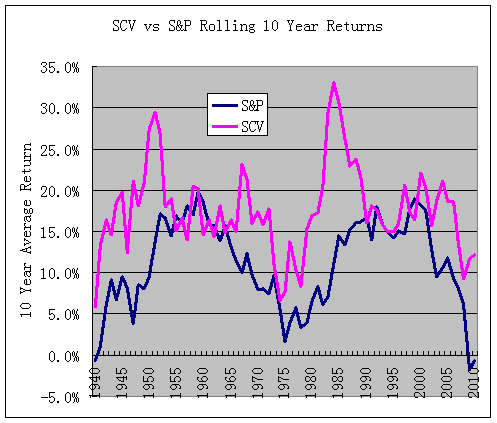
Many investors are puzzled by the underperformance of small cap value since May of this year. They ask: “Is it worth being in an asset class that can’t do well in bad times?”
To answer their question, I did a 10-year rolling return comparison between the Fama/French Small Cap Value (SCV) and the S&P 500 index using data from 1931 to 2010. The first 10-year period is 1931 to 1940, the second is 1932 to 1941, and the last is 2001 to 2010. Here is the rolling return chart I got.
Share this:

What happened to the market in August and September?
Between July and the end of September, markets lost between 13.5% (Dow) and 27% (Emerging markets) depending on which market you are looking at.
I pored through economic data and could not see any marked deterioration in the economy. In fact, on balance, I see continued slow improvements.
Pundits attribute the market tumble to 1) political gridlock in Washington and 2) the European debt crisis. I don’t buy either of these explanations.
Share this:


Wall Street Journal
If you think reading Wall Street Journal would make you a more intelligent investor, think again.
After a recent one-day market rally, WSJ wrote this:
U.S. stocks jumped on Tuesday as many investors sent a plea to Federal Reserve Chairman Ben Bernanke: Come to the rescue of the stalling economy and battered financial markets.
The Dow Jones Industrial Average jumped 322.11 points, or 3%, to 11176.76 as a new round of bleak economy data helped buoy investor hopes that Mr. Bernanke will step in with some sort of monetary stimulus.
That optimism comes despite all signs to the contrary. Federal Reserve officials are saying nothing to encourage market speculation that Mr. Bernanke will use a speech in Jackson Hole, Wyo., Friday to unveil further Fed actions …
Share this:


Harry Markowitz
The common approach to dealing with a market correction is trying to get out of the way at the first sign of trouble before the big one hits, like getting out after a 5% dip before the 30% drop hits. This approach requires perfect foresight. God can do that, not you, and certainly not a financial advisor who needs the job to make a living. (FYI, only one out of every thirty 5% dips turns into a 30% fall.)

 The Investment Scientist