Archive for the ‘Investor Behavior’ Category
 Yesterday I wrote about this little mental quirk called the “availability bias” that could cost you a lot. I gave you an example, based on my conversations with clients and their propensities that I had to suppress. If an investor sold his portfolio four days ago at the bottom of the market based on his experience the prior week, and bought back yesterday because he was inspired by the 3-day 20% rally, he would have owned 20% less productive assets. This is even though the total dollar amount is the same, since what he bought was 20% more expensive than when he sold it.
But most likely, this person won’t sense any loss, since after all, he owns the same dollar amount of stocks. How cool is that? He loses 20% of his wealth, his future income will be 20% less, and yet he barely notices it. It turns out there is another mental quirk that is playing games with him. It is called the “saliency bias.”
Share this:

 After three days of the stock market rallying, I have noticed a change of tune among my clients who have been calling me. Three days ago, a few of them were asking if they should get out of the market altogether and wait until things turned the corner. Three days and 20% higher in the Dow, they want to increase their investment in stocks. But why? Why are stocks so bad when they are 20% cheaper and so good now that they are 20% more expensive!?
There is a little mental quirk that has been playing games with us. This quirk was discovered by Nobel Prize winner Daniel Kahneman, together with his trusted collaborator Amos Tversky who died too young to share the Nobel Prize. This quirk is called “availability bias.” That is when we assess the probability of a future event, we try to recall that event from our memory. If the event can be easily recalled, we subjectively judge it to be more likely. Read the rest of this entry »
Share this:

Buying Strong Stocks On Sale
Posted on: March 25, 2020
Now that the panic has abated a little, many financial advisors (FAs) are advising their clients to buy strong stocks on sale. None other than Jim Cramer made the same proclamation, he even mentioned ten stocks by name. (Just FYI, he did the same in 2008 – and I did a study afterward – 8 out of the 10 underperformed the S&P 500 index that year.)
So what are the strong stocks to own? Are they industrial titans like Boeing or GE? They were strong stocks but are they still? Are they Wall Street banks too big to fail like JP Morgan or Citibank? But how do we know they’re not just another Lehman Brothers? Is it a consumer tech giant like Apple? How can we be sure it won’t go the way of Sony, which was the previous consumer tech giant. How about Netflix? When we are stuck at home social distancing, you’ve got to watch Netflix right? But what if Amazon, Apple and the other big boys jumping in the streaming market eat its lunch?
Share this:

 Over the weekend, a client of mine sent me a news report about how Senator Richard Burr, head of the Senate intelligence committee, sold his stocks before the coronavirus market crash. This maneuver is called front-running the market. Simply explained, if you possess superior information that the market does not have yet, you can massively profit from this superior information by positioning your portfolio ahead of the anticipated impact the information will have on the market once it becomes public.
There is a whole body of academic studies on who has superior information. They are the usual suspects: lawmakers and company executives. Regarding company executives, research shows that CEOs and COOs have the best inside information, followed by CFOs. After that, information superiority drops off quickly. The information possessed by company directors is rarely superior. Research also shows that legislators are able to position their portfolios as they make laws. The difference between lawmakers and company executives is that the latter’s actions are heavily regulated and the former’s are not.
Share this:

Let me start with my usual disclaimer that I can not predict the market. This article is an exercise in which I think through possible scenarios for the market. Also, while the media and common folks like to use “crash”, “tumble”, “fall,” etc to describe the market, I prefer to use the term“discount”. The former signifies danger while the latter signifies opportunity.
As of the market close yesterday, after dropping 2000+ points, the Dow is right at the edge of correction territory (meaning down barely 20%.) The 2000+ point drop was the result of the double whammy of coronavirus out of control in Italy, and oil prices dropping 30% because of a price war between Russia and Saudi.
Share this:

 A few days ago I got a question from a client.
Why don’t we move the money to T-Bills to avoid market volatility, and get back to full market exposure only when the market is on an up-trend?
It is all too human to only want to take the upside risk without the downside risk. However, study after study has shown that investors who do that usually end up hurting themselves financially.
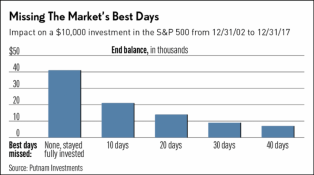
Look at the chart. In the fifteen years between 12/31/02 and 12/31/17, missing just 10 of the best return days of the S&P 500 Index would mean that you gave up 66% of the total return during the whole period.
I conjectured that the best return days usually happened at the depth of a bear market when fear and desperation were highest and investors were quitting the market in droves. I asked my assistant Taro to look up historical data to verify that, and here is what he found: the first nine out of the ten best return days in the last fifteen years happened during the Great Recession, just as I had thought!
Share this:


Recently, some of my clients asked me a very good question: “Why is my portfolio not doing as well as the S&P 500 index? Shouldn’t we invest more in US stocks?”
The answer is very simple. US equity is only one component of their portfolio, and it happened to do the best this year. The best component of the portfolio will always do better than the whole portfolio. That does not mean we should not diversify.
In fact, I hear similar questions all the time. Seven years ago, it was “Why didn’t we invest more in emerging markets? There’s no way the US market will do better than emerging markets.” Five years ago, it was “Why shouldn’t we put everything in gold? All of my friends are investing in gold.” In each case, I had to twist their arms to get them to stay invested in US stocks, and now they are thanking me.
Share this:

The following is the content of my June 2012 newsletter. It’s still very relevant today.
As I am writing this, the markets are falling like a rock. The Dow has entered negative territory for the first time this year; Nasdaq, which was up 20% a mere two months ago, is up only 5% for the year. The S&P 500 has lost close to 10% of its value since its April 1 peak.
I wrote the above paragraph using typical financial press lingo. This type of language has the tendency to cause amygdala hijack.
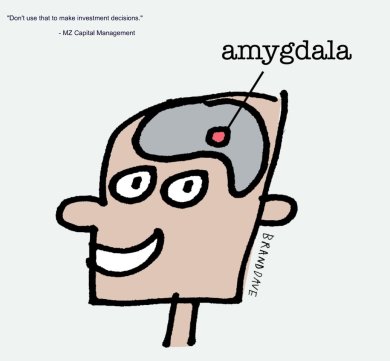
The amygdala is a part of our brain that processes threats. When we perceive a threat, the amygdala takes over the whole brain. fMRI scans show that blood supplies are Read the rest of this entry »
Share this:

If you go to the Morningstar website to do research on a very popular fund, the Vanguard S&P 500 Index Fund or VFINX, you may find this information after some digging around:

The Investment Return is basically what the fund produces. (If the fund is a S&P 500 Index fund, then its investment return is basically synonymous to what the market produces.) The Investor Return is what the average fund investor receives. So why on earth would the typical investor get less than half of what the fund produces?
The answer is actually pretty simple: most investors just don’t have the mental wherewithal to stay in the market when it drops. They pulled out at the bottom of the market, thereby missing much of the rebound rally in 2009. See this fund flow chart below.

Share this:

 A few days ago I got the news that Richard Thaler won the 2017 Nobel Prize for Economics. If you don’t know about his work yet, you should. He, Danield Kahneman (2002 Nobel Prize) and the late Amos Tversky are considered the founding fathers of Behavioral Economics. His insights have a great deal of practical application and here I am trying to sum it up in one page for you.
Does The Stock Market Over-react?
This is the title of his paper published in The Journal of Finance in 1985. I read the paper for the first time when I was a PhD student at Carnegie Mellon University. The short answer to the question posed by his title is YES. He found that the market tends to overreact and reverse itself. When you look at five year intervals, stocks that did best in the previous five years tend to underperform over the next five years compared to stocks that did worst in the previous five years. What can you learn from that? Don’t be a hot stock (or fund or sector) chaser.
Myopic Loss Aversion
Share this:

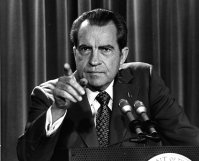 After the Comey firing and the dropping of a few other shoes, there is enough talk about the similarity to Watergate that piques my interest to study the stock market’s reaction during the Watergate period.
The Watergate period started with the arrest of five burglars breaking into the DNC offices located in the Watergate Hotel on 6/17/1972 and ended with Nixon’s resignation on 8/8/1974. I split that time period into three different stages.
-
The early stage: from 6/17/1972 to Nixon winning re-election on 11/11/1972.
-
The middle stage: from 11/11/1972 to 10/20/1973 when Nixon fired Archibald Cox and abolished the office of the special prosecutor. Attorney General Richardson and Deputy Attorney General William D. Ruckelshaus resigned. The day’s events are commonly known as the Saturday Night Massacre.
-
The final stage: from 10/20/1973 to 8/8/1974 when Nixon resigned.
Share this:

 I took the sensationalist title from a CNBC article I read yesterday. The articles talks about, and I quote, ” … hedge funds, as a category, is experiencing the worst quarter of outflows since the bottom of the financial crisis … there were an avalanche of stories about the industry’s nearly systematic underperforming.”
Readers of my newsletter and blog, The Investment Scientist, can thank me later for warning them years ago.
On April 28, 2011, I published “A Balanced Portfolio to Avoid (II): Hedge Funds Don’t Deliver Outstanding Returns.” Let me quote my former self: “Hedge funds are often peddled as an unique asset class that are uncorrelated with the market. In reality, hedge funds are as much an asset class as Las Vegas is.” The unspoken message is: you should expect to lose money.
On August 15, 2012, I published “Why You should Avoid Hedge Funds.” I wrote that article after I read the book by former hedge fund industry insider Simon Lack, “The Hedge Fund Mirage.” I summarized the book in one sentence for my readers: “Between 1998 and 2010, hedge fund fees totaled $440 billion vs. $9 billion profits for investors. Read the rest of this entry »
Share this:


At the end of June this year, UK citizens voted in a referendum for the nation to withdraw from the European Union. The result, which defied the expectations of many, led to market volatility as participants weighed possible consequences.
Journalists responded by using the results to craft dramatic headlines and stories. The Washington Post said the vote had “escalated the risk of global recession, plunged financial markets into free fall, and tested the strength of safeguards since the last downturn seven years ago.” The Financial Times said “Brexit” had the makings of a global crisis. “[This]represents a wider threat to the global economy and the broader international political system,” the paper said. “The consequences will be felt across the world.”
What about those self-proclaimed financial gurus? Motley Fool wrote: “Sell Everything! How Brexit Can Shatter Share Market” and Jim Cramer wrote: “Don’t Buy! Why the Mass Brexit Sell Off is Worth Riding Out.”
It turned out there was no “mass brexit sell off.”
It’s true UK got a new Prime Minister, and the Pound Sterling fell to 35 years low. But within a few weeks of the UK vote, Britain’s top share index, the FTSE 100, hit 11-month highs. By mid-July, the US S&P 500 and Dow Read the rest of this entry »
Share this:

The Real Danger of A Market Decline
Posted on: June 30, 2016
 I was an amateur pilot. I remember vividly an episode happened during a training class ten years ago.
That was a very windy day. Up to that point, I had only experience flying in calm weather. As soon as my Cessna took off, I immediately felt the difference. My plane was tugged and pulled in all directions by cross winds. I felt like I was losing control of the plane, and fear swelled up from the bottom of my spine to the top of my head. I sat stiffen in the pilot seat and my sweaty palms grabbed tightly at the control handles like a sinking person holding onto a straw.
My trainer sensed my tenseness and she asked: “Are you OK?”. Not willing to acknowledge my fear, I asked her instead: “Is it more dangerous to fly in turbulent weather like this?” The trainer smiled and said: “It is not more dangerous to fly in turbulent weather. The plan was built to withstand any turbulences. But occasionally, an amateur pilot would lose his cool and do something stupid. That’s the real danger.”
Share this:

Brexit: What to Do About It?
Posted on: June 17, 2016

A week from now, there will be a referendum in Great Britain to determine if the UK should stay in EU or should leave for good.
A mere month ago, the stay vote still won by a comfortable margin. Just showing how political wind can shift, the odds are now 50/50 that the leave vote might win.
Here are some consequences I believe a leave vote would entail:
- Copycat referendums in other EU states, and within a few years, EU might not exist.
- London’s reputation as world financial capital on par with New York may be diminished.
- Disruptions to trades and investments, since UK’s relationship with Europe and the rest of the world, will have to be renegotiated.
- Pound Sterling, London stocks, and property prices might go south. Potential capital flights from the UK.
- More volatility in global stock markets.
As an investor, what should you do about it?
Well, all of the above can be called informed speculations. They are not actionable Read the rest of this entry »
Share this:

Investors Gone Crazy
Posted on: January 11, 2016
 Here is the culprit of the global market selloff in the first week of 2016: The CSRC (China Securities Regulatory Commission) instituted a stock market circuit breaker in the new year: a 15 minute trading pause after a 5% drop in the main index, and the market closes for the day after a 7% drop.
The purpose of the circuit breaker was to temper the crazy volatility in the Chinese market. Talking about unintended consequence, it achieved the exact opposite effect. Retail investors there, fearful they couldn’t sell their shares fast enough, rushed for the exit, driving the main index down 7% (thereby triggering the circuit breaker) for 2 out of the first 4 trading days of the new year.
The CSRC did a quick about face and suspended the circuit breaker, basically telling investors now you could sell to your hearts’ content. You know what? The selling stopped, and the market came back about 2%.
This just shows how crazy and irrational Chinese investors can be. A circuit breaker should have no value impact on stocks whatsoever, and yet they brought their stocks down more than 17%. Read the rest of this entry »

 The Investment Scientist