Archive for the ‘Prudence & Fiduciary Duty’ Category
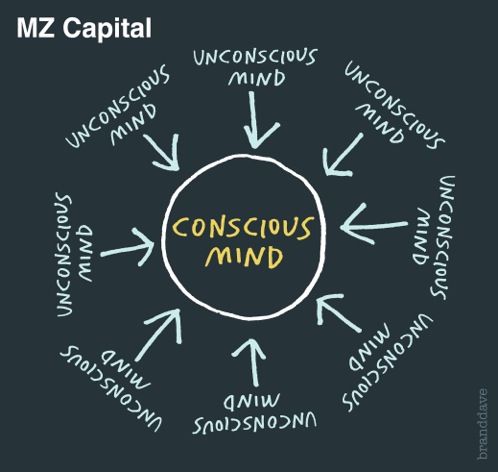
conscious and unconscious mind
What prompted me to write about financial peace of mind is actually something that happened to me recently that had nothing directly to do with the topic.
My iPhone failed to sync with my desktop calendar; as the result, I missed an important client meeting.
For a whole day and whole night, I had this nagging feeling that I missed something but couldn’t quite be sure what it was. Did I leave my keys in the gym? No.
Then, I woke up in the middle of the night and remembered the appointment that did not show up on my iPhone! Apparently, some part of my mind was not resting during sleep.
Share this:

While reading USA Today at Panera Bread, I came across an article with a headline that blared: “Managed commodities can counter volatility.” You should have seen the chagrin on my face; you would have thought I was a facial contortionist.
How could such an uninformed article ever get published by a major newspaper? Just imagine the large number of people who will be misled by this article to put money into a financial product they don’t understand.
The claim of this article is based on a comparison of a managed futures index and the S&P 500 index. The managed futures index was compiled by a private firm called Barclay Hedge, basically a marketing arm of the managed futures industry. Read the rest of this entry »
Share this:


Leap of faith
Recently, I went to the monthly meeting of the Chicago Booth Entrepreneur Advisory Group. The group is made up primarily of University of Chicago alumni, and it provides a forum for entrepreneurs to share their issues.
I was blown away by one entrepreneur’s unbridled optimism. He invented a technology that makes changing TV channels on a PC feel as fast as on a real TV. He plans to challenge the cable companies by convincing all of us to watch TV on our PCs.
Yes, cable companies charge us an arm and a leg for their channels, many of which we don’t watch. And nobody loves their cable company. But they have been in business for years. How could a solo entrepreneur working in his bedroom take them on?
Share this:

 Many people think that fee-based financial advisors are those who charge their clients fees for service; therefore, they have more transparency and less conflict of interest. That’s exactly what the financial industry wants you to think.
Fee-based financial advisors are the financial industry’s response to the rise of independent fee-only financial advisors. Fee-only financial advisors are paid solely through fees for service paid directly by clients; they are not licensed to receive third-party commissions. Consumers rightfully associate this compensation model with integrity and unbiased advice.
Firm | Youtube | Facebook | Twitter | LinkedIn | Newsletter
Share this:


Morgan Stanley Smith Barney
Recently, a number of people came to me for advice with one thing in common: they all had a financial advisor from Morgan Stanley Smith Barney. These advisors all promised them that they could beat the market because Morgan Stanley, as a major institution in Wall Street, has extraordinary investment research resources.
I am just amazed how the financial industry (not just Morgan Stanley) uses the same trick to seduce people. Unfortunately, people fall for it over and over without fail.
If Morgan Stanley’s research is so good that it can beat the market, why can’t the company use some of that research to help its own stock price. I did a comparison of Morgan Stanley’s stock (MS) and the S&P 500 and found the following: Read the rest of this entry »
Share this:

“Only a fool invest without rules” – Jason Zweig

Young People
A client of mine asked me to teach his young son how to save and invest. The following are some rules I wrote down for him.
1. How much to save?
This is just a rule of thumb. If you start investing in your 20s, you need to put aside 10% of your income; if you start in your 30s, 15%; 40s, 20%, 50s, 25%.
The client’s son is a 26-year-old college grad, who is making about $48,000. Based on the rule of thumb, he needs to save $4,800 a year. That averages to $400 a month.
To make saving simple and painless, open a brokerage account, then set up an automatic bank payment of $400 a month to the account.
Share this:

Government Retirees Beware: Your Financial Advisor May Not Be Your Friend
Posted on: January 14, 2012
I have a client (Let’s call him John) who retired 12 years ago from the government. He had a pension, and he had the option of taking out a lump sum of about $800k or drawing a monthly check of more than $4,400 per month until death.

Lost Retirement Money?
John took his options to his financial advisor from Smith Barney (now absorbed into Morgan Stanley Smith Barney.) Guess what the advisor recommended? He recommended that John take out the lump sum and let him manage it instead.
By the time John came to me for a second opinion financial review four years ago, his retirement account had only $265k left. John decided to become my client, and I have been able to restore some of his money, but not all.
Share this:

A 2011 Investment Recap
Posted on: January 8, 2012
My investment approach can be summed up by three principles:
- Globally diversified
- Small cap value tilt
- Short duration tilt
This approach endured extraordinary challenges in 2011.
1. Globally diversified
Even though the US equity market largely ended up where it started, the global equity markets did a lot worse: the MSCI EAFA Index (world developed markets) dropped 15% and the MSCI Emerging Market Index dropped 20%. To the extent that your portfolio is globally diversified, it will suffer along with the rest of the world. Despite that, global diversification is still a sound principle. We should not regret just because the US market did better. In fact, the market that did the best last year was Venezuela; it went up 110%! Should we regret not concentrating on the Venezuela market? (The answer is no.)
Share this:

 This week, a business woman came to my office for a second opinion financial review.
She explained why she came to see me: she bought a permanent life insurance policy because her financial advisor told her it is a great investment. She has been paying $3000 a month for that, and so far she has put in roughly $80k. Recently, she needed some cash and called to redeem the policy. Much to her surprise, the surrender value is only $1,300. She became suspicious of everything in her portfolio and wanted me to examine it for her.
It took me only five minutes to figure out that her financial advisor is screwing her, no punt intended.
Share this:


Bill Miller’s Legg Mason Value Trust
On November 17, Bill Miller announced that he would step down as manager of Legg Mason Capital Management Value Trust (LMVTX).
From 1991 to 2005, under Miller’s stewardship the fund outperformed the S&P 500 index for an astounding 15 straight years. Since then, the fund has underperformed the index in all but one year, and by a significant margin.
So what’s the problem? The problem is many investors bought the fund only after Miller had become a mutual fund rock star, just in time for his hot streak to end. They missed much of his upward ride, but were fully onboard when the fund went down the toilet. See the table below. Read the rest of this entry »
Share this:


Setting Up a 401k Plan
Dr. Smith is a client of mine. He is a facial plastic surgeon with a booming solo practice supported by five non-essential staff members. His staff turnover is very high; no one stays more than three years. This has allowed him to contribute the maximum amount to his SEP IRA without contributing anything to his employees (Note that by law working three years out of the last five years is the eligibility requirement for SEP IRA participation.)
In our recent regular progress meeting, he told me that he was pondering setting up a 401k plan for his employees. There are three reasons why it’s time for him to have a 401k plan:
Share this:


Fear
On March 6, 2009, about lunch time, I got a call from Mrs. C. Apparently she was in some sort of a panic; she asked me when the market would stop falling. I couldn’t predict the future, all I could tell her: the market will eventually turn around, and when it does, it will stage a huge rally and we won’t know it in advance.
I felt I was making some progress in comforting Mrs. C and convincing her to stay the course. Then, I heard a roaring voice: “Get out! Get out! Tell him to get the hell out of stocks!!!” I knew it was Mr. C in the background. Mrs. C broke down in tears on the other end of the phone call. She said, “Michael, I can’t take it anymore, just get out of stocks.” I meekly replied: “OK, but you should never try stocks again.”
Share this:


Harry Markowitz
The common approach to dealing with a market correction is trying to get out of the way at the first sign of trouble before the big one hits, like getting out after a 5% dip before the 30% drop hits. This approach requires perfect foresight. God can do that, not you, and certainly not a financial advisor who needs the job to make a living. (FYI, only one out of every thirty 5% dips turns into a 30% fall.)
Share this:

[Guest post by Andrew Platou] Who qualifies as a plan’s fiduciaries? Fiduciaries are generally those individuals or entities who manage an employee benefit plan and its assets. A plan must have at least one fiduciary, a person or an entity, named in the written plan, or through a process described in the plan. The named fiduciary can be identified by office or by name. For some plans, it may be an administrative committee or a company’s board of directors. Employers often hire outside professionals, sometimes called third-party service providers, or use an internal administrative committee or human resources department to manage some or all of a plan’s day-to-day operations. Even if an employer hires third-party service providers or uses internal administrative committees to manage the plan, it still has fiduciary responsibilities. A key point to note is that fiduciary status is based on the functions the person performs for the plan, not just the person’s title. Using discretion in administering and managing a plan or controlling the plan’s assets makes that person a fiduciary to the extent of that discretion or control.
Share this:

I was called a “wing nut” by a commenter for pointing out all the malpractices of insurance companies. Indeed, I could go nuts seeing how they mislead their customers into financial peril. They know full well that their customers are not going to read beyond the first few pages of their hundred-page contract, so they put all the goodies on the first page and keep the disclaimers on the back pages.
The following is an actual annuity contract a client of mine purchased a few years ago, much to his regret now.
On the first page of the contract, all the warm and fuzzy keywords are used: “GUARANTEE”, “fixed”, “annualized interest rate of 5.75%”. Pay attention to the following line though: This rate is subject to change each month.

Annuity Contract Front Page
Share this:

A Balanced Portfolio to Avoid (II): Hedge Funds Don’t Deliver Outstanding Returns
Posted on: April 28, 2011
Hedge funds are often peddled as a unique asset class that has outstanding returns that are uncorrelated with the market. In reality, hedge funds are as much an asset class as Las Vegas is.
Hedge funds are a general description of private investment companies that are organized as limited partnerships with fund managers as the general partners and investors as limited partners. The keyword here is private. By law they are not supposed to be sold to the public; therefore, they are exempted from government oversight. But sold to the public they are! It is not the first time unscrupulous “financial advisors” have pushed the limit of the law, while the SEC looks the other way.
 The Investment Scientist