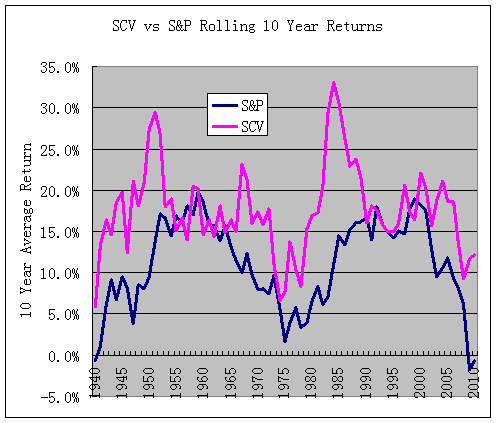
Many investors are puzzled by the underperformance of small cap value since May of this year. They ask: “Is it worth being in an asset class that can’t do well in bad times?”
To answer their question, I did a 10-year rolling return comparison between the Fama/French Small Cap Value (SCV) and the S&P 500 index using data from 1931 to 2010. The first 10-year period is 1931 to 1940, the second is 1932 to 1941, and the last is 2001 to 2010. Here is the rolling return chart I got.
Share this:

Businesses should consider making expenditures that qualify for the business property expensing option. For tax years beginning in 2011, the expensing limit is $500,000 and the investment ceiling limit is $2,000,000. And a limited amount of expensing may be claimed for qualified real property. However, unless Congress changes the rules, for taxyears beginning in 2012, the dollar limit will drop to $139,000, the beginning-of-phaseout amount will drop to $560,000, and expensing won’t be available for qualified real property. The generous dollar ceilings that apply this year mean that many small and medium sized businesses that make timely purchases will be able to currently deduct most if not all their outlays for machinery and equipment. What’s more, the expensing deduction is not prorated for the time that the asset is in service during the year. This opens up significant year-end planning opportunities.
Share this:

Tax Loss Harvesting
Realize losses on investment without substantially changing your portfolio positions; for instance, selling Vanguard 500 Index and buying Vanguard Total Stock Market Index.
Roth Conversion
If you do a Roth conversion, the IRA account will become a multigenerational tax shelter. Do this only if you have sufficient cash to pay taxes now.
Capital Gains
The 15% rate on long-term capital gains was extended through the end of 2012. After that, the rate could go up to 20% or higher. You may want to sell assets to realize long-term capital gains and reset the basis.
Dividends
The 15% rate on qualified dividends was also extended through 2012. If you are a shareholder in a closely held corporation with accumulated retained earnings, you may wish to take dividends now, while the rate is low. In 2013, a surtax on investment income will become effective.
Required Minimum Distribution (RMD)
If you are age 70.5 and older, don’t forget RMD from your IRA and 401k plan.
Health Flexible Spending Account (FSA) and Health Savings Account (HAS)
Increase the amount you set aside for next year in your employer’s health FSA if you set aside too little for this year. If you become eligible to make HSA contributions in December this year, you can make a full year’s worth of deductible contributions for 2011.
Qualified Small Business Stock (QSBS)
Purchase QSBS before the end of this year. There is no tax on gains from the sale of such stock if it is (1) purchased after 9/27/2010 and before 1/1/2012 and (2) held for more than five years.
Bonus Depreciation
This is still in effect and allows expensing of 100% of the cost of eligible assets acquired in 2011. The rate will fall to 50% and the provision will expire at the end of the year.
Charitable Gifting
Gift your significantly appreciated assets, or if you are age 70.5 and older directly from your IRA.
Gifts
You can give a total for the year of up to $13,000 to each individual without reducing your lifetime gift or estate tax exclusions.
Kiddie Tax
If your children do not fall under the kiddie tax rules, give them appreciated shares of stock or mutual funds instead of cash. Their lowest capital gains tax rate could be 0%.
Education Saving
Set up 529 plans for your children and claim state tax deductions. The deduction limit is per plan owner per beneficiary. Take Virginia, for example; the limit is $4,000. For a couple with three children, the maximum state tax deduction is 2x3x$4,000 = $24,000.
Energy Tax Credit
If you are a homeowner, making energy savings improvements to the residence may qualify you for a tax credit if those improvements were installed in your home before 2012
Get my white paper: The Informed Investor: 5 Key Concepts for Financial Success.
Get informed about wealth building, sign up for The Investment Scientist newsletter

Share this:

What happened to the market in August and September?
Between July and the end of September, markets lost between 13.5% (Dow) and 27% (Emerging markets) depending on which market you are looking at.
I pored through economic data and could not see any marked deterioration in the economy. In fact, on balance, I see continued slow improvements.
Pundits attribute the market tumble to 1) political gridlock in Washington and 2) the European debt crisis. I don’t buy either of these explanations.
Share this:

[Guest post by Jeremy Bendler] IRS has launched a new voluntary compliance program that allows employers to prospectively reclassify-as employees-those workers they have erroneously treated as independent contractors. The program carries generous settlement terms and provides audit relief for previous years.
Background. Whether a worker is an independent contractor or employee generally is determined by whether the enterprise he works for has the right to control and direct him regarding the job he is to do and how he is to do it. Under the common law rules (so-called because they originate from court cases rather than from the Code), multiple factors are used to determine if an individual is a common law employee.
Section 530 of the ’78 Revenue Act (as amended) provides retroactive and prospective relief from employment tax liability for employers who misclassified workers as independent contractors using the common law facts and circumstances standards. Section 530 applies only if:
Share this:

10. How Investors Lost Monday: Evidence from Mutual Fund Flows
9. Irrevocable Life Insurance Trust
8. Recession Stock Market Performance Revisited
7. America’s Top Financial Advisors: How Are They Made?
6. The 2011 Estate Tax Changes
5. Variable Annuity Fees You Don’t Know You Are Paying
4. Recession and Stock Market Performance
3. Why Doctors Don’t Get Rich
2. Bonus Depreciation: Congress Wants Business to Invest in 2011
1. Profit From Larry Dent’s Prediction? Thank Again.
Also see the top 10 last month.
Get informed about wealth building, sign up for The Investment Scientist newsletter
Share this:


Setting Up a 401k Plan
Dr. Smith is a client of mine. He is a facial plastic surgeon with a booming solo practice supported by five non-essential staff members. His staff turnover is very high; no one stays more than three years. This has allowed him to contribute the maximum amount to his SEP IRA without contributing anything to his employees (Note that by law working three years out of the last five years is the eligibility requirement for SEP IRA participation.)
In our recent regular progress meeting, he told me that he was pondering setting up a 401k plan for his employees. There are three reasons why it’s time for him to have a 401k plan:
Share this:


Wall Street Journal
If you think reading Wall Street Journal would make you a more intelligent investor, think again.
After a recent one-day market rally, WSJ wrote this:
U.S. stocks jumped on Tuesday as many investors sent a plea to Federal Reserve Chairman Ben Bernanke: Come to the rescue of the stalling economy and battered financial markets.
The Dow Jones Industrial Average jumped 322.11 points, or 3%, to 11176.76 as a new round of bleak economy data helped buoy investor hopes that Mr. Bernanke will step in with some sort of monetary stimulus.
That optimism comes despite all signs to the contrary. Federal Reserve officials are saying nothing to encourage market speculation that Mr. Bernanke will use a speech in Jackson Hole, Wyo., Friday to unveil further Fed actions …
Share this:

 [Guest post by Christopher Guest] One of the areas of estate planning that causes the most confusion is gifting. Gifts are transferred from a donor to a done in several ways. Gifting has a huge diversity of answers in how gifting is accomplished.
Here are some basics on gifting. The IRS considers any gift from one person to another a taxable gift. But, there are some exceptions to the rule:
- Gifts of any property that are not more than the annual exclusion for the calendar year. (Note – the annual exclusion is $13,000 for 2011.)
- Tuition or medical expenses you pay for someone (the educational and medical exclusions).
- Gifts to your spouse.
- Gifts to a political organization for its use.
Share this:


Fear
On March 6, 2009, about lunch time, I got a call from Mrs. C. Apparently she was in some sort of a panic; she asked me when the market would stop falling. I couldn’t predict the future, all I could tell her: the market will eventually turn around, and when it does, it will stage a huge rally and we won’t know it in advance.
I felt I was making some progress in comforting Mrs. C and convincing her to stay the course. Then, I heard a roaring voice: “Get out! Get out! Tell him to get the hell out of stocks!!!” I knew it was Mr. C in the background. Mrs. C broke down in tears on the other end of the phone call. She said, “Michael, I can’t take it anymore, just get out of stocks.” I meekly replied: “OK, but you should never try stocks again.”
Share this:

This year, total federal spending in theU.S.is projected to be $3.6 trillion. The top three budgetary categories are:
- Medicare/Medicaid — $826 billion
- Social Security — $717 billion
- Defense/Wars — $703 billion
Medicare and Medicaid costs alone account for 23% of total federal spending.
Share this:
Imagine your house has a ticker symbol, and it scrolls along the bottom of CNBC together with other ticker symbols. The price of your house, like a stock price, is set by a bunch of people you’ve never met making apparently random bets based on a combination of intuition, general economic statistics, output of an automatic-trading program, and, a couple of times a year, the real price achieved by one of your neighbors actually selling a house.
Minute by minute, the price of your home would gyrate wildly. If you are a nervous type, you might lie awake at night wondering if its value would cover your mortgage in the morning.
Share this:
10. How Often Do Market Corrections Happen?
9. Google’s Revenge: Morgan Stanley’s Downgrade Fiasco
8. America’s Top Financial Advisors: How They Are Made?
7. How Can A Investor Prepare for Market Corrections?
6. The 2011 Estate Tax Changes
5. Variable Annuity Fees You Don’t Know You Are Paying
4. Why Doctors Don’t Get Rich?
3. Bonus Depreciation – Congress Wants Businesses to Invest in 2011
2. Recession and Stock Market Performance
1. Profit from Harry Dent’s prediction? Think Again.
Get informed about wealth building, sign up for The Investment Scientist newsletter
Share this:
Tax Planning for College
Posted on: August 23, 2011
[Guest post by Jeremy Bendler]  It’s back to school time! Many of our clients are wondering how to properly plan for higher education expenses. If your children are younger you may be wondering how to efficiently save for college. If your children are already college age, your goal is to pay for current or imminent college bills. I’d like to address both of these concerns by suggesting several approaches that seek to take maximum advantage of tax benefits to minimize your expenses. (Please note that the following suggestions are strictly related to tax benefits. You may have non-tax-related concerns that make the suggestions inappropriate.)
Share this:

Not satisfied with its downgrading of U.S. Treasury Debt and Fannie Mae, today S&P downgraded Google’s stock from “Buy” to “Sell,” sending GOOG tumbling by 3.3%.
In case you don’t remember, yesterday Google announced that it would purchase Motorola Mobility for a whopping $12.5 billion in cash – a decision that prompted S&P’s downgrade of Google. According to S&P’s equity analyst, Scott Kessler:
Share this:
Trustee Powers
Posted on: August 13, 2011
[Guest Post by Christopher Guest] Last month, I discussed the questions a settlor, or creator of a trust, needs to ask before selecting a trustee. Once a trustee is selected, a settlor needs to determine the trustee’s powers with respect to the trust.
The trustee is charged with caring for and managing the trust property. To do this, the trustee must have the ability to control the property, and, depending on the property, the trustee can be given a vast array of powers. A few of those powers could include the power to: Read the rest of this entry »

