Posts Tagged ‘education’
During the Oxford Reunion Week, I had many interesting conversations with classmates who were attending the strategy class. I took the same class five years ago, and today I would like to share my biggest takeaway from it – reductive strategy.
What is Reductive Strategy?
When it comes to strategy, most businesses ask, “What more can we do?” Professor Whittington suggested that we ask a different question instead: ”What else can we stop doing?” This question forms the foundation of reductive strategy.
Take my own line of business for example. Most financial advisory firms try to be all things to all people. Some firms even offer to walk clients’ dogs and to be their golf partners. They believe this makes them more competitive. Drawing from the insight of reductive strategy, I don’t do any of those that is 1) not my core competency, 2) not what my clients come to me for. This strategy has helped me build a simple but elegant practice.
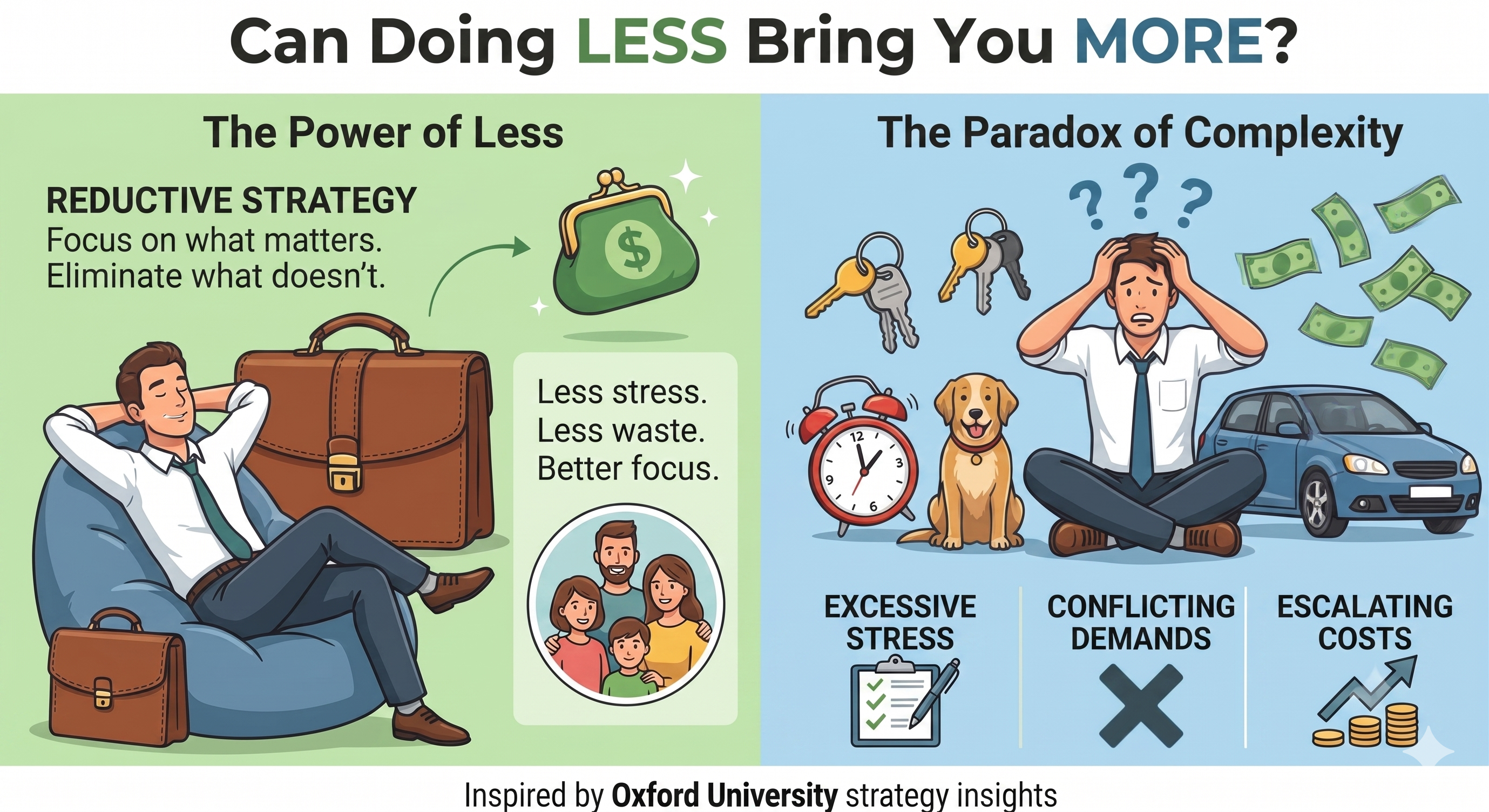
Great Savings from Reductive Strategy
Read the rest of this entry »Share this:


I was invited to a dinner by a client couple of mine. Their youngest daughter has been accepted to three universities and they are having a hard time picking the right one and they wanted my help.
Universities A and B are both out-of-state Ivy League universities that cost more than $60k a year in tuition. University C is an in-state university that costs only $15k. I listened to their reasoning as to why it is so hard to make a decision. They really want to give the best to their daughter and besides, an Ivy League university would give them a lot of face (there you know they are a Chinese American family) since their peer families all brag about their children’s academic achievements and they feel pressured to keep up.
Before I said anything, I forewarned them that the choice of university is a very personal one for them and their child so they should take my words only as my observations and not as my professional advice.
First, since universities A and B are four times as expensive as university C, do they provide four times more value? By this I mean, would their child acquire four times as much knowledge or earn four times as much after graduation? (I will get to this point later.) If not, they would be paying the extra just for the bragging rights.
Second, what financial values do they want to impart on their children? That they should borrow money to pay for something they can’t afford just for vanity? Would such a value system not lead to financial ruin for their children down the road?
Read the rest of this entry »Share this:

Little-known Secrets of How Small Business Owners Pay for their Kids’ Education
Posted on: July 18, 2012

College graduation
Being a small business owner comes with risk, responsibilities, and advantages.
This week I went to a seminar called “Little-known Secrets of Paying for College”.
My biggest take away was that everything being equal, being a small business owner makes it easier for your kids to qualify for financial aid. Let me explain.
Universities and colleges determine the financial aid eligibility of a student by the following formula: COA – EFC, where COA stands for cost of attendance and EFC stands for expected family contribution. COA is fixed, so the lower the EFC, the higher the amount of aid the student is eligible for.

 The Investment Scientist