Posts Tagged ‘politics’
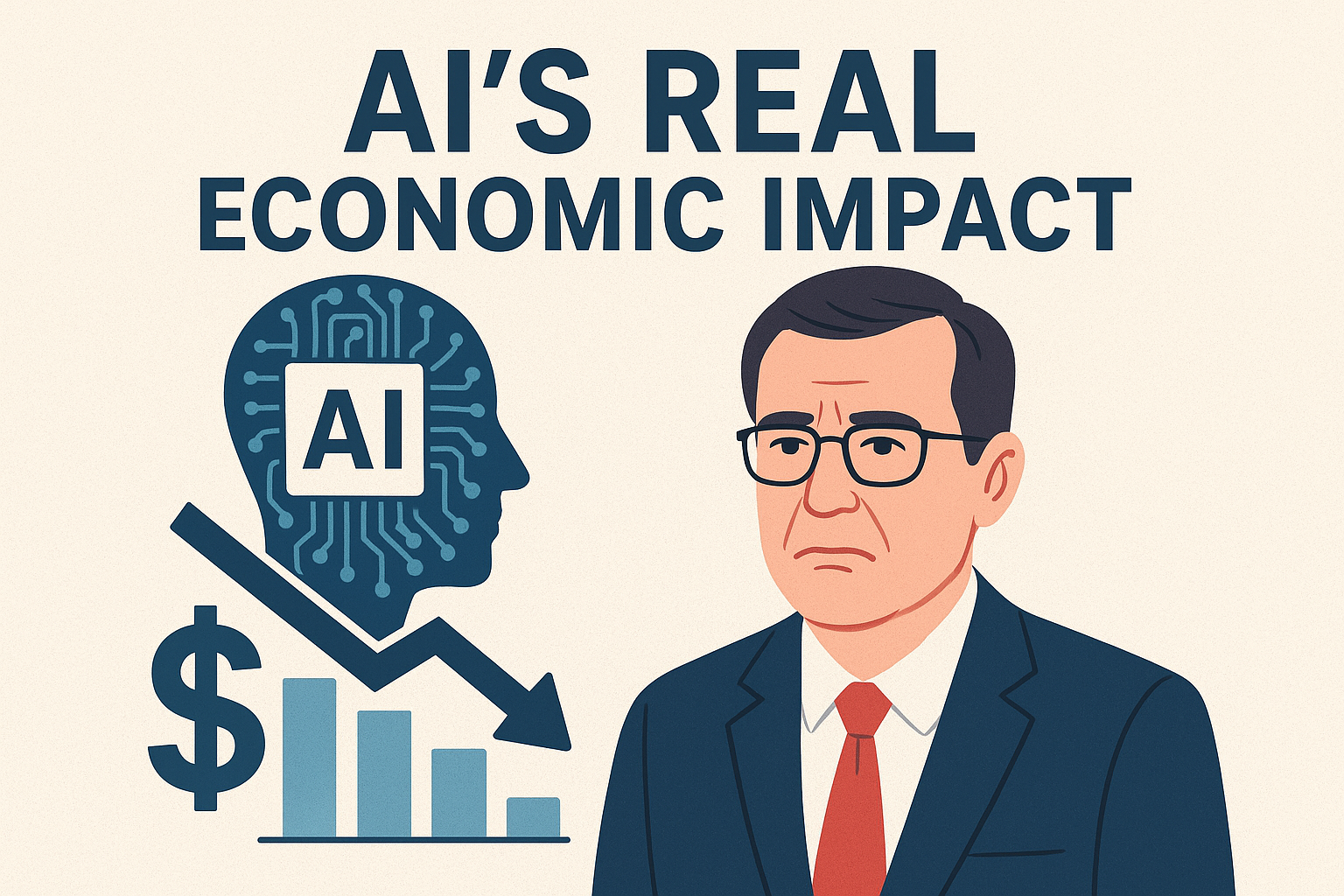
Today I am writing about a paper by MIT professor and 2024 Economic Nobel Laureate Daron Acemoglu titled “The Simple Macroeconomics of AI”.
Unlike the bullish projections of AI’s transformative impact on economics, Acemoglu’s view is much more measured. Given the overwhelming media coverage favoring maximalist views on AI, his perspective offers a necessary counterpoint.
Acemoglu argues that over the next ten years, AI will likely automate only 5% of tasks and increase the GDP by about 1%. He explains that while AI excels in specific tasks with clear truths, most real-world jobs involve complex, tacit, contextual knowledge and social intelligence that AI can not easily replicate and replace.
His paper also makes these important points:
Read the rest of this entry »Share this:

Triffin’s Dilemma: The Privilege and The Curse of the Dollar As World Currency
Posted on: March 28, 2025
Following our series about academic research, today I will write about Triffin’s Dilemma, a theory proposed by Dutch economist Robert Triffin in the 1960s.
The theory postulates that the country that owns the world’s reserve currency will inevitably face a persistent trade deficit that will imperil the confidence in that currency.
The theory was originally tied to the Bretton Woods Accord after World War II, where the US dollar was pegged to gold, and the rest of the world’s were pegged to the dollar. In 1971, President Nixon announced the de-pegging of the dollar from gold, effectively, making the dollar a fiat currency that the government could “print” as much of as they wanted.
This is an exorbitant privilege that other countries do not enjoy. By this, I mean that no matter what problems our country faces, we can print our way out of trouble. The oversupply of the dollar would normally cause hyperinflation in our country, but since ours is the world currency, we can export our surplus dollars to the rest of the world by running a trade deficit.
Exporting dollars is a great business to have, since instead of goods, which requires costly manufacturing, dollars can be created by simply adding an entry into the Fed’s computer system. However, a side effect is, that nobody wants to invest in manufacturing and no young people want to work in factories. All smart kids want to be in finance, the industry that is closely related to money creation, allocation, and management. This has led to overfinancialization and the gradual deindustrialization of the country (See chart below.)
Read the rest of this entry »Share this:


I was invited to a dinner by a client couple of mine. Their youngest daughter has been accepted to three universities and they are having a hard time picking the right one and they wanted my help.
Universities A and B are both out-of-state Ivy League universities that cost more than $60k a year in tuition. University C is an in-state university that costs only $15k. I listened to their reasoning as to why it is so hard to make a decision. They really want to give the best to their daughter and besides, an Ivy League university would give them a lot of face (there you know they are a Chinese American family) since their peer families all brag about their children’s academic achievements and they feel pressured to keep up.
Before I said anything, I forewarned them that the choice of university is a very personal one for them and their child so they should take my words only as my observations and not as my professional advice.
First, since universities A and B are four times as expensive as university C, do they provide four times more value? By this I mean, would their child acquire four times as much knowledge or earn four times as much after graduation? (I will get to this point later.) If not, they would be paying the extra just for the bragging rights.
Second, what financial values do they want to impart on their children? That they should borrow money to pay for something they can’t afford just for vanity? Would such a value system not lead to financial ruin for their children down the road?
Read the rest of this entry »Share this:

 Today I went to listen to Professor Jing of Renmin University speaking about US – China relations. The last time I went to listen to the same subject, it was Professor Mearsheimer of the University of Chicago speaking. His theory predicts that the US and China will come into conflict inevitably. I was curious to hear a Chinese perspective.
When I told Professor Jing about Dr. Mearsheimer’s theory and prediction, I was surprised to learn that the two professors are friends. In fact, Dr. Mearsheimer teaches at Dr. Jing’s Renmin University as a visiting scholar.
Dr. Jing does not agree with Professor Mearsheimer’s theory and prediction.
He does however agree that the rivalry between China and the US will intensify in coming years. In his words, “This is structural.” No matter how hard the leaders of the two nations try, the most powerful nation on earth and the second most powerful will always be suspicious of each other.
However, Professor Jing believes this rivalry need not result in open conflict. “Both the US and China are nuclear states. Should war break out between us, only cockroaches will survive.”
Firm | Youtube | Facebook | Twitter | LinkedIn | Newsletter

 The Investment Scientist