Archive for the ‘Prudence & Fiduciary Duty’ Category
 Following the post I wrote about deep risk vs shallow risk, I went to Amazon and flipped through Bill Bernstein’s latest book “Deep Risk” to see if he feels the same way as me.
It turns out there is a lot that we agree on, but not everything.
Here’s where we see eye to eye: 1) our definitions of deep and shallow risks are almost the same: 2) we both see market fluctuation as a shallow risk and 3) we both see inflation as the #1 deep risk.
Our agreement stops there however. Bernstein does not seem to believe behavior risk and agency risk are deep risks, as I do. Instead, he mentions the following three risks as deep risks in addition to inflation risk.
Firm | Youtube | Facebook | Twitter | LinkedIn | Newsletter
Share this:

 When I am approached by a prospective client, the question they always ask without fail is “Are you properly licensed?”
This is actually the wrong question. The right question should be, “Which license do you have?”
Generally, there are two types of licenses for people who call themselves a “financial advisor.” People who passed the series 65 test and people who passed the series 7 test. The nature of these two licenses are as far apart as heaven and earth.
Series 7 is a securities license. People who have passed this test can legally be a broker. They are actually prohibited by law to give financial advice, except incidental to the financial products they are selling.
Firm | Youtube | Facebook | Twitter | LinkedIn | Newsletter
Share this:

 Recently a business owner asked me to review his investment portfolio. He is currently with an Ameriprise financial advisor and his gut feeling tells him something is amiss.
He is paying the advisor 1.6% in fees. First of all, this fee is quite exorbitant. For the size of his portfolio, he shouldn’t be paying more than 1% in advisor fees.
Adding insult to injury, for the fee that he is charging, this advisor puts his money into a collection of very expensive mutual funds like ODMAX.
It is very easy to check the expenses of a mutual fund. I just googled ODMAX and I found out it has a load of 5.75% and an expense ratio of 1.36%. (For those who don’t know, load is a one time charge to pay commision to the Ameriprise advisor who doubles as a broker. Expense ratio is an ongoing annual charge.)
ODMAX is a mutual fund that invests in emerging market stocks. If you use the low cost alternative, aka a Vanguard fund, you will pay no load and the expense ratio is only 0.33%, a saving of 1.06%.
Don’t ever underestimate these tiny savings. Because in ten years, the savings will be more than 10%, in twenty years, more than 20%. This businessman is in his 50s; he can easily live another 30 years. I asked him: “How would you like to be more than 30% poorer in retirement?” That is exactly what this financial advisor will make him.
Firm | Youtube | Facebook | Twitter | LinkedIn | Newsletter
Share this:

 Many middle aged Americans are caught between a rock and a hard place financially. They are the so-called sandwich generation, having to take care of both kids and parents at the same time.
This has recently been a subject of discussion with clients of mine. They are a self made millionaire couple. their parents however, are relatively poor. They have enough to live on by themselves, but if they ever got sick, they would be financially dependent on their children for care.
To that end, my clients have set aside $1m just in case.
I suggested they fork over a few hundred a year to pay for their parents’ gym memberships. If their parents actually use the memberships, my clients may never need to spend the million.
Firm | Youtube | Facebook | Twitter | LinkedIn | Newsletter
Share this:

 1. “The gross revenues for the financial services industry in 2010 were $1.129 trillion. That year, total US financial assets stood at $50.38 trillion, meaning that the financial services industry as a whole is skimming 2.25% a year out of everyone’s wealth.” This is an excerpt from a post on Wealthcare Capital entitled “Investment Expenses – The Other Millionaire You Make.” How about I help you cut those expenses by half?
2. Shocking! Shocking! Your elected representatives want the financial industry to continue ripping you off!
3. Ike Devji wrote a piece “Investment Fraud Red Flag for Physicians.” It is packed full of useful tips. I have one thing to add though, never work with a broker, regardless how clean his or her broker check record. These people are not legally obliged to watch out for your best interest.
4. A very succinct piece in Physicians’ Monday Digest about How Rising Interest Rates Would Affect You.
5. Taxpayers beware, AccountingToday has a piece on tax deductions expiring in 2014.
Firm | Youtube | Facebook | Twitter | LinkedIn | Newsletter
Share this:

The Agony of The Landlord
Posted on: September 5, 2013
 A physician client of mine called me the other day and asked my advice as to whether she should evict the tenant currently residing in her condo. This is advice I hate to give. Let me explain.
The tenant is a single mom with two young children, whose estranged husband just stopped paying child support because he is officially unemployed, but the tenant believes he is getting paid under the table.
My heart goes out to this tenant, I would never want her and her children to become homeless. But my head tells me that if my client lets her stay for free, she would most likely wind up staying for free forever and my client’s rental property would become a toxic asset.
So what should I advise my client?
Firm | Youtube | Facebook | Twitter | LinkedIn | Newsletter
Share this:

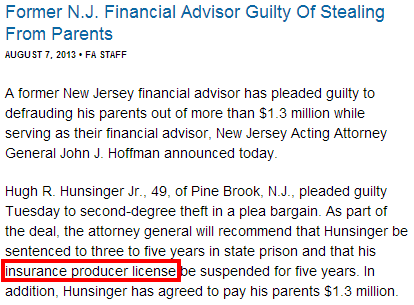
I want all of you to know that not all financial advisors are the same. In fact “financial advisor” is a free term. There is no educational requirement nor legal requisite. Justin Bieber and his grandmother could call themselves financial advisors and begin dispensing advice – and they would not get into trouble for it!
In reality though, there are generally four types of people who like to call themselves “financial advisors”:
Firm | Youtube | Facebook | Twitter | LinkedIn | Newsletter
Share this:

He then had the gall to call me back and ask whether I think he is paying too much for his new advisor. Here is what he said.
My advisor puts me in low cost ETFs and meets with me every quarter. But otherwise he does nothing with my portfolio, so what exactly do I pay him $15k for?
I know this gentleman has a sizable portfolio, and $15k means a fee of well below 1%. So I told him what I thought.
-
The fee is very competitive.
-
The advisor did the right thing by putting his money in low cost EFTs.
- Doing nothing with a portfolio is the only right thing to do!
Share this:
 A few days ago, I interviewed Jim Ludwick using Google+ Hangout On Air (HOA.) This is the first time I’ve interviewed an expert live on air! Feel free to laugh as you watch me stutter and trip over my words left and right.
Jim is the owner of MainStreet Financial, he used to be an agent at NY Life. Now he is a licensed insurance advisor.
I did not waste his appearance and got right down to the nitty gritty. I asked about a client case during the interview. Specifically, this client of mine was talked into 1) buying a universal life insurance inside her defined benefit plan, 2) buying a whole life insurance policy for her young daughter, because “it’s a great investment” according to the agent’s illustration of 8% growth.
I asked Jim three questions:
Share this:

Morgan Stanley Smith Barney
Last weekend, I went to New Jersey to meet a potential client who is an executive at a pharmaceutical company.
He told me that, as part of the executive benefit package, the company refers executives to Morgan Stanley where they get “free” financial advice. I smirked and said: “Well, we will find out how free it is. One thing I know, though, Wall Street firms are not known for charity.”
It turns out that Morgan Stanley advised him to open several, separately managed accounts (SMA), each with a management fee of 1.5%. The reason for the multiple accounts?
Share this:

What fills up your tank?
Posted on: February 28, 2013

How Can I Help?
“What makes you smile every day? What fills up your tank?”
These are questions a friend of mine asked me recently. For my wife, it is hosting dinner parties. She loves seeing people come together and enjoys conversations with friends. She does this almost every week now. It is also a great way for me to see her doing the thing she loves.
For me, it is learning improv and performing comedy on stage. English is not my first language, and I never thought I could do that. Now, I regularly go on stage to make people laugh.
Share this:


Email scam
I recently received an email from a client of mine. The mail contained only one line: “What’s the balance of my account?”
“It’s $978k as of close of yesterday,” I replied.
“I need $500k for a business transaction,” my client responded.
I went into an explanation of the tax consequence of selling long-held investments to fund a business transaction, but my client insisted that he needed the money urgently. So I emailed him: “send me your wire instruction, and I will make sure the money will be in your account tomorrow.”
Share this:

The reward of a financial advisor
Posted on: January 7, 2013
 Recently, a client of mine fell, broke his hip and ended up lying on the floor for 20 hours before he was rescued. I went to visit him in the hospital a couple of times. The good news is: he is out of immediate life-threatening danger. The bad news is: he may be wheelchair bound for the rest of his life.
When John first came to me to seek my help with his personal finance, I looked at his overall financial big picture and was pleased overall. He worked at federal and state jobs and enjoyed good pensions. On top of that, he had a decent investment account.
But there was a gaping hole in his retirement security: he was turning 70 then, was divorced, and his children lived far away. That meant if he were to get sick, nobody would be there to take care of him; he would need to hire caregivers. Right then, I insisted that he buy long-term care insurance.
Share this:

Here is a selection of the best wealth management articles around the web for September:
5 reasons your portfolio is too complicated, by Kyle Bumpus
Why analysts are scratching their heads over QE3, by Robert Wasilewski
Under the radar bill could benefit fiduciary rule making, by FI360
Is rebalancing market timing?, by Mike Piper
Choosing a mutual fund – Avoid these 6 mistakes, by Roger Wohlner
Fidelity’s new retirement saving guidelines, by Barbara Friedberg
Can I consistently outperform the market? by Ken Faulkenberry
Dividend reinvestment plans (RIPS) and their benefits, by Dave Scott
Questions to ask when picking a financial advisor, by Carl Richards
Get my white paper: The Informed Investor: 5 Key Concepts for Financial Success.
Get informed about wealth building, sign up for The Investment Scientist newsletter

Share this:


New York Stock Exchange
When talking to prospective clients, I am upfront about what I can and can not do. I can NOT beat the market.
Recently, that straightforwardness caused me to lose a prospective client to a major Wall Street firm. Apparently, the financial advisor from that firm was able to convince him that with their exclusive location, expensive brochure, and nice Armani suits, they could beat the market.
This led me to do a mental exercise.
Share this:


Is a round of golf all the value you get from your financial advisor?
Why do you charge me 1% every year regardless how well you do for me? I would rather not pay you anything for the first 5% return and split anything above and beyond that.
This is a question a prospective client of mine asked me. Let me explain why this fee arrangement is not in the client’s best interest.
Historically, the mean return of the market is 10%, and the standard deviation of return is 15%. This means the market is equally likely to go up 25% in one year and go down 5% in another.
Despite what they want you to believe, financial advisors have very little control over the market.

 The Investment Scientist