Archive for the ‘Wealth Management’ Category

What a difference a month can make! At the end of June, the stock market gave us discounts of between 20% to 30% (depending on indexes.) That made the first half of 2022 the worst six months of the stock market since 1970. Many investors were panicky! I, on the other hand, called it a good opportunity to acquire assets on the cheap.
What a difference one month can make! All through July, the market went up and up despite much bad news like we are now technically in a recession. Now that the month is over, stocks are between 7.5% to 10% more expensive (depending on indexes.) Happy now?
Read the rest of this entry »Share this:

My IRA Lost 15%, Should I Panic?
Posted on: July 17, 2022
The first half of 2022 was the “worst” six months of the stock market since 1970 according to the financial media. The S&P 500 is in bear market territory. The tech-heavy Nasdaq is down 30%. Even the bond market, which is usually up when the stock market is down, is down by double digits. What a blood bath!
I had rolled over an old 401k account to an IRA last October. By the end of June, the account was down nearly 15%. Let’s take a closer look at how I invested the money.
The Initial balance was about $711k, which I used to invest in 3054 shares of US Total Stock Fund (USTSF), 4511 shares of Global Real Estate Investment Fund (GREIF), 4900 shares of International Stock Fund (INTSF), 263 shares of Nasdaq 100 Stock Fund (NDQSF), and 53109 shares of High Yield Corporate Bond Fund (HYCBF). Note that all of these symbols are pseudonyms.
After the initial investment, I made only one change in April, which was to sell some GREIF and HYCBF to buy 223 shares of Gold Fund (GOLDF). In the table below, I show how the amount of each asset increased (green) or decreased (red). In the last two rows, I also show the value and the income of the portfolio and how they increased or decreased over time.
Read the rest of this entry »Share this:

Today I had a very productive meeting with a long-time client of mine. At the end of the meeting, I mentioned that he appeared to have lost quite a bit of weight and he went on to tell me that through diet, exercise and some medications, he was able to reverse his diabetes. I am so happy for him! He is truly making the best investment in his life!
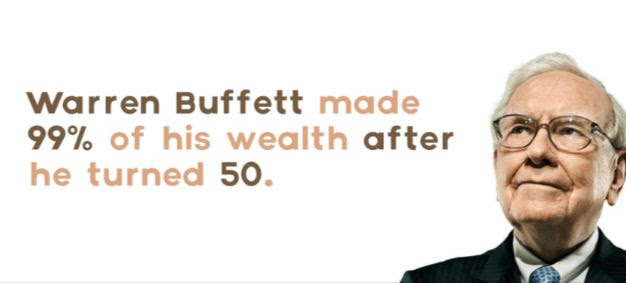
Did you know that Warren Buffet made 99% of his $90b wealth after he turned 50? To be more exact, he did it after he turned 54. Now he is 91. So how did he do that? After all, he is such a boring investor! He missed the best moment to get into AAPL. To this day, he is still not invested in TSLA and he totally doesn’t understand Bitcoin. In his entire investment career, he has rarely had a blockbuster win. So how on earth did he accumulate so much wealth? One often-overlooked reason is that he has lived a very long life.
Share this:


It appears to me that in times of great uncertainty, people want me (a financial advisor) to know where the market is heading the most. Certainly, I have my informed opinions, bringing all my education and experiences to bear. But I often find myself having to explain that I can’t see into the future and tell them exactly what the market is going to do, all I can provide is informed guesses, and long-term investment success should not depend on guesses, informed or otherwise.
Today, let’s do a mental exercise: imagine I can actually accurately predict the market. If an ordinary person had $10,000 to invest in the S&P 500 index on 1/1/2000, by the close of the market yesterday his investment would have grown to $45,320. Not too bad!
Read the rest of this entry »Share this:

I am writing this article one hour before today’s market close. If there are no surprises, the S&P 500 will end the day in a bear market, meaning the index is giving us a 20% discount from its peak. As a comparison, the Nasdaq is already giving us a 30% discount.
As savvy investors, many of my clients and readers want to know: will the discount get deeper? And how long will the discount last? Well, like I always say, nobody can predict the future, but we surely can learn from history. That’s why I have done a study of all twelve bear markets since 1950. The table below illustrates my findings:
Read the rest of this entry »Share this:

If you bought a bond fund three months ago, you may have seen your fund go down about 10% in value! What the heck is going on? Aren’t bond funds supposed to be safe? In today’s newsletter, I will explain what’s going on, I will explain why you should still consider your bond funds safe, and I will even give you some hidden upsides of bond funds going down in value.
What’s Going On?
Last month we saw interest rates rallying. Bonds are essentially fixed future promised payments. The current value of a bond is the sum of all fixed payments discounted by interest rates. When interest rates go up, it stands to reason that, applying the mathematical formula, the current value of the bond will go down. This mathematical logic applies to all bond funds.
Share this:


When something seems too good to be true, it is often not true. But there is one exception in the financial world: I bonds.
I bonds are federal government bonds sold to individual investors that pay a very high-interest rate that is linked to inflation. For instance, the current rate is 7.12%. On the first business day of May, the Treasury Department will announce a new rate that will be close to 10%. Some expected it to be 9.62%. Nowhere in the world can one get this high of an interest rate, guaranteed by none other than the US government.
So what is the catch?
Well, there is no catch, but there are some limitations.
Read the rest of this entry »Share this:

In the face of rising uncertainties and the prospect of persistent inflation, today I investigated the historical performance of stocks and gold relative to inflation. Here is what I found:

Share this:


Over the last few days, I have begun to sense that a number of my clients are worried since the S&P 500 has dropped 13% and Nasdaq, about 20%.
I would like to argue, if you are going to worry about something, please worry about the inflation rate, which just went up to 7.9% in February even before Russia’s invasion of Ukraine.
Why is inflation so much more damaging?
You could have kept your money in a safe, and yet you still lost 7.9% to inflation in one year. If this level of inflation keeps going for ten years, you will lose 79% of the value of your money. That’s basically a wipeout.
Share this:

Last Thursday when the news reported that Russia had just launched an invasion of Ukraine, the market opened down nearly 800 points. A client called to ask if we should move to safety, but I was able to persuade him to stay put. I did that without knowing that the stock market would end the day slightly positive, followed by the BEST rally since 2020 on Friday. Such is the unpredictable nature of the stock market. Today I am gonna show you, missing the best days of the market can be extremely costly.
Below is research from JP Morgan that I found on the internet. You can see that between 1995 and 2014, the annual return of the S&P 500 is 9.85% if invested through the whole duration. But missing just the 10 best days would drop the annual return to only 6.1%. Missing the 20 best days would drop the annual return to 3.62%. Missing the best 30 days would further drop the annual return to only 1.49%.
Read the rest of this entry »Share this:


Last week I completed the Venture Capital class at Oxford, and I have at least two take-aways I’d like to share with my readers. Today, let’s talk about SPACs since a few of you have asked me if we should invest in those, and before I had not felt qualified to answer the question.
What are SPACs?
The name SPAC is a shorthand for the Special Purpose Acquisition Vehicle. These are companies backed by famous investors/entrepreneurs (sponsors) that raise a sum of money via IPO then search for a private company to buy.
For venture-backed companies that want to go public, this is a great option since they don’t have to go through the IPO process – roadshows, book building, the whole nine yards. All they need to do is to sell to a SPAC.
Read the rest of this entry »Share this:

Last week I shared an example of how you could still lose money on an investment that gives you a 20% average annual return. I ended the article with five questions:
- Can the average return tell you if you will make or lose money?
- Can the average return tell you how much money you make or lose?
- What else determines if you make or lose money?
- Why do hedge funds love to use average returns?
- Why do I use asset class diversification to reduce client portfolio return variability? (Note that this will make the return number look smaller.)
Here are the right answers:
- No.
- No.
- Return variability or volatility. It is also called volatility drag – the higher the volatility, the lower the return. Here is an article on this subject I wrote 13 years ago.
- It’s great for marketing.
- One word: I am a fiduciary. (Ok, four words.)
Share this:


Sure you can! Look at the following stylized example.
Hedge Fund A has a first-year return of 100%, and a second-year return of -60%. The hedge fund’s average return is (100-60)/2 = 20%. But if you have invested $100k in this hedge fund, by the end of the second year, you will only have 100*(1+100%)*(1-60%) = 100*2*0.4 = $80k. In other words, Hedge Fund A gives you 20% average annual return, but you still lose $20k or 20% of your money!
What gives?! Let’s look at the following 6 investments, all of which have a 20% average return. Some are profitable and some are not. All assume an initial investment of $100,000.
Share this:

Beware of NFC Payments!
Posted on: August 17, 2020
 Near-Field Communication (contactless) payment either through your smart phone or through your credit card chip has revolutionized commerce. Instead of swiping or inserting your credit card, waiting for a printout and signing your name, you can just wave your phone, wait for the beep and go. But just a moment ago, I learned the hard way that this technology is not secure.
I went to Giant to buy a bottle of Diet Coke. I do that because I know soda is a bad habit so I don’t keep it in my refrigerator. When I want to drink Coke, I will drive to the nearby Giant and buy only one.
Share this:

 By the close of the market yesterday, the Dow was discounted by 32% from its peak just three weeks ago. This level of discount happens once a decade. The last two times were during the 2000 dotcom bubble burst and 2008 financial crisis.
I have been busy rebalancing portfolios for myself and my clients. What is a rebalancing? Imagine a client has a target allocation of 60/40, that is, 60% in stocks and 40% in bonds. After the last round of discounts, the allocation becomes 45/55. To get back to the target, I must sell bonds worth 15% of the portfolio and use the money to buy stocks.
All investors set out to buy low and sell high, but when the market is giving them a 30% discount, most of them freak out and want to sell every stock instead. There are a few human judgement heuristics and biases at play here that were studied by Nobel Prize winner Daniel Kahneman, like representative bias, base rate neglect, availability bias, anchoring and framing heuristic. When I have time, I will write about those heuristics and biases.
Share this:

Predicting the market is a dangerous business, but there are enough people asking me this question that I thought I’d give it a try.
First things first, Covid19 is not a Pandemic yet. It is primarily in China and even within China, 88% of the cases and 95% of deaths are in Hubei province which has 60mm people. The second worst-hit province is Guangdong (my hometown). There are 586 existing cases and 7 deaths there as of this writing and this goes up by one or two cases every day. Guangdong has a population of 113mm people. So my sense is that outside of the epicenter province, the situation is under control within China.
That said, the virus has spread beyond China and infected hundreds of people in Japan, Korea, Italy, and Iran. The first three countries are unlikely to implement draconian measures limiting movements of people, the latter country does not have the medical resources to detect and fight the virus. The chances of Covid19 becoming a pandemic are increasing. So asking how that will affect your investments is a reasonable question.
The best way to answer the question is to study close historical precedents. The most recent, I believe, is the H1N1 swine flu pandemic. We have the added benefit that this virus was first detected in the U.S., which took the worst economic hit. Covid19 has barely reached the U.S. shores yet. Whatever impact it will have economically, it should be less than H1N1.

 The Investment Scientist