Author Archive
Guest author: Mike Piper
“Much rides on how you take your money out, not simply how much you have in.” –Lee Eisenberg in The Number

It’s true. Yet, for whatever reason, there’s much more written about strategies for accumulating assets than about strategies for intelligently spending down your assets.
Investors nearing retirement have a lot of questions, and so far they’ve gone more or less unanswered by mainstream financial media.
Asset Allocation in Retirement
During the accumulation stage, the goal when crafting a portfolio is simply to achieve the maximum return over the period in question without giving yourself a heart attack due to volatility.
Share this:

 Few people know that there are 2,613,000 financial advisors in the U.S. It is the fifth largest vocation, right after truck drivers and before janitors. Even fewer people know that, unlike attorney and CPA, financial advisor is a free title – there is no uniform legal standard or educational requirement for the title. Nobody will get into trouble calling himself or herself a financial advisor.
In practice, there are two types of professionals who call themselves financial advisors: registered representatives (aka brokers) and registered investment advisors (aka RIAs).
Share this:

 When talking to a prospect about my advisor services, I would ask him his philosophy about risk. The conversation would usually go like this:
Prospect: “I don’t like losing money.”
Me: “What do you mean? Can you be more specific?”
Prospect: “I don’t mind giving up a little upside; I just don’t want to lose too much on the downside.”
Me: “So you are concerned about volatility risk?”
Prospect: “That’s it.”
Me: “Other than that, are there risks you are concerned about?”
.. (long pause)
Prospect: “Not that I can think of.”
It is not surprising that most investors equate investment risk to volatility; they see assets prices (and their portfolio values) fluctuate every day. But there is much more to investment risk than what meets the eye. And what investors don’t see usually is far more insidious. For example:
Share this:

“Stir-Frying” Chinese Stocks
Posted on: January 26, 2010

Is it how you treat you stocks?
At the end of last October, the Chinese stock market index was up 70% for the year. One would expect Chinese investors to be making money hand over fist. Not so, the Chinese Securities Investor Protection Agency, the equivalent of SIPC, did a survey of investors in November that garnered 2,791 valid responses. The result was shocking.
Share this:

“Good intentions” doesn’t cut it
Posted on: January 25, 2010
Guest author: Mike Piper
There are inherent conflicts of interests between for-profit mutual fund companies and the investors in funds run by such companies. For example:
- Investors benefit from low expense ratios. Fund management benefits from high expense ratios.
- Investors benefit from plain-English, thorough disclosures regarding costs and conflicts of interests. Fund management benefits from poor disclosures.
A reader (we’ll call her Martha) recently asked me if such problems could be avoided by using mutual fund managers who have the interests of their investors at heart.
Share this:

Roth IRA conversion examples
Posted on: January 17, 2010
 There is one important rule to keep in mind when it comes to converting a traditional IRA to a Roth IRA – you need to pay federal income taxes on any portion of the conversion that you haven’t already paid taxes on.
Example 1
For example, let’s say you started to fund traditional IRAs in 2006 and by 2010 you’ve got $20,000 in your account. Furthermore, let’s say this account consisted of four years of $4,000 non-deductible contributions – a total of $16,000 in non-deductible contributions and $4,000 in account growth.
In this example, you’d need to pay income taxes on the $4,000 in fund growth when you convert to a Roth IRA. But the good news is you’ll never have to pay income taxes on this account again.
Read the rest of this entry »
Share this:

‘The Investment Scientist’ or ‘The Investment Fiduciary’: Help me Choose
Posted on: January 17, 2010
 When I started this blog 30 months ago, my only goal was to disseminate the best investment research done in academia.
Much of the so-called investment research produced by the financial industry (aka Wall Street) and purveyed by the media is nothing more than advertisement in disguise. The truly rigorous and unbiased research is often done in the nation’s best universities, like Yale, Harvard, and the University of Chicago. This research is not accessible to the vast majority of investors who are not academically trained. My blog was meant to change that, thus the title “The Investment Scientist.”
Share this:


Boo-Yahhh
Never underestimate what a bull market could do to Jim Cramer. After shying from making any top picks for 2009, presumably because he didn’t see any stocks worthy of buying at the beginning of 2009, he is back to his own game with a vengeance this year. We’ll see if his 2010 picks below will turnout as dismal as his 2008 ones.
- Apple (AAPL)
- Google (GOOG)
- Crown Castle (CCI)
- American Tower (AMT)
- SBC Communications (SBC)
- Skyworks Solution (SWKS)
- Altera (ALTR)
- Cypress Semi (CY)
- Xilinx (XLNX)
- Amazon (AMZN)
- Cisco (CSCO)
- Electronic Arts (ERTS)
- Qualcomm (QCOM)
Get informed about wealth building, sign up for The Investment Scientist newsletter
Share this:

How not to ruin a 60/40 portfolio
Posted on: January 6, 2010
This past Christmas, I had the distinct pleasure of calling several of my clients in retirement and telling them their portfolios are back to their pre-crisis level and their financial freedom is safe and sound.
Their portfolios are variations of the so-called 60/40 portfolio – about 60% in equity-like investments and 40% in bond-like ones.
Many other 60/40 portfolios have been decimated by this crisis. Even with recent gains, they are still far from recovering all their losses. How did I manage to pull even for my clients? There are a few key lessons I’d like to share.
Share this:

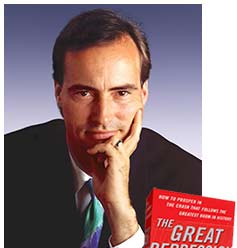
Harry Dent selling “The Great Depression Ahead”
I am exasperated. A client of mine just sent me Harry Dent’s latest book, The Great Depression Ahead, with a note. My client was absolutely convinced that the Dow will go down to 3,800, and he wanted me to do something to profit from this inevitability.
I don’t blame him. Dent is a brilliant man; he makes compelling arguments based on the demographic of aging baby boomers like my client, with just enough data and charts to make the book look authoritative. Couple that with a daily dose of bleak headlines:
Share this:


Professor James Poterba
MIT economics Prof. James Poterba has conducted very rigorous research on the subject of demographic trends and asset returns. His research examined the relationship between demographic structure and returns on Treasury bills, long-term government bonds, and stocks, using data from the United States, Canada, and the United Kingdom.
What he found?
From his research, Poterba concluded: “The empirical results suggest very little relationship between population age structure and asset returns.”
Share this:

 Who are we? That’s the question many financial advisors have been asking themselves. I agree with Carl Richards when he says financial advisors have an identity crisis. Are we looking in the mirror each morning wondering who we are? Maybe not, but we do have a problem.
Let’s Confuse ‘Em
There are many so-called “financial advisors” that simply want to sell clients expensive products; and one of the ways to do that is to confuse the customer. Now, financial firms don’t actually have an official Customer Confusion Department, but they might as well have one. Case in point: We call ourselves “fee-only” advisors, hoping to differentiate from product pushers on commission; pretty soon, they re-brand themselves as “fee-based” advisors. How many people can actually tell the difference between a “fee-only” advisor and a “fee-based” one?
Share this:


French

Fama
In their seminal paper “The Cross-section of Expected Stock Returns,” Fama and French demonstrated
that value stocks had outperformed growth stocks in the U.S. markets since 1963 (when CRSP data became available). They called this phenomenon the Value Premium.
Share this:

 Harvard University Endowment significantly increased its holding of Market Vector Russia, iShare Mexico and iPath India in third quarter of 2009.
Table: Top 10 holdings in Harvard University Endowment’s public portfolio
| Rank | Names | 9/30/09 (x1000sh) | 6/30/09 (x1000sh) | Change |
| 1 | iShares E. Mkt | 10298 | 9712 | +586 |
| 2 | iShares Brazil | 3355 | 3294 | +61 |
| 3 | iShares China | 4962 | 4178 | 784 |
| 4 | iShares S. Korea | 4127 | 4349 | -222 |
| 5 | iPath India | 1882 | 1388 | +494 |
| 6 | iShares S. Africa | 1624 | 1595 | +29 |
| 7 | iShares Taiwan | 7297 | 6836 | +461 |
| 8 | Mkt vector Russia | 2596 | 882 | +1714 |
| 9 | iShares Mexico | 1639 | 570 | +1069 |
| 10 | Vanguard E. Mkt | 1568 | 1758 | -190 |
Get informed about wealth building, sign up for The Investment Scientist newsletter
Share this:


Warren Buffet
Being a financial advisor, I get asked to forecast the market all the time. I notice most other financial advisors would regurgitate the morning financial news and look really smart and up-to-date. I felt like I am the only one in my profession who doesn’t know what the market is going to do in the near future. So what a relief Warren Buffet threw me a life line like this one:
We have long felt that the only value of stock forecasters is to make fortune-tellers look good. Even now, (Berkshire Hathaway vice chairman) Charlie (Munger) and I continue to believe that short-term market forecasts are poison and should be kept locked up in a safe place, away from children and also from grown-ups who behave in the market like children.
I am gonna print this quote on note cards and hand it to anyone who ask me to forecast the market again.
Get informed about wealth building, sign up for The Investment Scientist newsletter
Share this:

This is a story shared with me by Larry Swedroe …
In 1959 Harry Roberts, of the University of Chicago, had a computer generate a series of random numbers that would have a distribution matching the average weekly price change of the average stock (about 2 percent). Since the numbers were randomly generated, there was no pattern and therefore no knowledge that could be obtained by studying a chart of this nature. In order to create the illusion that his charts were those of particular stocks, Roberts placed a starting price of $40 on each chart. He then took a group of these charts to the leading technical analysts of his day. He asked for their advice on whether to buy or sell these unnamed hypothetical stocks. He told them that he did not want them to know the name of the stock since this knowledge might bias them. Each technical analyst had very strong advice on what Roberts should do but since the numbers were randomly generated the patterns were only in the minds of the observers. I am sure that you will never hear about this story from a technical analyst.
Get informed about wealth building, sign up for The Investment Scientist newsletter
 The Investment Scientist