Archive for the ‘Investor Behavior’ Category
He then had the gall to call me back and ask whether I think he is paying too much for his new advisor. Here is what he said.
My advisor puts me in low cost ETFs and meets with me every quarter. But otherwise he does nothing with my portfolio, so what exactly do I pay him $15k for?
I know this gentleman has a sizable portfolio, and $15k means a fee of well below 1%. So I told him what I thought.
-
The fee is very competitive.
-
The advisor did the right thing by putting his money in low cost EFTs.
- Doing nothing with a portfolio is the only right thing to do!
Share this:

 If you are a typical investor, given the choice between investing in a small cap value fund or a large cap growth fund, which one would you choose?
You would probably go with the large cap growth since “large cap” sounds a lot safer than “small cap,” and “growth” sounds a lot more promising than “value.”
To prove how wrong you are, I did a study of the relative performances of these two styles in the eight decades between 1931 and 2010. Here is what I found.
Firm | Youtube | Facebook | Twitter | LinkedIn | Newsletter
Share this:

 A client of mine is trying to get his money out of an ill-conceived investment. I want to share this with you so you don’t make the same mistakes.
In 2009, he had a windfall of $1m. He asked a lady who had sold him a bunch of annuities where he should put his newfound cash. He further told her he was already up to his neck in annuities so he wanted to take some risks.
The agent pointed him to a celebrity business. Basically, some hollywood celebrity was trying to start an online gaming business, and needed $30m to do so.
My client went to their presentation and was mesmerized by the income projection. Then, when he saw that one of his relatives was a minority partner in the venture, he was totally sold. He signed a check for $1m on the spot.
He might as well have flushed it down the toilet.
Here is what he did wrong.
Firm | Youtube | Facebook | Twitter | LinkedIn | Newsletter
Share this:

 1. ThinkAdvisor highlighted a Maryland study which showed that states which pay the highest fees to Wall Street (for managing pensions) have the lowest returns. That says it all about Wall Street. No wonder Rick Ferri wants you to steer clear of actively managed funds.
2. Reuters Money reported how Health Savings Accounts (HSAs) can be used as retirement savings accounts. This information is especially useful for small business owners and self-employed individuals who tend to neglect their retirement savings and face high deductibility in their health insurance. Here is the garden variety of ways they can save for retirement.
3. DIY Investor Robert Wasilewski encountered a bear while hiking. He survived to write about it, but he mused that the same reactions that kept him in the gene pool will surely “eliminate you from the investment pool.”
Firm | Youtube | Facebook | Twitter | LinkedIn | Newsletter
Share this:

Why You Want a Simpler Portfolio
Posted on: July 22, 2013

When I write a blog post, I like to drive home one and only one point at a time.
In my last blog post, the point I wanted to make was that cost matters. In case you didn’t notice, not only did I reduced my new client’s cost by 85 basis points, I also reduced the number of funds in her portfolio from 39 to 4.
With such a small numbers of funds, is the portfolio diverse enough?
Emphatically yes. In fact, it is much more diversified than the previous portfolio of 39 actively managed funds.
What I use are asset class funds; DFQTX holds all 5000+ stocks traded in the US equity market; DFTWX holds all foreign stocks; DFGEX holds all domestic and foreign REITs and of course VBTIX holds all bonds. With these four portfolios, you are holding all of the world’s productive assets. How much more diversified can you get?
Firm | Youtube | Facebook | Twitter | LinkedIn | Newsletter
Share this:


Rebalancing your portfolio
Recently, I visited a prospective client in New Jersey. He is currently a client with Fisher Investments, and his advisor told him never to rebalance since that involves market timing.
I have to hand it to this financial advisor for recognizing that market timing is an unproductive endeavor, but he is so wrong about rebalancing that I am compelled to write this article.
Rebalancing is not a market timing activity, it is calendar-driven or condition-driven. For instance, you may decide that you will rebalance your portfolio on January 1st of each year or whenever an asset class allocation is off by 20%.
Share this:

 I met with three prospective clients on my trip to Los Angeles last week. I did a quick financial review with each one of them and gathered some lessons learned as well.
Prospective client A is a physician in his late 60s. He has already reached retirement age but he needs to keep working since he has less than $1mm saved for his retirement.
All that money is in tax deferred accounts, meaning far less than $1mm is available for his retirement. This is NOT retirement security.
Client A is not an extravagant person, so why is he in such dire straits?
Share this:


House for sale
Recently, a client called to tell me that he had finally got the big boulder off his back, and it was such a relief for him.
The “big boulder” he referred to was his big house, with a swimming pool and a tennis court. The house had been costing him $100k a year in property taxes and upkeep, more than 50% of my client’s retirement income. No wonder he called it a big boulder on his back.
He bought the house 25 years ago for $2.2mm, and he just sold it for $2.1mm. After all the costs associated with selling the house, he took home $2mm and change.
Share this:

January Barometer Effect: What Will the Stock Market Do for the Rest of 2013?
Posted on: February 7, 2013

New York Stock Exchange
With the market up about 5% in January, a prospective client of mine called to let me know he is not going to invest in stocks at this time – in fact, he is going to pull all of his money out of the market.
This may not be the best course of action for him.
According to research done by Cooper and McConnell, what the market does in January has a strong predictive power for what the market will do for the rest of the year.
Using data since 1940, they found that if the market is up in January, it will rise an additional 14.8% for the rest of the year; if the market is down in January, it will rise only 2.92% for the rest of the year. This gives rise to a spread of almost 12%, a highly statistically significant number.
Share this:


Oil and Gas Investment Scam
In the last month alone, I’ve gotten calls from two clients asking me if they should invest in tax advantaged oil and gas investments being pitched to them? Both of these clients are physicians.
The pitch is that oil and gas investments are like IRA accounts, but without the contribution limit. Whatever amount you invest can be written off right away.
The pitch is quite alluring to high-income professionals like physicians who are facing higher taxation. But it sounds too good to be true, so I did a study.
It turns out what is being pitched as “tax advantaged” is in fact the riskiest part of an oil and gas investment.
Share this:


New Year’s investment resolutions
After working as a financial advisor for six years and after reading tons of research, I have developed a good sense about how the average investor loses money. As the New Year approaches, I think it’s good to share my insight so that readers can determine if they are making these mistakes.
Conflict of interest
I cannot emphasize this enough: Wall Street firms don’t work for you. If you have a Merrill Lynch or Morgan Stanley advisor, expect to give away 2.5% of your money every year – about half of it will be in explicit fees, the other half will be in hidden fees. If you invest through insurance products, expect to give up 3.5 percent of your money.
Share this:

Young Physicians: Do You Understand Your Employment and Buy-Sell Agreements?
Posted on: November 19, 2012

Young doctors need legal advice
When a young physician joins a practice, he will have to sign an employment agreement.
After a few years as an associate physician, he will make partner, or become a shareholder.
At which time, he will sign a buy-sell agreement.
These two agreements to a great extent determine the wealth this physician will accumulate.
If they are not done right, this physician will likely not see any of the wealth he creates.
I am not being an alarmist. Let me tell you about a client of mine….
Share this:


Like Odysseus, automatic investments help investors avoid the Siren call of market timing
We call it stupid if someone takes a $55k job, even if he is offered the same job at $100k.
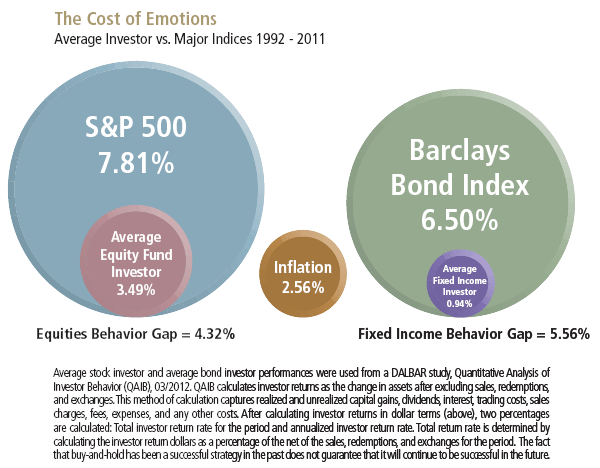
We call it market-timing when the same thing happens in the stock market. The long-term average annual market return is 10%, but the long-term average annual investor return is only about 5.5%. This is documented both by Dalbar’s study titled “Quantitative Analysis of Investor Behavior” and Morningstar’s research on fund returns and investor returns.
How could this possibly happen?
Share this:

Here is a selection of the best wealth management articles around the web for September:
5 reasons your portfolio is too complicated, by Kyle Bumpus
Why analysts are scratching their heads over QE3, by Robert Wasilewski
Under the radar bill could benefit fiduciary rule making, by FI360
Is rebalancing market timing?, by Mike Piper
Choosing a mutual fund – Avoid these 6 mistakes, by Roger Wohlner
Fidelity’s new retirement saving guidelines, by Barbara Friedberg
Can I consistently outperform the market? by Ken Faulkenberry
Dividend reinvestment plans (RIPS) and their benefits, by Dave Scott
Questions to ask when picking a financial advisor, by Carl Richards
Get my white paper: The Informed Investor: 5 Key Concepts for Financial Success.
Get informed about wealth building, sign up for The Investment Scientist newsletter

Share this:

Meeting Allan Roth
Posted on: September 10, 2012

financial blogging
I was in Denver attending the Financial Blogger Conference (FinCon12), and I was thrilled to meet Allan Roth there.
If you don’t know Allan Roth, for the sake of your financial wellbeing, you should.
Allan is an hourly fee-only financial advisor practicing in Colorado Spring. He also writes an investment column for CBS MoneyWatch. Recently, Jason Zweig invited him to write a column in the Wall Street Journal as well. Read the rest of this entry »
Share this:

New York Stock Exchange
When talking to prospective clients, I am upfront about what I can and can not do. I can NOT beat the market.
Recently, that straightforwardness caused me to lose a prospective client to a major Wall Street firm. Apparently, the financial advisor from that firm was able to convince him that with their exclusive location, expensive brochure, and nice Armani suits, they could beat the market.
This led me to do a mental exercise.

 The Investment Scientist