Archive for the ‘Wealth Management’ Category
I met a couple today (who could become my clients.) The husband is a medical specialist who has been making close to $1mm a year, the wife is a psychologist who was making peanuts. They are both retired now and planning to claim social security incomes.
To maximize their incomes, there is a little-know “File and Suspend” strategy they can use. Here is the gist of it according to Kipinger.
Say you are the higher earner and want to delay until 70. If your wife is 62 or older, she could collect her own benefit — but perhaps she’d get more money with a spousal benefit. One catch: She can’t collect a spousal benefit until you file for your own.
As long as you’re full retirement age, you file for your benefit and your wife applies for a spousal benefit. You ask Social Security to suspend your benefits. Your wife will still receive a spousal benefit, and you can continue to accrue delayed retirement credits until you reapply for benefits, presumably at age 70. Because you’re increasing the value of the survivor benefit, this “file and suspend” maneuver supercharges the survivor benefit for your wife if you die first.
Get informed about wealth building, sign up for The Investment Scientist newsletter
Share this:

Special Need Planning
Posted on: April 7, 2014

Special Need Planning
[A client of mine has two special need kids, so I know how important it is. This is an article I got from a estate planning attorney James Braswell.]
Understanding the pitfalls associated with special needs planning is a must for all who assist families with children, grandchildren or other loved ones (such as parents) with special needs.
Keep in mind these nine tips for Special Needs Planning:
Tip #1: Don’t disinherit your special needs child. Many disabled persons receive Supplemental Security Income (“SSI”), Medicaid or other government benefits that provide basic food, shelter and/or medical care. The loved ones of the special needs beneficiaries may have been advised to disinherit them – beneficiaries who need their help most – to protect the public benefits. But these benefits rarely provide more than basic needs. And this solution (which normally involves leaving the inheritance to another sibling) does not allow loved ones to help their special needs beneficiaries after they themselves become incapacitated or die. The best solution is for loved ones to create a special needs trust to hold the inheritance of a special needs beneficiary. A properly drafted special needs trust will protect public benefits a disabled beneficiary may be receiving, and it will provide for proper care of that individual throughout their lifetime.
Share this:

Disability Planning Gone Wrong
Posted on: March 13, 2014
Many families face hard questions as they decide how to manage the needs of their disabled child after death.
[I got this cautionary tale from a newsletter sent to me by William Fralin, Esq and President of The Estate Planning & Elder Law Firm.,P.C.]
Often, during the parents’ lives a disabled child’s siblings can hold the mantle of responsibility, especially as the parents grow into their golden years. However, this harmonious family dynamic is likely to change after the death of the parents. While many caretaker siblings feel a sense of duty while their parents are alive, and express this sense of duty through the proper care and oversight of the disabled child, this sense of duty often ends when the parents are no longer in the picture. A generation ago, it was common to leave assets to the caretaker sibling in a family in order for that caretaker sibling to see that the needs of the disabled child are met. In fact, this technique was standard practice. However, with so many options available within the realm of modern estate planning it is not necessary, and somewhat risky, to give away assets directly under a moral obligation. One family in California recently experienced the downside of what can occur after the death of a parent.
Share this:
Despite higher tax rates, S corporations retain advantages over C corporations
Posted on: February 10, 2014
(I got this from Cal Klausner, a CPA friend of mine.)
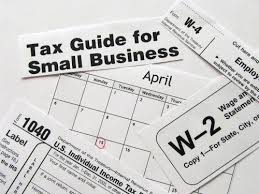 After recent tax changes, owners of small businesses face a question: Should the business continue to function as an S corporation, or should the entity revoke its election under Subchapter S of the Code?
Despite a number of statutory constraints, conventional wisdom has generally favored an S corporation classification. An S corporation is a pass-through entity whose shareholders are subject to personal income tax based on the income of the corporation. A C corporation, by contrast, is taxed as a separate entity at corporate rates, and its distributions to shareholders are subject to the personal income tax. A small business corporation electing under Subchapter S may have no more than 100 shareholders, and may not have more than one class of stock. There are no similar constraints on C corporations. Nevertheless, an S corporation classification provides business owners a superior degree of flexibility and is therefore generally preferred. Specifically, by having its income flow directly to its shareholders, an S corporation is not subject to the double taxation that a C corporation may be unable to avoid.
Share this:

 As far as investment philosophy is concerned, I am solidly in the camp of Nobel Prize winner Eugene Fama and Vanguard founder Jack Bogle. They both believe that the market is by and large efficient, and there is no point in picking stocks.
Most of my money is in broad-based passively managed asset class funds, but I do set aside 5% just to have some fun with and right now I only have three stocks in my fun account.
Safeway
I bought SWY last November after going to the Chicago Booth Entrepreneur Advisory Meeting. From the meeting, I learned that big retailers routinely write off their inventory at a huge loss. The reason being that they can not control demands as they have little information about the needs of the individual consumer, though they can usually make a rough guess on aggregate needs.
I noticed my wife had been shopping at Safeway more and more. After a little digging, I found out Safeway had set up a technology system to track each individual’s needs and price sensitivities. Then it can make targeted offers to shoppers like my wife that unfailingly brought her back over and over. I recalled my earlier meeting and realized they would save tons of money just from better inventory management.
Firm | Youtube | Facebook | Twitter | LinkedIn | Newsletter
Share this:

National Estate Planning Week
Posted on: October 21, 2013
 I bet you didn’t know that this week, the third week of October, is … drum roll please … National Estate Planning Awareness Week!
Seriously! Congress established it in 2008 in House Resolution 1499.
I only know this after getting an email from my estate planning attorney friend. I think you should read it as well.
According to the resolution passed by Congress, “Many Americans are unaware that lack of estate planning and financial illiteracy may cause their assets to be disposed of to unintended parties by default through the complex process of probate.” The resolution goes on to state that “careful planning can greatly assist Americans in preserving assets built over a lifetime for the benefit of family, heirs, or charities.”
Firm | Youtube | Facebook | Twitter | LinkedIn | Newsletter
Share this:

 When I was in California, I had a very intelligent debate with a doctor. He mentioned that in 2012, the US took in $2.5T in revenue and spent $3.6T in government expenditures.
He accurately pointed out, “If I spent like that, I would be bankrupt in a few years.” He believes so strongly that the US is going the way of national bankruptcy that he has moved substantial amounts of his money overseas and has invested a great deal in gold.
I happen to believe that gold is the most unproductive of assets, since it does not generate dividends or interest and it actually costs money for upkeep in a safe in a Singapore bank.
On top of that, by throwing so much money into gold, one could over prepare for a disaster that is very unlikely to happen and thereby miss out on all the opportunities to grow wealth in this country.
But I still need to explain why the US won’t go bankrupt anytime soon. Here are two explanations:
Firm | Youtube | Facebook | Twitter | LinkedIn | Newsletter
Share this:

10. How Often Do Market Corrections Happen?
9. Why Asset Class Diversification is Superior
8. Happiness That Doesn’t Take Money
7. Would You Buy This Variable Annuity with Income Guarantees?
5. The High Cost of Fee-Based Financial Advisors
4. Variable Annuity Fees You Don’t Know You are Paying
2. Profit from Harry Dent’s prediction? think again
1. Be Careful When Buying a Condo as a Rental Property
Also see Top 10 in August
Firm | Youtube | Facebook | Twitter | LinkedIn | Newsletter
Get my white paper: The Informed Investor: 5 Key Concepts for Financial Success.
Get informed about wealth building, sign up for The Investment Scientist newsletter

Share this:

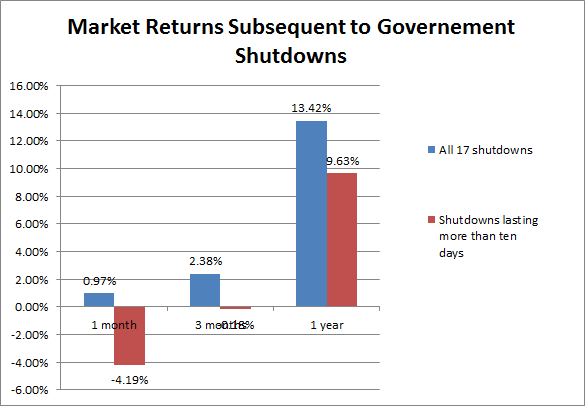
Using the closing price prior to the day of government shutdown as a base line, he found on average, the market rose 0.97% in one month, 2.38% in three months and 13.42% in a year.
If we isolate the 5 most severe shutdowns that lasted more than 10 days, the picture is a bit worse, but not by much. On average the market fell 4.19% in one month, fell .18% in three months and rose 9.63% in a year.
These historical precedents confirm my gut feeling that a government shutdown is really no big deal, as far as the market is concerned.
More worrisome is the upcoming debt ceiling fight. There is no precedent of US default to guide my outlook on this, but the longer the government shutdown lasts, the deeper heels get dug in by both parties and the more likely a default. Nevertheless, I’m still thinking that will also be a storm in a tea cup.
The bottom line is these are issues beyond our control, there is no point worrying about them. If worst comes to worst (ie default,) and the market should drop 20%. That’s actually great because then we can buy shares at a discount!
Share this:
Overwhelmed by Tasks?
Posted on: October 1, 2013
 If you are successful in your line of work, you are probably overwhelmed by tasks and find yourself wishing there were 25 hours in a day and 8 days in a week.
Well, that wish will not be granted, at least not by me. But there are ways to make those tasks less overwhelming. I call it ‘The Five Ds’: Delete, Do Now, Delay, Divide, Delegate. Let’s go through them one by one.
Delete
Tasks that add no value, just delete them. When I first started out in my career, I used to write a weekly investment column for a local Chinese newspaper. After a whole year of writing, I did not get a single decent client. That task has now been relegated to my delete bin.
Firm | Youtube | Facebook | Twitter | LinkedIn | Newsletter
Share this:

 Many middle aged Americans are caught between a rock and a hard place financially. They are the so-called sandwich generation, having to take care of both kids and parents at the same time.
This has recently been a subject of discussion with clients of mine. They are a self made millionaire couple. their parents however, are relatively poor. They have enough to live on by themselves, but if they ever got sick, they would be financially dependent on their children for care.
To that end, my clients have set aside $1m just in case.
I suggested they fork over a few hundred a year to pay for their parents’ gym memberships. If their parents actually use the memberships, my clients may never need to spend the million.
Firm | Youtube | Facebook | Twitter | LinkedIn | Newsletter
Share this:

- In: Life | Wealth Management
- 2 Comments
 I visited Dr. Chu who is a family doctor with a solo practice. He told me EHR is killing him.
He is in his 60s, very comfortable with pen and paper, but now Medicare requires him to record all patients’ records electronically, or he will have to pay a stiff penalty.
So now, in addition to seeing patients for eight hours, he has to spend three hours inputting health records.
I sat down with him and we toyed around with a few potential solutions.
Firm | Youtube | Facebook | Twitter | LinkedIn | Newsletter
Share this:

 Seven years ago when I started my advisory practice, I used to call myself ‘The Investment Scientist’ to differentiate from those run of the mill financial advisors.
My blog was called ‘The Investment Scientist’, and in marketing materials, I highlighted my academic training and scientific approaches toward investing.
Then, for whatever reason, I stopped doing that. Even the title of my blog has been changed to ‘The Investment Fiduciary.’ (The word ‘fiduciary’ signals my intention to put my clients’ interest first, but few understand its true meaning.)
Over the past year, I’ve rarely heard people call me an investment fiduciary, but sometimes would come across a long lost contact who’d say, “Aren’t you the Investment Scientist?”
There is a lesson here for me. Don’t use obscure words people don’t understand in marketing.
So why am I reverting back to ‘The Investment Scientist’ again?
Firm | Youtube | Facebook | Twitter | LinkedIn | Newsletter
Share this:

How to Pay Off Debts
Posted on: September 12, 2013
 A client I visited shared with me that he is very burdened by his debts. He has a primary mortgage, a secondary mortgage and a personal loan. He asked me whether he should pay off the debts and in what sequence. That’s a fantastic question.
Here are the partial details of his debts (I’ve concealed the amounts).
-
The primary is a 15 year fixed rate mortgage with a rate of 3%.
-
The secondary is a 5 year ARM with a current rate of 2.5%.
-
The personal loan has a rate of 5%.
Here are my recommendations to him.
Firm | Youtube | Facebook | Twitter | LinkedIn | Newsletter
Read the rest of this entry »
Share this:

 1. “The gross revenues for the financial services industry in 2010 were $1.129 trillion. That year, total US financial assets stood at $50.38 trillion, meaning that the financial services industry as a whole is skimming 2.25% a year out of everyone’s wealth.” This is an excerpt from a post on Wealthcare Capital entitled “Investment Expenses – The Other Millionaire You Make.” How about I help you cut those expenses by half?
2. Shocking! Shocking! Your elected representatives want the financial industry to continue ripping you off!
3. Ike Devji wrote a piece “Investment Fraud Red Flag for Physicians.” It is packed full of useful tips. I have one thing to add though, never work with a broker, regardless how clean his or her broker check record. These people are not legally obliged to watch out for your best interest.
4. A very succinct piece in Physicians’ Monday Digest about How Rising Interest Rates Would Affect You.
5. Taxpayers beware, AccountingToday has a piece on tax deductions expiring in 2014.
Firm | Youtube | Facebook | Twitter | LinkedIn | Newsletter
Share this:

The Agony of The Landlord
Posted on: September 5, 2013
 A physician client of mine called me the other day and asked my advice as to whether she should evict the tenant currently residing in her condo. This is advice I hate to give. Let me explain.
The tenant is a single mom with two young children, whose estranged husband just stopped paying child support because he is officially unemployed, but the tenant believes he is getting paid under the table.
My heart goes out to this tenant, I would never want her and her children to become homeless. But my head tells me that if my client lets her stay for free, she would most likely wind up staying for free forever and my client’s rental property would become a toxic asset.
So what should I advise my client?
Firm | Youtube | Facebook | Twitter | LinkedIn | Newsletter

 The Investment Scientist