Archive for the ‘Asset Classes & Allocation’ Category
Small Cap Value: Risk and Returns
Posted on: March 29, 2011
If you invested $1 in the small cap value index at the beginning of 1927, you would have had $52,892 by the end of 2010. This is according to the recently published Dimensional Fund Advisors’ annual Matrix Book. Included in the book are historical risk and returns of various indices based on capitalization and book-to-market valuation.
Table 1 presents a summary of historical returns. The best returns are marked in green; the worst, marked in red. As one can see, the small cap value index is the best for all the periods considered. And it is the best by a huge margin.
Share this:

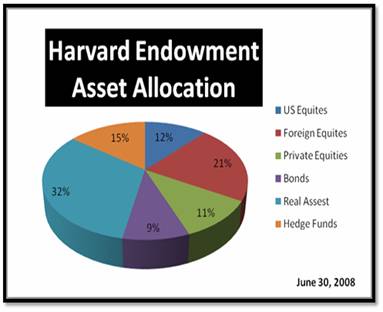 Recently I asked my assistant John to pull up Harvard Endowment’s 13F filing for Q4 of 2010 and compare it to that for Q4 of 2009 (shown in table below).
Apparently, Harvard Endowment’s year-end position in 2010 had changed significantly from that of 2009. The way I see it, there are three significant changes:
1. At the end of 2009, Harvard Endowment was extremely bullish on emerging markets; the top 10 positions were emerging market positions. That number was reduced to 5 at the end of 2010. On top of that, the size of each emerging market position has been reduced. Take China for example; the value of shares of FXI was reduced from 365k to 203k.
Share this:

Inflation is the silent killer of wealth. It does not have the “bark” of a full-blown financial crisis, but it certainly has the “bite.” Just imagine if the inflation rate is 4% over the next 10 years; within a decade you would lose nearly 40% of your wealth if you didn’t do anything about it.
Inflation over the next decade is highly probably because of two simple macro realities:
- America – from the federal government to the states down to individual households – is heavily in debt. The easiest way to get out of debt is to print money. There is a tremendous political incentive to do so.
- China, which has been the low-price setter for the past two decades, has seen labor costs galloping at a 20% to 30% annual clip lately (thanks to the one-child policy). Before long, that will translate into higher prices at your local Walmart.
Share this:
How not to ruin a 60/40 portfolio
Posted on: January 6, 2010
This past Christmas, I had the distinct pleasure of calling several of my clients in retirement and telling them their portfolios are back to their pre-crisis level and their financial freedom is safe and sound.
Their portfolios are variations of the so-called 60/40 portfolio – about 60% in equity-like investments and 40% in bond-like ones.
Many other 60/40 portfolios have been decimated by this crisis. Even with recent gains, they are still far from recovering all their losses. How did I manage to pull even for my clients? There are a few key lessons I’d like to share.
Share this:
Beyond the S&P 500
Posted on: November 4, 2009
 If you are like most investors, your equity portfolio will have a few auspiciously named stock funds and a few company stocks you feel comfortable with. You think you are well-diversified, but you really are only investing in the universe of the S&P 500 – the largest 500 stocks of the US equity market.
Share this:

My friend Carl Richards made an interesting observation in his last post:
Just when we need something to zig, they all zagged together!
 Some people draw the conclusion that diversification no longer works. I strongly disagree.
Share this:

 In his book Unconventional Success: A Fundamental Approach to Personal Investment, Swensen recommends the following allocations, for individual investors who want a “well-diversified, equity-oriented portfolio”:
30% Domestic stock funds
20% Real estate investment trusts
15% U.S. Treasury bonds
15% U.S. Treasury inflation-protected securities
15% Foreign developed-market stock funds
5% Emerging-market stock funds
In an interview with Yale magazine, Swensen said, economic conditions might call for a modest revision. He now recommends that investors have 15 percent of their assets in real estate investment trusts, and raise their investment in emerging-market stock funds to 10 percent.
Sign up for The Investment Fiduciary monthly newsletter.
Get informed about wealth building, sign up for The Investment Scientist newsletter
Share this:

University endowments are important institutions. They play a critical role in maintaining the academic excellence of the universities that rely heavily on their income. Recently, these endowments have drawn much attention because of their superior investment returns compared to other institution investors, such as investment banks and insurance companies.
There is much diversity among university endowments. Ivy League endowments such as those of Yale and Harvard are well ahead of the pack in terms of investment returns.
Share this:

Yale Endowment asset classes
Posted on: February 6, 2009
Once upon a time, the Yale University Endowment invested like the rest of us, in just two asset classes: US equity and fixed income. After taking over the reins in 1987, David Swensen, the chief investment officer of Yale Endowment, moved aggressively into non-traditional and often illiquid asset classes like foreign equity, absolute return, real assets and private equity.
Chart: The Yale Model asset allocation
![[enable picture display to see this chart]](https://i0.wp.com/www.thedividendguyblog.com/wp-content/themes/leia-en/imagenes/2008/03/yale-asset-allocation.gif)
Picture credit: thedividendguyblog.com
His unconventional approach produced a 20-year unbroken record of positive returns, resulting in stellar growth of the endowment from $1b to $17b. No wonder rival school Harvard University studies him closely. Other institutional money managers trip over themselves trying to mimic him.
Yale’s six asset classes are defined by their different expected response to economic conditions, such as inflation, growth and interest rate. Here is my own simplified explanation and cautionary note about these asset classes in relation to us as individual investors.
Absolute Return is a class of investment that seeks to generate long-term returns not correlated with the market.It does this by exploiting market inefficiencies. There are two basic strategies: event-driven and value driven. Event driven strategies rely on specific corporate events such as mergers, spin-offs or bankruptcy restructuring. Value driven strategies rely on buying under-valued assets while at the same time short-selling over-value assets. Don’t try this at home! You might just be the inefficiency being exploited.
Private Equity is a class of investment that participates in leverage-buyout (“LBO”) and venture capital. Venture capital is money that funded Google. However, it also funded thousands of failed ventures. LBO partnerships engage in the exercise of buying badly run businesses, reforming them, and then reselling them for a profit. Good private equity funds are generally close to individual investors. However, many below-average funds (often with exorbitant fees) are being aggressively marketed by Merrill Lynch and the like to unsuspecting high-net-worth individuals.
Real Assets include real estate and commodities. They are tangible (as opposed to paper assets) and they’re a good hedge to inflationary forces. This asset class is accessible to individual investors through Exchange Traded Funds (ETFs) and physical property such as the houses they live in.
Fixed Income is an asset class that produces a stable flow of income. It provides greater certainty than other asset classes. Fixed-income investments will perform badly in an inflationary environment, with the exception of treasury inflation protected bonds or TIPS. This asset class is readily accessible to individual investors.
Foreign Equity includes both matured market equity and emerging market equity. With US economy becoming an ever smaller slice of the global pie. This asset class provides a great way to participate in foreign growth. However, their diversification benefit is over-rated. With the exception of China, foreign stock markets highly correlate with the US market. Foreign equity is very accessible to individual investors.
Domestic Equity needs no additional explanation.
By all mean let David Swensen enlighten you, but don’t fall all over yourself trying to mimic him. What is good for Yale is not necessarily good for you. This is an advice coming from none other than Swensen himself.
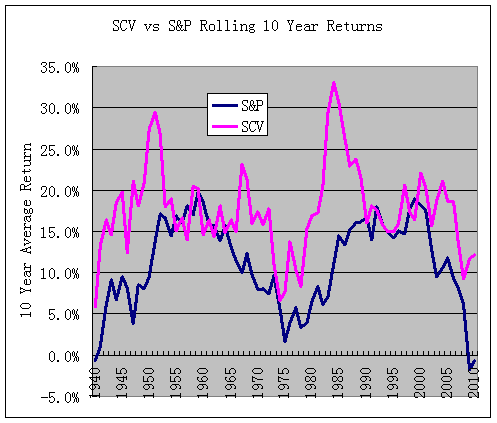
Many investors are puzzled by the underperformance of small cap value since May of this year. They ask: “Is it worth being in an asset class that can’t do well in bad times?”
To answer their question, I did a 10-year rolling return comparison between the Fama/French Small Cap Value (SCV) and the S&P 500 index using data from 1931 to 2010. The first 10-year period is 1931 to 1940, the second is 1932 to 1941, and the last is 2001 to 2010. Here is the rolling return chart I got.
Share this:

A David Swensen lecture on asset allocation, security selection and market timing
Posted on: February 3, 2009
David Swensen, Yale’s Chief Investment Officer and manager of the University’s endowment, discusses the tactics and tools that Yale and other endowments use to create long-term, positive investment returns. He emphasizes the importance of asset allocation and diversification and the limited effects of market timing and security selection.
Share this:
In his book “Unconventional Success: A Fundamental Approach to Personal Investing,” David Swensen prescribes for retail investors an asset allocation markedly different from his management of Yale Endowment.
- Domestic Equity (30 percent) – Stocks in U.S.-based companies listed on U.S. exchanges.
- Emerging Market Equity (5 percent) – Stocks from emerging markets across the globe. Brazil, Russia, India, China, etc.
- Foreign Developed Equity (15 percent) – Stocks listed on major foreign markets in developed countries, such as the UK, Germany, France, and Japan.
- REITs or Real Estate Investment Trusts (20 percent) – Stocks of companies that invest directly in real estate through ownership of property.
- U.S. Treasury Notes and Bonds (15 percent) – These are fixed-interest U.S. government debt securities that mature in more than one year. Notes and bonds pay interest semi-annually. The income is only taxed at the federal level.
- TIPs or U.S. Treasury Inflation-Protection Securities (15 percent) – These are special types of Treasury notes that offer protection from inflation, as measured by the Consumer Price Index. They pay interest every six months and the principal when the security matures.
Share this:

David Swensen’s 2008 public equity investments in Yale Endowment portfolio
Posted on: October 15, 2008
Yale Endowment, as an institution investor, has to disclose to SEC its public equity holdings every quarter. This allows us to get a glimpse of David Swensen’s direct stock investments. Since Yale Endowment does not have to disclose its private equity investments and its allocations to money managers, this is not the complete picture of its asset allocation.
The author is president of MZ Capital, a RIA serving DC/MD/VA. Get his monthly newsletter in your mailbox or get to the directory of his past articles.
Table: David Swensen’s stock portfolio
| Ticker | % weight of portfolio | Name |
| OEF | 1.24% | iShares S&P 100 Index |
| INFN | 0.12% | Infinera Corp |
| EFA | 13.82% | iShares MSCI EAFE Index |
| EEM | 37.42% | iShares MSCI Emerging Market Index |
| AKR | 7.12% | Acadia Realty Trust |
| XTXI | 1.39% | Crosstex Energy Inc. |
| WWW | 0.07% | Wolverine World Wide |
| CELG | 0.05% | Celgene Corp |
| DEI | 29.47% | Douglous Emmett Inc. |
| CXO | 8.39% | Concho Resources Inc |
| SPY | 0.9% | SPDR S&P 500 Index |
Share this:
All-weather portfolio: how Harvard and Yale Endowments invest for bad times
Posted on: September 21, 2008
This post was written at the depth of the financial crisis. If you stuck to the Swensen Model through out the crisis, you would be ahead now. See our model portfolio.
– Michael Zhuang
Wall Street Journal headline: “Harvard Endowment Returned 8.6%”
In light of the events of the last few weeks when financial companies collapsed in rapid succession, an all-weather portfolio is what all of us need. Yale and Harvard University endowments have portfolios that do well in both good and bad times. You’d expect these smart people to know what they are doing. They do!
In any one fiscal year (ending in June) since 2000, The Yale Endowment has never had a loss. Don’t you wish you had a portfolio that could do so well? Sadly, your record is likely to be worse than that of S&P 500. Harvard’s endowment portfolio had only two years with small losses. The worst was in 2001. That was when it suffered a loss of 2.7%. Here are the details:
Table 1: Comparison of returns for Yale, Harvard, and the S&P 500
| Year | Economic Cycle | Yale | Harvard | S&P 500 |
| 2000 | Tech bubble | 41% | 32% | 7% |
| 2001 | Tech bubble bust | 9.2% | -2.7% | -14.83% |
| 2002 | Tech bubble bust | 0.7% | -0.5% | -17.99% |
| 2003 | 8.8% | 12.5% | 0.25% | |
| 2004 | 19.4% | 21.1% | 19.11% | |
| 2005 | RE bubble | 22.3% | 19.2% | 6.32% |
| 2006 | RE bubble | 22.9% | 16.7% | 8.63% |
| 2007 | RE bubble bust | 28% | 23% | 21% |
| 2008 | RE bubble bust | 4% | 8.6% | -14.8% |
| Average Return | 17.8% | 14.4% | 1.6% | |
| Volatility | 12.4% | 11.3% | 14.6% | |
How did Yale and Harvard achieve such return stability through two major cycles of boom and bust?
The answer lies in their unconventional asset allocation. The typical US investor allocates 60% to domestic equity, primarily in large-cap growth stocks, and 40% to fixed income assets. In contrast, the endowments allocate to six non-cash asset classes that have low correlation with each other. In particular, domestic equity and fixed income make up only a small percentage of the overall portfolio: see Table 2 below. This broad diversification across weakly correlated asset classes is the primary reason why the endowment portfolios did well in both boom and bust times. (I will discuss secondary reasons in the future.)
Table 2: Asset allocations of Yale and Harvard endowments
| Asset Classes | Domestic Equity | Absolute Return | Foreign Equity | Private Equity | Real Assets | Fixed Income | Cash |
| Yale | 11% | 23.3% | 14.1% | 18.7% | 27.1% | 4% | 1.9% |
| Harvard | 12% | 18% | 22.% | 11% | 26% | 16% | -5% |
Both endowments allocate over 25% to real assets, such as real estate and basic materials. This allocation seeks to protect against the double threat of a weak dollar and inflation.
Chart: Evolution of Yale Endowment asset allocation

As the chart above shows, Yale Endowment significantly increased its exposure to real assets in the last three years. Average investors like you and me would be well-served to heed the unspoken message of these intelligently-managed endowments. And now for your take-home lesson:
1. Broadly diversify
2. Hedge against inflation and the weak dollar.
Get informed about wealth building, sign up for The Investment Scientist newsletter
Share this:

Over the last 60 years, the simple average annual return of the Fama/French benchmark small-cap portfolio* was 16.3%. For the same period, the large-cap portfolio* was only 12.76%. Do you think small cap beat large cap by a wide margin? I put my mathematician’s hat on to find out.
Volatility shrinks the return difference
The small-cap portfolio return volatility for this period was 26%, and 16.4% for the large cap. Taking into account the drag to return by volatility , I calculated the geometric mean return for both portfolios. My results showed 12.9% for small cap, and 11.4% for large cap. Mathematically, the return advantage of the small-cap portfolio is significantly reduced by its volatility.
The odd favors small cap … somewhat
For most investors, long-term investing means holding a stock for three to five years. What is the odds of the small-cap portfolio beating the large-cap portfolio? Not by much.
In any given three-year period during the last 60 years, the odd of the small-cap portfolio beating the large-cap portfolio were only 51%. It increases to 58% when the investment horizon is 5 years and 72% when the investment horizon is 10 years. For most investors, the odds barely favor small-cap investing.
| Investment horizon | 1 year | 3 years | 5 years | 10 years | 20 years | 30 years |
| Odds of small cap beating large cap | 53% | 51% | 58% | 72% | 75% | 90% |
Data source: Kenneth French data library
Emotional accounting
Daniel Kahneman, the 2002 Economic Nobel laureate and the father of behavioral finance observed that the pain from a loss is twice the pleasure from a gain of the same size.
Applying his principle: I assigned one unit of positive emotion to each 1% gain and deducted two units of positive emotion to each 1% loss. So a resulted positive number represents pleasure and a negative number represents pain. The sum of monthly results over the last 60 years showed: -788 for the small-cap portfolio and -482 for the large-cap portfolio. It is clearly painful to invest in stocks, small cap stocks especially. (This also explains why people prefer to put their money in CDs.) Is the pain of small cap investing worth the gain? You decide.
There are ways to reduce the pain and enhance the gain through diversification and valuations. They are the subjects of my future newsletter, which you can subscribe here.
*Fama/French benchmark small cap portfolio contains stocks in the bottom 30% of market capitalization. Fama/French benchmark large cap portfolio contains stocks in the top 30% of market capitalization.
Get informed about wealth building, sign up for The Investment Scientist newsletter
Share this:
Volatility: a drag on return
Posted on: May 16, 2008
In my last article, I explained why volatility does not measure risk. It’s an assertion by none other than Warren Buffet himself. I hope the historical data I used convincingly illustrated the point.
If volatility doesn’t measure risk, then what can we learn from it?
Let’s look at this simple example. Let’s say you invest $100 in asset A, whose volatility is 10%. In year one, the asset returns 10%. In year two, it returns -10%. What is the terminal value in year two? If you’re like most of us mortals, you’d call it a wash. You’d guess $100. Not so, the terminal value is $100*(1+10%)*(1-10%)=$99.
Now let’s assume you invest $100 in asset B, whose volatility is 20%. In year one, the asset returns 20%. In year two, the asset returns -20%. What is the terminal value in year two? This time you should get it right, it is $100*(1+20%)*(1-20*)=$96. So, everything else being equal, we can say higher volatility means lower investment return.
Mathematically speaking, volatility is a drag on return.
Steve Shreve, the math professor in my quantitative finance class, would give you this formula:
Reduction in return = ½ volatility2
For instance, if the annual volatility is 20%, then the drag on annual return is ½*(20%)2=2%. This drag on return is not risk, since it is deterministic – there is nothing uncertain about it.
How to reduce volatility drag on return?
This simple answer is diversification. However, diversification requires special care. Blind diversification could do more harm than good. This is a topic best left for another article.
The author is president of MZ Capital, a RIA serving DC/MD/VA. Get his monthly newsletter in your mailbox.
Share this:
Confusing volatility and risk could cost you a bundle. Let’s take a look at returns on an investment of $1000 over 50 years from 1958-2007 in five asset classes.
- Small cap value: $3,750,000
- Small cap growth: $81,200
- Large cap value: $854,000
- Large cap growth: $130,000
- CD: $13,800
Isn’t it obvious which is the best long-term investment?
Why small cap value is the best long-term investment
So you don’t have a 50-year investment horizon? Few of us do. How about a ten-year horizon? In any ten-year period from 1958 to 2007, small cap value had much better investment results than a “safe” CD. (See Table below. Green = best result in the given ten years; red = worst.)
Table: How would $1 investment become?
| 10 year periods | Small Cap Growth | Small Cap Value | Large Cap Growth | Large Cap Value | CD |
| 1958-1967 | $5.64 | $8.02 | $3.22 | $5.39 | $1.36 |
| 1968-1977 | $0.97 | $2.66 | $1.2 | $2.64 | $1.75 |
| 1978-1987 | $3.38 | $7.84 | $3.52 | $4.96 | $2.41 |
| 1988-1997 | $2.87 | $6.47 | $5.38 | $5.13 | $1.7 |
| 1998-2007 | $1.53 | $3.47 | $1.77 | $2.36 | $1.42 |
| Annual volatility | 28.23% | 24.05% | 17.67% | 18.54% | 1.7% |
Safety paradox
Even though a FDIC guaranteed CD is perceived to be safe, over time, inflation eats away at returns. For the long-term investor – and by that we mean you – small cap value is less risky.
Why do few investors put their long-term investment in small cap value? And, when the going gets rough, why do many small-cap-value investors switch their money to CDs?
Here’s why, small cap value is highly volatile (See last row of Table) and volatility makes us anxious and jumbles our judgments.
“Volatility does not measure risk.” -Warren Buffet
Volatility becomes risk only when the investor can’t stand it anymore, and abandons an otherwise safe long-term investment. Typically, volatility is highest and its impact most painful when the market reaches bottom. Not surprisingly, many investors bail out at the worst possible time.
Upon learning that he had to sail by the Sirens – the creatures whose beautiful songs could lure him to jump to his death – Odysseus asked his sailors to tie him to a mast. What mast do you tie yourself to?
Get my monthly article in your mailbox before blog posting.
Portfolio review – uncover problems, avoid losses.
Get informed about wealth building, sign up for The Investment Scientist newsletter
 The Investment Scientist