Archive for the ‘Conflict of Interest’ Category
I recently met an entrepreneur friend of mine. I was pleasantly surprised to learn that he had sold his business and was now looking forward to retirement. He has about $1mm in his 401k plan. As any shameless financial advisor would do, I asked him if he had someone helping him manage his money.
“As a matter of fact, yes!” he answered. “A friend of mine is also a financial advisor, and he helped me create a balanced portfolio.”
He related that “50% of the money will be in safe investment—a (deferred) annuity that has a guaranteed yield of 5%; the other 50% will be in alternative investments for higher performance.”
To say that I was flabbergasted is a serious understatement. With a friend like that, who needs enemies?
Share this:

You may not believe it: the term “financial advisor” is a free title. Anybody can use it; there is no legal requirement, nor educational qualification. In practice, though, generally there are three types of people who use this title: insurance agents, stockbrokers, and registered investment advisors (RIAs). Whether they are required to disclose fees all depends on what type they are.
Share this:

Suze Orman Talk Money at Google
Posted on: March 30, 2011
My friend DIY Investor found this pearl. I thought it contains incredibly good advice for young investors.
I personally had a few encounters with Google employees (to do their financial review.) In the end, I had to tell them they are fine on their own, they don’t need my help by and large. This is owing to three factors:
- Google provides strong continuous education on money, like this Suze Orman talk.
- They have a vibrant discussion forum about money inside Google.
- Their 401k plan is with Vanguard.
About Suze Orman, her show is the only show on CNBC that actually gives good information. Enough said. Enjoy the talk!
Get informed about wealth building, sign up for The Investment Scientist newsletter
Share this:
I must confess: I have fallen short of the standards and requirements to become one of America’s Best Financial Advisors. To be exact, I am $497 short.
In March of last year, I received an email with a congratulatory title: “You Have Been Nominated To Be One of America’s Top Advisors.” I eagerly opened the email. It read:
You have been nominated to be listed on the most Exclusive List of Financial Advisors in America….We would love to have you as a member of this exclusive club and I have attached additional information regarding how our unique marketing model works. We will be advertising the list of Top Advisors in the Wall Street Journal next week so I would like to get you included before the deadline on Monday.
Share this:

Invest in a Variable Annuity
Recently, a client of mine brought me the variable annuity he bought a few years ago.
Prominently displayed on the first page are the benefits of the annuity:
Death Benefit: Enhanced Guaranteed Minimum Death Benefit
Living Benefit: Lincoln Lifetime Income Advantage
as well as the fact that the money will earn an fixed annualized rate of 5.75%. Under the bold ACCOUNT FEE subtitle, it states: Account fee is $35 per contract year.
Share this:


Annuity without Risk
Recently, I was approached by a prospective client named John, who has all of his retirement in one annuity.
I have always been intrigued by how annuities and life insurance are sold. Listening to John explain his decision-making process and reading through the annuity contract is like turning on the light bulb in my head.
It turns out that the unique selling point of this product is the “200% Step-Up of the Guarantee Amount (GA).” The way John puts in, if he just keeps the annuity for 10 years, he will get back 200% of what he put in. What is there not to like about that! After all, he gets guaranteed upside with absolutely no downside risk.
Share this:


Tom making his new year resolution
[Guest Post by Tom Warburton] How’s this for a New Year’s Resolution – repeat after me – I Resolve That I Will Abandon Personal Stock Picking And I Will Not Permit That Foolishness To Be Foisted Upon Me By Stock Brokers, Money Managers Or Financial Advisors.
New evidence shows up every day suggesting that it makes more sense to invest in index funds than to personally pick stocks, invest in hedge funds, invest in actively managed mutual funds or let a money manager pick stocks for you.
Share this:

Warren Buffet on Hedge Funds
Posted on: October 31, 2010
These are Warren Buffet’s own words. As usual, they are as humorous as insightful.
“In 2006, promises and fees hit new highs. A flood of money went from institutional investors to the 2-and-20 crowd. For those innocent of this arrangement, let me explain: it’s a lopsided system whereby 2% of your principal is paid each year to the manager even if he accomplishes nothing – or, for that matter, loses you a bundle – and, additionally, 20% of your profit is paid to him if he succeeds, even if his success is due simply to a rising tide.
“…The inexorable math of this grotesque arrangement is certain to make the Gotrocks family poorer over time than it would have been had it never heard of these hyper-helpers. Even so, the 2-and-20 action spreads. Its effects bring to mind the old adage: When someone with experience proposes a deal to someone with money, too often the fellow with money ends up with the experience, and the fellow with experience ends up with the money”
Get informed about wealth building, sign up for The Investment Scientist newsletter
Share this:
 Few people know that there are 2,613,000 financial advisors in the U.S. It is the fifth largest vocation, right after truck drivers and before janitors. Even fewer people know that, unlike attorney and CPA, financial advisor is a free title – there is no uniform legal standard or educational requirement for the title. Nobody will get into trouble calling himself or herself a financial advisor.
In practice, there are two types of professionals who call themselves financial advisors: registered representatives (aka brokers) and registered investment advisors (aka RIAs).
Share this:

 When talking to a prospect about my advisor services, I would ask him his philosophy about risk. The conversation would usually go like this:
Prospect: “I don’t like losing money.”
Me: “What do you mean? Can you be more specific?”
Prospect: “I don’t mind giving up a little upside; I just don’t want to lose too much on the downside.”
Me: “So you are concerned about volatility risk?”
Prospect: “That’s it.”
Me: “Other than that, are there risks you are concerned about?”
.. (long pause)
Prospect: “Not that I can think of.”
It is not surprising that most investors equate investment risk to volatility; they see assets prices (and their portfolio values) fluctuate every day. But there is much more to investment risk than what meets the eye. And what investors don’t see usually is far more insidious. For example:
Share this:

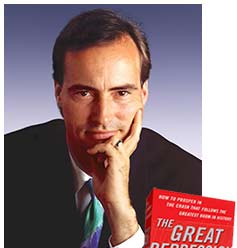
Harry Dent selling “The Great Depression Ahead”
I am exasperated. A client of mine just sent me Harry Dent’s latest book, The Great Depression Ahead, with a note. My client was absolutely convinced that the Dow will go down to 3,800, and he wanted me to do something to profit from this inevitability.
I don’t blame him. Dent is a brilliant man; he makes compelling arguments based on the demographic of aging baby boomers like my client, with just enough data and charts to make the book look authoritative. Couple that with a daily dose of bleak headlines:
Share this:

 Who are we? That’s the question many financial advisors have been asking themselves. I agree with Carl Richards when he says financial advisors have an identity crisis. Are we looking in the mirror each morning wondering who we are? Maybe not, but we do have a problem.
Let’s Confuse ‘Em
There are many so-called “financial advisors” that simply want to sell clients expensive products; and one of the ways to do that is to confuse the customer. Now, financial firms don’t actually have an official Customer Confusion Department, but they might as well have one. Case in point: We call ourselves “fee-only” advisors, hoping to differentiate from product pushers on commission; pretty soon, they re-brand themselves as “fee-based” advisors. How many people can actually tell the difference between a “fee-only” advisor and a “fee-based” one?
Share this:

and this will happen.

What will happen to your money if you hire a salesman as your financial advisor
Get informed about wealth building, sign up for The Investment Scientist newsletter
Share this:

“They are the cancer of the institutional investment world.” – David Swensen
 Would you consider forming a partnership with someone you don’t know, in which you would contribute the money and that someone would conduct a business that you don’t understand, and do the accounting as well?
Most business owners would respond with a resounding “No!” The reason is obvious: such an arrangement is the surest way to lose money.
Share this:

“Avoid conflicts of interest.” – David Swensen, Yale Endowment CIO.
Jose is the head of a ultra high-net-worth family. He has a number of accounts with Merrill Lynch (ML), the storied brokerage firm that paid their senior executives $4 billion in bonuses last year. Three of his accounts lost a great deal of money, not due to the market crash but to conflicts of interest.
Double dealing in Treasury
Jose has a Treasury account where his ML wealth manager![[picture of double dealing, enable image to view]](https://investment-fiduciary.com/wp-content/uploads/2009/02/financial-advisor.jpg?w=240&h=160) purchases Treasury bills, notes and bonds for him. Last year was a great year for Treasury securities – the market turmoil caused investors to flock to them, driving prices up more than 10%. Jose’s account, however, lost 3%. How could this happen? Conflicts of interest. ML is a primary dealer in the Treasury market. They buy Treasury securities and resell them to their customers at a markup. It looks like the markup is so high it takes away all the customer profit.
purchases Treasury bills, notes and bonds for him. Last year was a great year for Treasury securities – the market turmoil caused investors to flock to them, driving prices up more than 10%. Jose’s account, however, lost 3%. How could this happen? Conflicts of interest. ML is a primary dealer in the Treasury market. They buy Treasury securities and resell them to their customers at a markup. It looks like the markup is so high it takes away all the customer profit.
Churning stocks
Share this:

“Avoid the fee-ing frenzy,” says David Swensen. 
Marion banks at Wachovia. When she needs to rollover her 401(k) into an IRA account, she naturally asks a Wachovia financial advisor for help. He helps her open an account and recommends she buy the Evergreen Asset Allocation Fund (EAAFX). Is there anything wrong with this picture? Plenty!
First, the fund has a sales charge (front-end load) of 5.75%. Her 401(k) balance is $100,000. This means, the advisor takes $5,750 just for the act of opening the account for her.

 The Investment Scientist