Archive for the ‘Wealth Management’ Category
Beyond the S&P 500
Posted on: November 4, 2009
 If you are like most investors, your equity portfolio will have a few auspiciously named stock funds and a few company stocks you feel comfortable with. You think you are well-diversified, but you really are only investing in the universe of the S&P 500 – the largest 500 stocks of the US equity market.
Share this:

 Starting from tax year 2010, the Tax Reconciliation Act permits all taxpayers to make Roth IRA conversions, regardless of income level. Previously, taxpayers with a modified adjusted gross income of $100,000 (or more) were not permitted to make Roth IRA conversions.
With a stroke of the pen, many affluent Americans can increase their wealth by 10-20% in their lifetime. If circumstances are right, they may even double their wealth for their family.
Share this:

Why doctors don’t get rich
Posted on: April 17, 2009

Doctors need financial treatment
“Physicians have a significantly low propensity to accumulate substantial wealth.” – Thomas Stanley, author of The Millionaire Next Door
How come doctors fail to get rich? I’ve identified six reasons based on observations working with my physician clients.
A late start
By the time doctors finish medical school and residency, they’re typically in their middle or late thirties. Many have families to feed, and substantial student loans to pay off. It will be years before they can even start accumulating wealth.
Challenging environment
It is increasingly challenging to practice medicine. With the Medicare Trust Fund slated to go bust in 2019, the Center for Medicare and Medicare Service (CMS) is increasingly resorting to cutting physician reimbursements and implementing bundled payments.
Lifestyle expectations
Society expects a doctor to live like a doctor, dress like a doctor, and drive like a doctor. Meeting social expectations can be quite expensive.
Time and energy
Share this:

The financial crisis has sparked a debate about the Yale model, that it doesn’t work as advertised in the current market condition. Here is David Swensen‘s response in an interview with Seth Hettena, Special to ProPublica.
The first thing I’d say is it’s too short a time period over which to judge. If you want to have a fair assessment of any investment strategy, get through the crisis and then look back and see how things performed.
If you look back 10 years from June 30, 2008, Yale’s performance was 16.3 percent per annum. Bonds were 5 percent plus or minus, and stocks were 3 percent plus or minus. So what are you going to do? You’re going to give up that kind of performance to hold a lot of bonds to protect against the financial crisis? Where’s the alternative that performs so much better? 100 percent government bonds? Is that the alternative? Well, then what would have happened if you had held that the decade before? I don’t get it.
They’re not thinking about what happened the 10 years before and they’re not giving us time to get through this crisis and see how it plays out for the Yale model against a more traditional portfolio. That’s one of the really interesting things in these articles that have been critical of the Yale model and sometimes of me personally: Where’s the alternative? What’s the option? Yeah, the model fails. Well, relative to what?
Here is the source.
Get informed about wealth building, sign up for The Investment Scientist newsletter
Share this:

It was reported a few days ago that Merrill Lynch lost a staggering $15.3 billion in 2008. That did not prevent their senior executives to pay themselves $4 billion bonus. In the words of John Thain, CEO of Merrill Lynch, that’s what it takes to keep the talents.
Continue to read how to avoid hidden fees by the like of Merrill Lynch financial advisors.
Share this:
This is based on an interview David Swensen done on Fox News Network.

David Swensen
1. Have a strong decision-marking process
Investing success requires sticking with decisions made uncomfortable by the variance of opinions. In his own words:
Think carefully how it is that you are gonna allocate your assets and stick with it. Too many individuals were excited about the equity market 18 months ago and were despairing 3 months ago. It should have been the other way around. They should have been concerned about valuation 18 months ago and excited about the opportunity to put money to work at lower prices 3 months ago.
2. Sell mania-induced excess, buy despair-driven value
On his favorite area of despair-driven value, David Swensen has this to say:
I think the most interesting area is the credit market. Bank loans are trading at extraordinary low value. High-grade corporate debts, below investment grade corporate debts associated with companies that are gonna survive this are extraordinarily cheap. It’s not the only place to find value, but that would be the top of my list.
3. Make decision based on thorough analysis
Know where you belong …
There are two ends of the continuum in the investment market. You should be in one extreme or the other. There is no room for success in the middle. At one end of the spectrum, you get investors who committed resources to do high quality jobs in active management … At the other end of the continuum are purely passive investment vehicles – index funds. The vast majority of players are in the middle and the vast majority of players end up failing. Be at one end or the other and almost all investors belong to the passive end.
4. Watch out for the “fee-ing frenzy“
This one should be obvious but ignored by many investors.

Get my white paper: The Informed Investor: 5 Key Concepts for Financial Success.
Get informed about wealth building, sign up for The Investment Scientist newsletter
Share this:

Boston Globe: “Harvard’s endowment plunges $8 billion”
WSJ: “Harvard hit by loss as crisis spreads to college”
Harvard Crimson: “Yale losses a quarter of its endowment”
Edward Eptein in The Huffington Post argues in “How much has Harvard really lost?” that Harvard endowment loss could be a lot higher than disclosed.
Check out how Harvard and Yale endowments performed prior to this fiscal year here. Note their fiscal year ends in June 30th.
Get informed about wealth building, sign up for The Investment Scientist newsletter
Share this:
I wrote this article in early December 2008. Amazingly, it is one of the least read in my blog. Had someone read it and followed it, he would have earned 10% return so far in 2009.
– Michael Zhuang 3/10/2009
At the moment of writing this, SPY, the exchange traded fund (ETF) for the S&P 500 index, is trading at $85.95 and the near at-the-money call option (with strike 86 and only eight days until expiration) is trading at $3.45! (A call option is the right to buy the underlying stock at the strike price. At-the-money means the option strike price is equal to the price of the underlying stock.)
The at-the-money call premium is a full 4% of the underlying index price! Historically, that number has been in the 1% to 2% range.
What does 4% premium imply?
Share this:

This is the complete list of US dividend oriented ETFs.
| Symbol | Asset (mm) | Expense | Yield* | Name |
| DVY | 4782 | 0.40% | 4.67% | iShares DJ Select Dividend |
| VIG | 402 | 0.28% | 2.20% | Dividend Achievers Select |
| PFF | 308 | 0.48% | 11.21% | iShares S&P US Preferred Stock |
| DLN | 288 | 0.28% | 3.61% | WisdomTree LargeCap Dividend |
| SDY | 230 | 0.35% | 4.40% | SPDR S&P High Yield Dividend Aristocrats |
| DTN | 145 | 0.38% | 4.82% | WisdomTree Dividend 100 |
| PEY | 139 | 0.60% | 5.69% | Mergent Dividend Achievers 50 |
| FVD | 137 | 0.70% | 3.20% | First Trust Value Line Dividend |
| VYM | 120 | 0.25% | 3.72% | FTSE High Dividend Yield |
| DHS | 120 | 0.38% | 5.50% | WisdomTree High-Yielding Equity |
| DES | 80 | 0.38% | 4.73% | WisdomTree SmallCap Dividend |
| DTD | 80 | 0.28% | 3.71% | WisdomTree Dividend |
| DON | 78 | 0.38% | 4.31% | WisdomTree MidCap Dividend |
| PFM | 53 | 0.60% | 2.72% | PowerShares Dividend Achievers |
| CVY | 50 | 0.60% | 7.61% | Claymore Yield Hog |
| FDL | 45 | 0.45% | 5.52% | First Trust Morning Star Dividend |
| PHJ | 23 | 0.61% | 2.70% | PowerShares High Grow Rate Dividend Achievers |
| LVL | 7 | 0.60% | 11.21% | Claymore High Income |
* Yield information is according to Yahoo Finance as on 9/30/08.
The high-dividend-yield ETFs could come to the rescue of your retirement if we have a prolonged recession.
Need help with investment? Call 301-452-4220.
Sign up for The Investment Fiduciary monthly newsletter.
Share this:
Life insurance and annuity
Insurance companies who issue life insurance and annuity contracts are regulated by state insurance commissioners. The holders of life insurance and annuity contracts are protected by the state insurance guarantee fund up to some limits. While laws governing maximum limits and types of policies covered vary from state to state, most states set basic limits of:
- $300,000 in life insurance death benefits
- $100,000 in cash surrender or withdrawal value for life insurance
- $100,000 in withdrawal and cash values for annuities
- $100,000 in health insurance policy benefits
The National Organization of Life and Health Insurance Associations has more information.
Bank accounts
Bank accounts are insured by the Federal Deposit Insurance Corporation on a per depositor per type of account basis. Four types of accounts are eligible for FDIC insurance, the maximum dollar limit for each type being:
- Single ownership accounts – $100,000 per depositor. This is sum of all checking accounts, savings accounts, CDs, etc., owned by the depositor.
- Joint ownership accounts – $100,000 per depositor. Same as above.
- Certain retirement accounts – $250,000 per depositor. This is sum of all eligible retirement accounts, such as IRA and self-directed Keogh plans.
- Testamentary (revocable trust) account – $100,000 per beneficiary named for each account, with the amount held in the account being paid out to the beneficiary upon the depositor’s death, usually to one of the depositor’s children.
This site has a detailed explanation.
Brokerage accounts
In the event of brokerage failure, securities investors are protected by the Securities Investor Protection Corporation (SIPC) up to $500,000 per account type, of which $100,000 can be cash. SIPC insurance does not insure investors against the loss of value of securities in the account. SIPC just had a press release about the safety of brokerage accounts.
Get informed about wealth building, sign up for The Investment Scientist newsletter
Share this:
Bear market: how long will it last?
Posted on: July 30, 2008
It’s official. On July 9, US stocks slid more than 20% from their October high, sending the S&P 500 into bear market territory. Even earlier this month the NASDQ and Dow Jones turned bearish following the Russell 2000, an index of small caps, which lead the decline.
How long will this bear market last?
Well, I don’t have a crystal ball, but I do have a rear view mirror.
Since 1960, there have been ten bear markets (see Table). The worst bear market took one-and-a-half years to reach bottom. Four reached bottom within a month. The remaining five hit bottom between one and ten months. On average, it took 4 months to reach bottom.
| Date of entering bear market | Months to bear bottom | 1 year return from entry | 3 year return from entry |
| 2/26/2001 | 19 months | -11% | -8% |
| 10/8/1998 | < 1 months | 38% | 12% |
| 10/17/1990 | < 1 months | 33% | 59% |
| 10/19/1987 | 2 months | 3% | 13% |
| 3/1/1982 | 5 months | 34% | 63% |
| 3/6/1978 | < 1 months | 13% | 49% |
| 12/10/1973 | 10 months | -32% | 9% |
| 1/26/1970 | 4 months | 10% | 35% |
| 10/3/1966 | < 1 months | 28% | 24% |
| 5/28/1962 | 1 month | 20% | 51% |
| Average | 4 months | 14% | 31% |
Data source: Moneycentral.com
Now that we are in a bear market, shall we move to cash?
I don’t recommend it. Here’s why. From the day the S&P 500 entered a bear market, on average it returned 14% in one year and 31% in three years.
Let’s look at the distribution of returns. This is important. Among the ten one-year returns, two were negative, yet three were over 30%. As for the three-year returns, only one was negative but three were over 50%!
I don’t know about you, but I like those odds.
Get informed about wealth building, sign up for The Investment Scientist newsletter
Share this:
Retirement Investment Bookmarks
Posted on: June 11, 2008
Why is oil closing on $138? James Hamilton has an answer.
William Engdahl argues “60% of today’s oil price is pure speculation“.
J.D. of Get Rich Slowly explains why it pays to ignore financial news.
Newsweek has a piece on the Great Leap Downward of Chines stocks. Did I tell you this last year?
Get informed about wealth building, sign up for The Investment Scientist newsletter
Share this:
Retirement investment bookmarks
Posted on: April 17, 2008
Richard Conniff of MSN Money wrote about “How fear can make you lose millions.”
Blind trust in pundits could wipe you out as well. Alice Gomstyn of ABC News asked “Should you stay away from Jim Cramer?” (My answer is yes.)
Bob Klosterman explained life insurance in wealth management.
Greg Mankiw examined Barrack Obama’s tax return, he found Obama is not a fan of retirement saving.
Get informed about wealth building, sign up for The Investment Scientist newsletter
Share this:
Retirement investment bookmarks
Posted on: March 2, 2008
Janice Revell of Money Magazine makes a good case that inflation is more of a threat to your retirement than a recession.
Bob Klosterman asks if you are undermining your financial independence by overly risk-averse.
James Hamilton writes scholarly about predicting recession and stagflation.
Talking about inflation, we can’t ignore China’s role. Ebn Esterhuizen has an essay on that.
Get informed about wealth building, sign up for The Investment Scientist newsletter
Share this:
During this correction, the Russell 2000 Value Index tumbled 16.88% based on intra-day data. Comparatively, the peak-to-trough draw-down for the Russell 2000 Growth Index is 12.97%, for Nasdaq 100 12.38% and for S&P 500 11.91%.
This is quite usual! There are a few well-established effects in the stock market. Among them are the Small Cap Premium Effect and the Value Premium Effect. In plain English, small cap stocks outperform large cap stocks, and value stocks outperform growth stocks, in aggregate and over the long run. In the case of the Value Premium Effect, this is not due to risk. Lekonishok, Shleifer and Vishny in one of their researches, investigated how different types of stocks performed during the 25 worst months over the last 30 years. They found overall, value stocks held their value better than growth stocks. During this correction however, this pattern was broken. Why small cap value stocks fell so much, even more than small cap growth stocks? Is it an aberration? or does it portend something new academic researchers have not yet discovered?
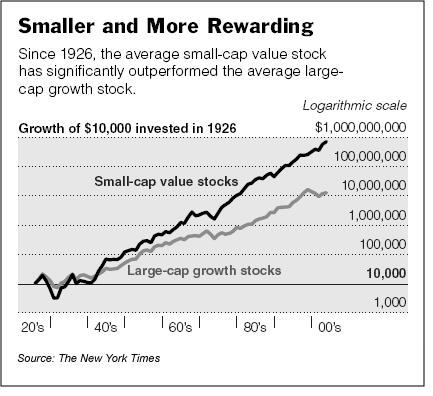
I believe there are two reasons to small cap stocks falling more in this correction: exposure to financial sector and hedge fund liquidation.
This correction started with the news that two Bear Sterns hedge funds investing in CDOs (Collateralized Debt Obligations) and CMOs (Collateralized Mortgage Obligations) suffered severe losses and had to shutdown. That sudden event helped focus the market’s attention on that fact that subprime mortgage delinquency has jumped more than 100% in the past year. The market decided to punish all financial stocks, regardless of their subprime exposure. The value sector is over-weighted with financial stocks, mostly small community banks. For instance, 30% of the Russell 2000 Value Index made up of financial stocks. As the result, the Russell 2000 Value Index fell more than the Russell 2000 Growth Index.
The news that three BNP Paribus hedge funds also had to shutdown must have caused a run in hedge fund money that persist to this day. Overnight, Nikkei dropped more than 5% and in the previous night the South Korean Kospi dropped 7%. They do not have any subprime exposure, why punish them? Alas, hedge funds are unwinding their positions everywhere.
The run in hedge funds hit a specific type of funds called quantitative funds as well. The two Goldman hedge funds who got a $3 billion dollar bailout from Goldman Sachs belong to this type. They use long-short strategies to capture the Small Cap Premium Effect and the Value Premium Effect. The long portfolios tend be small cap and value stocks and the short portfolios tend to be large cap and growth stocks. According to a Wall Street Journal report, the two Goldman hedge funds are leveraged up to 6x. Goldman’s Global Equity Opportunities Fund had $5 billion in capital, with 6x leverage, they had $30 billion to play with. To unwind their positions, they were forced to sell their longs and buy back their shorts. With billions of dollar of selling from Goldman’s hedge funds alone, and unknown billions from other quantitative hedge funds, small cap value stocks were hit very hard.
I believe the effect of this sequence of events is transitory and small cap value investing remains fundamentally sound.
Get informed about wealth building, sign up for The Investment Scientist newsletter
Share this:

How to Set Effective Stops?
Posted on: June 24, 2007
The title is a question posted to me, the following is my answer.
I don’t use stops, there is not any evidence that there are effective stops. (By evidence I mean rigorous and peer reviewed academic research.) To protect against downside risks, I use an “ex ante stop”. OK, this is a term I make up on the fly. What I mean is that I only invest in stocks with P/B less than 1.3 where P is the market value of the stock and B is the book or accounting value of the stock. Presumably, the market value of a stock can not fall below its book value in equilibrium. (It does not work that way all the times, but it works most of the time.) By investing in these type of stocks, I limit my potential losses to less than 25%. Comparatively, S&P 500 stocks have an average P/B of 4.7, which means the average stock price needs to fall over 75% before reaching the average book value. Nasdaq stocks have an even higher average P/B of 8.6. In summary, investing in low P/B stocks is a much more effect way (with a mountain of academic research to back up) to limit downside risks.
Get informed about wealth building, sign up for The Investment Scientist newsletter
 The Investment Scientist