
In the last two days I have been doing tax loss harvesting for my clients.
According to Google,
Tax loss harvesting is the practice of selling a security that has experienced a loss. By realizing, or “harvesting” a loss, investors are able to offset taxes on both gains and income. The sold security is replaced by a similar one, maintaining the optimal asset allocation and expected returns.
That sounds simple enough, but actually I learned a few things doing tax loss harvest. 1) You can make money and still claim a tax loss. 2) The difference between TTM Yield vs 30 Day SEC Yield and how to use them to select a bond fund.
Take one high net worth client for example, he has about $500k of DWFIX, an international bond fund. I sold that to realize a $31k loss that he can use for tax deductions. But during the three years that the position was in his portfolio, it generated more than $100k in incomes. So he makes money in this position but still gets to claim a tax loss. How nice!
Share this:

 Stocks Decline 14% (June 1950 to July 1950) North Korean troops attack along the South Korean border. The U.N. Security Council condemns North Korea. The U.S. gets involved.
 - Stocks Decline 20.7%, (July 1957 to October 1957) The Suez Canal crisis manifests itself, the Soviets launch Sputnik and the U.S. slips into recession.
- Stocks Decline 26.4% (January 1962 to June 1962) Stocks plunge after a decade of solid economic growth and market boom, the first “bubble” environment since 1929.
- Stocks Decline 22.2% (February 1966 to October 1966) The Vietnam War and Great Society social programs push government spending up 45% in five years. Inflation takes off.
- Stocks Decline 36.1 % (November 1968 to May 1970) Inflation really starts to pick up, hitting 6.2% in 1969 up from an average of 1.6% over the previous eight years. Vietnam War escalates. Interest rates surge; 10-year Treasury rates rise from 4.7% to nearly 8%.
- Stocks Decline 48% (April 1973 to October 1974) Inflation breaks double-digits for the first time in three decades. There is the start of a deep recession; unemployment hits 9%.
- Stocks Decline 19.4% (September 1976 to March 1978) The economy stagnates. High inflation. Adjusted for inflation, corporate profits haven’t grown for eight years.
- Stocks Decline 17.1% (February 1980 to March 1980) Interest rates approach 20%, the Read the rest of this entry »
Share this:

Quarterly Market Review
Posted on: November 18, 2015

As a recap of interesting developments in 2015-Q3 we offer the downloadable link below.
- Equities – US, International, Emerging and REIT Markets were down
- Fixed Income – US and Global Markets were up
- The ‘Best’ Stock Market was Ireland at -1.12%
- The ‘Worst’ Stock Market was Brazil at -33.06%
- Commodities were universally weak with Crude Oil turning in the worst performance at -27.39%
Share this:

 [by Russ Thornton] When sharing the initial results of my survey last week, there was a high level of interest in the topic of Social Security.
And here we are, just a week later, with a couple of significant Social Security changes included in Section 831 of the recent budget approved by the House and expected to be approved by the Senate.
These are changes that could cost some of you tens of thousands of dollars in lifetime Social Security benefits.
First, a little history . . .
Back in 2000, a law was passed that included a provision allowing you to apply for Social Security benefits and then voluntarily suspend those same benefits. While adding to the already complex choices involved with Social Security benefit elections, this law unintentionally allowed some couples to “double dip” from their Social Security benefits. Read the rest of this entry »
Share this:

 For those who are hard core about learning personal finance, I have this to share with you – Jim Ludwick’s Tweets for the Month. Jim is a hourly fee-only financial planner I respect a lot. His tweets cover a wide range of issues
- Is Wall Street Eating Your 401k Nest Egg?: PBS story: https://t.co/bpRIQVm8Um@asergunina #GarrettMember @SemperFrugalis8:34AM
- Is this a better way to manage your cash? Give a look to this new strategy:https://t.co/kh0t33E0RG @sergunina #GarrettMember4:11AM
- RT @SquaredAwayBC: Gulp. Average costs for dementia care $287,038- far exceeding cancer, study finds https://t.co/B0hmvCbN733:59AM
- Why you should file the college aid FAFSA no matter how rich you are:https://t.co/DVECFK2ceh @asergunina #GarrettMember3:58AM
- 7 scams that might affect you: https://t.co/biOGBqLSzK3:51AM
- RT @ASergunina: RT @Forbes: If your employer offers a Roth 401(k), consider it, especially if you’re on the younger side: https://t.co/pxTt…3:48AM
- Advantages of working with a remote financial advisor. My latest blog:http://t.co/v6GHi7od4i #GarrettMember @ASergunina @SemperFrugalis6:51AM
- @united typical: canx; 14 hrs later delayed; arrive early sit on tarmac; now late; connect Read the rest of this entry »
Share this:

When Accident Happens …
Posted on: October 13, 2015
A few months ago, a senior client of mine slipped and fell in his basement. He broke his hip and couldn’t get up to call help. He was only found lying in the basement by his tenant two days later.
His life was saved, but he is permanently wheelchair bound and he will need nursing care that costs over $150k per year. This expense alone will run down his personal wealth in a matter of a few years.
As his financial advisor, what could I have done for him?
Three years ago when he was just retired from work, he approached me for retirement planning. Upon hearing that he was living by himself and his children were far way, I was adamantthat he bought long-term care insurance. It was costly, over $500 per month in premium. He was very reluctant to “waste” money on insurance, but I was adamant.
For seniors, a major cause for the need of long-term care is slip and fall at home. I was even trying to talk him into selling his townhouse that has two flights of stairs. That was a long shot, but about buying long-term care insurance, I just would not relent. Read the rest of this entry »
Share this:

For those who are hard core about learning personal finance, I have this to share with you – Jim Ludwick’s Tweets for the Month. Jim is a hourly fee-only financial planner I respect a lot. His tweets cover a wide range of issues…
- Calculate your life insurance needs (capital analysis) on this website:http://t.co/FepufsO9wf #GarrettM
 ember @ASergunina @TheEdsonMiller8:09AM
 - Rating the rater: @Ritholtz writes about Morningstar’s 401k company options and how they could do better: http://t.co/ZrKxZBSZDY @ASergunina3:39PM
- NFL player makes millions, lives on $60,000 a year RT @MarketWatchPF:http://t.co/X6ld4FF7fr @ASergunina @TheEdsonMiller @LauraScharr4:47PM
- Most popular tweet this year? Tennant screening guide for landlords fromhttp://t.co/R0e8aiZGoH: http://t.co/jmq4ELCJiK @YuriSergunin4:35PM
- Equity Indexed Annuities or Fixed Index Annuities earn regulator alert:https://t.co/rT3GviYndA @ASergunina @TheEdsonMiller5:04AM Read the rest of this entry »
Share this:

Long-Term Care Costs
Posted on: September 30, 2015

[by Russ Thornton] At some point, 70% of people over the age of 65 will need some form of long-term care and support.
I get a lot of questions from clients about long-term care insurance.
Yet, I find many people are more willing to discuss their estate planning (and their mortality) than the possibility of finding themselves in a situation calling for long-term care.
Typical objections to insurance for long-term care include:
- It’s too expensive,
- My kids/spouse/family will take care of me,
- I’ll pay for it myself out of my savings and investments,
- or something else.
And let me mention the fact that I don’t sell long-term care or any other type of insurance, so I’m not sharing this information to motivate you to buy something from me.
In fact, long-term care insurance isn’t necessary for many, despite many insurance companies’ and agents’ best attempts to use fear-based tactics to sell you policies. Read the rest of this entry »
Share this:

 As of today, all three market indices Dow Jones, Nasdaq and the S&P 500 are in correction territory, meaning they’ve all fallen more than 10%. Last time this happened was in 2011. Then I wrote an article “How Often Does Market Correction Happen?” to calm the nerve of my clients and readers.
The key insight from that article is this. A 10% correction happened every other year in history, so you shouldn’t be surprised by it, nor should you be panic. In particular, this 10% correction is kinda over-due since that last one was 4 years ago.
In addition, don’t be surprised by a 20% correction over the next month and a half. The last time we had a 20% correction was in 2009. That was 6 years ago. In history, a 20% correction happened every other five years, give and take.
Share this:

Two days ago, Greek voters said “No” to the term of EU bailout in a national referendum. Yesterday, the Shanghai Stock Index fell another 5.9%. Cumulatively, the index has fallen 30+% since reaching its peak in June 12. Which of these two events will likely be the black swan that rocks the US market.
I don’t think it will be Greece. The Greek economy is a mere 1.7% of the total EU. It’s basically a rounding error. When the first act of this Greek drama was played in 2011, the US market promptly dropped 19%. That was a wealth destruction ten times the size of the entire Greek economy. This just shows the fear of a disaster can be much worse than than disaster itself. Now that we are in the third act of this Greek drama, global markets are more or less immune to it.
China is an entirely different matter, and it has a potential to become a black swan … Read the rest of this entry »
Share this:

Teaching My Kids About Money
Posted on: July 3, 2015
If you are a client of mine, you would have received a snail mail newsletter from me about two weeks ago that does not look quite right: The letter may look like it was folded clumsily, there might even be some water stains on the letter, the stamp may not be placed squarely on the upper left corner of the envelop. I let these unprofessional newsletters go out, because they were stuffed by my two sons: one six year old, the other mere three.
I want to teach them a lesson about money, so I promised I would pay them once they get the job done. The two boys were super excited since this was the first time they made money. The older one listened very intently as I instructed him what do. What impressed me is that he then created a work process and splited the tasks between himself and his younger brother. He also made himself a little manager by making sure the younger brother follow his process.

After the job was done, I gave the older one a $5 bill and younger one a $1 bill. The older one immediately tried to figure how long it would take for him to afford his own iPad. The younger one apparently did not know the difference between $5 and $1 and he was just happy he was getting as much as his older brother.
Share this:
What If the Market Falls 30%?
Posted on: June 19, 2015
Ever since it touched bottom on March 9th, 2009, the market has been going up and up and up with barely any hiccup. That’s dangerous! Because our minds could get complacent. That’s why I want to do a mental exercise with all of you: What would you do if the market fall 30%?
First of all, recognize these two important facts:
- Market fall of 30% and above happened every ten years or so. If we use history as a guide, we should expect a 10% odds of that happening over the next 12 months. (So don’t be surprised.)
- All market tumbles of that magnitude were recovered within 18 months in the US. (So don’t despair.) Read the rest of this entry »
Share this:

Six Costly Investment Behavior
Posted on: June 1, 2015
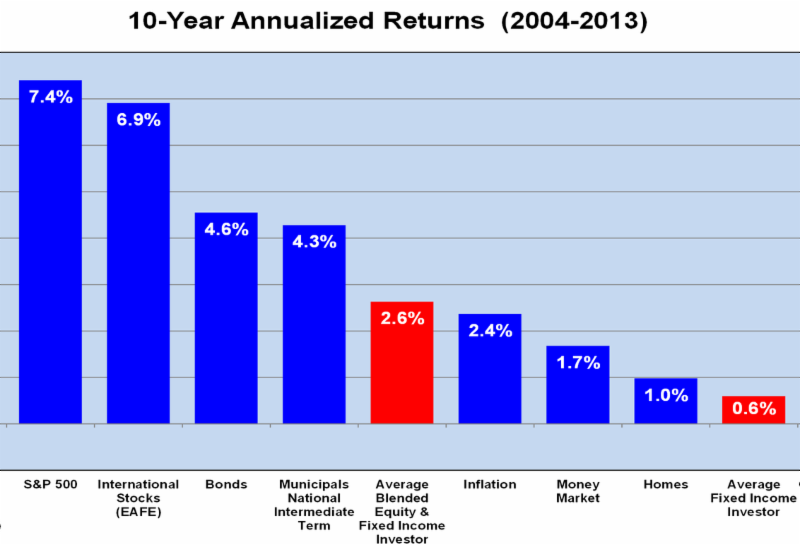
Most investors are very good at hurting themselves financially. According to latest release of Dalbar’s Quantitative Analysis of Investor Behavior (QAIB), the average investor has a return of only 2.6% over the last ten years. That’s pathetic compared to what the markets gave. See the chart below, over the same period, the S&P 500 gave an annualized return of 7.4% and the bond market gave 4.6%.
Share this:

Jim Ludwick’s Tweets for the Month
Posted on: May 1, 2015
 For those who are hard core about learning personal finance, I have this to share with you – Jim Ludwick’s Tweets for the Month. Jim is a hourly fee-only financial planner I respect a lot. His tweets cover a wide range of issues …
- Things people in the Finance business don’t want you to know from @awealthofcs: http://t.co/xptc6UzSs011:40AM
- Tax season is over but we’re still working for Uncle Sam say Dan Caplinger via @TheMotleyFool: http://t.co/FyttD7jHhy6:45AM
- @Dull_Investing compiles list of 10 financial tips for kids from top experts and himself via @AARP: http://t.co/WQiZFMY4gQ11:40AM
- @RickFerri argues that ETFs are not the total solution to passive investing in his latest blog: http://t.co/x9R91M5kcr8:34AM
Share this:

Why I do what I do …
Posted on: April 22, 2015
Recently I have a new client. As part of the onboarding process, I examined her old portfolio and found something I don’t recognize:
| Cusip | Symbol | Description | Return |
| 25190A104 | N/A | Deutsche Bk AG London BRH Ret Opt Secs Lkd Ishare MSCI Mexico Capped | -21.15% |
| 25190A203 | N/A | Deutsche Bk AG London BRH Ret Opt Secs Lkd Ishare Euro STOXX 50 Idx | -26.60% |
| 90273L815 | N/A | USB AG London BRH Notes Five 15 | -22.30% |
What they have in common is they don’t have a symbol, meaning they are not publicly traded securities, they have weird descriptions and they all lost a lot of money.

