Six years after the collapse of the stock market, I must say I begin to see signs that people are forgetting the lesson:
- Some of my clients are pressuring me to increase allocation to stocks.
- The US stock market has done better than others, and some of my clients are questioning why bother with global diversification.
- I have seen portfolios (not managed by me of course) where 90% of money is allocated to US growth stocks.
Recently, Independence Advisor, LLC produces a fabulous video explaining the behavior of investment returns. It’s only five minutes long. Whether you are my clients or not, please watch it in its entirety, then you will understand why I always act as a dampener of emotions. Whether it’s fear or enthusiasm, I would always counsel not to get carried away.
If you want to find out how I can help you, schedule a Discovery review with me. If you are not ready, you can still get my white paper for free: The Informed Investor: 5 Key Concepts for Financial Success.
Get informed about wealth building, sign up for The Investment Scientist newsletter
Share this:


Remember When Everybody Wants to Be in Gold?
At the turn of the year, a few clients asked me a very good question: “Why my portfolio is not doing as well as the S&P 500 index? Shouldn’t we invest more in US stocks?”
The answer is very simple, US equity is only one component of the portfolio, it happened to do the best last year. The best component of the portfolio will always do better than the whole portfolio. That does not mean we should not diversify.
In fact, I got similar questions every year. Four years ago, it was like “Why didn’t we invest more in emerging markets? there’s no way the US market will do better than emerging markets.” Two years ago, it was like “Why shouldn’t we put everything in gold? all of my friends are investing in gold.”
Share this:

When Tragedy Strikes
Posted on: January 3, 2015
 A few weeks ago, I got a call from a client of mine. She told me with great sadness in her voice that her husband just passed away unexpectedly.
Without much thought to my schedule, I told her I would visit her on Friday, a mere three days away. During the next two days, I moved my appointments around to clear up a whole day, and then I booked a round trip ticket and a rental car.
On Friday, I set out early on the trip and got to her place by noon. When I met her, I saw a middle-aged woman in deep grief and distress. I couldn’t help but give her a big hug, and she wept on my shoulder for a while.
Share this:

Year End Moves for Tax Savings
Posted on: December 4, 2014
 As 2014 draws to a close, my wife and I have sprung into action to save on our 2014 taxes. Here are a few things we do. We are no CPAs, so what we do is pretty easy to mimic.
Donate all the garbage. I couldn’t believe how many items in my household we literally didn’t touch, not even once, in the whole of 2014. Things like that are immediate candidates for donation. Things that fall into this category could be electronics, furniture, books, clothes, kitchenware, bedroom sets, used toothbrushes, etc. Ok, maybe not used toothbrushes, but just about anything you don’t use, you can find a better home for, and get a tax deduction for doing so. In some years, we’ve gotten $10,000 worth of deductions. Read the rest of this entry »
Share this:

 Recently, a doctor nearing retirement age approached me with the question of how to maximize his social security income. He is 62, and his wife is 4 years his junior. He made substantially more money than his wife, and as a result, his PIA is $2400, and his wife’s PIA is only $1000.
PIA, or primary insured amount, is the monthly amount a retiree would get if he or she retires at the normal retirement age, currently 66. For every year earlier (or later) that one retires, one would get 8% less (or more). The youngest one may retire is 62 and the oldest is 70.
I’ve found over the years that many people give very little thought to maximizing their social security income, and they jump at the first opportunity when they turn 62 to claim their benefits. But in so doing, they could be leaving nearly half a million dollars on the table. Read the rest of this entry »
Share this:

I asked my assistant to do an updated stock market seasonality study.
The data we used was the S&P 500 index from 1927 which we found in Nobel Prize winner Robert Shiller’s database.
We assumed that at the beginning of each year we invested $1 in the index, and we observed how the investment fluctuated over the year. Then we took the average over three different periods of time: the last 20 years, the last 50 years, and the last 86 years.
Here is the chart we got: Read the rest of this entry »
Share this:

Life Lessons From Improv
Posted on: September 10, 2014
 Some of you may have already known that my hobby is improv comedy. Here is what happens during a performance. I go on stage with my fellow actors, we ask for a suggestion from the audience, and then we create a comedy play from scratch using that suggestion.
It just so turns out that many lessons I learn in improv are totally applicable to real life. Since after all, life is a just a big improv show. Nobody wakes up with a script in hand for how to live the day.
So allow me to summarize the top three lessons I’ve learned.
- First things first; be a great listener.
Share this:

Is A Market Crash Imminent?
Posted on: July 30, 2014
 Yesterday I received an email from a doctor client of mine telling me how he had a conversation with some fellow doctors, and all of them are pulling their money out of stocks because they feel that with the market breaking new high after new high, a crash is imminent. He wanted my opinion.
First of all, while all of his doctor friends might feel a market crash is imminent and certain, there is simply no such thing as certainty in the stock market. All we can work with are odds. The following are the odds of market corrections:
| Magnitude of market decline | Frequency of occurrence (out of 64 years from 1950-2013) |
| >5% | Every year (94%) |
| >10% | Every two years (58%) |
| >20% | Every five years (20%) |
| >30% | Every ten years (10%) |
| >40% | Every fifty years (2%) |
My study also shows that the market breaking a new high does not substantially change the odds of returns. In other words, the odds of the market dropping over 20% in the next twelve months are still about one in five; the odds of the market dropping over 30% in the next twelve months are still about one in ten.
Read the rest of this entry »
Share this:

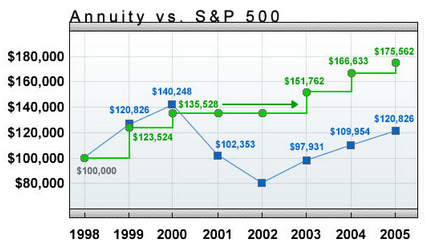
Typical Salesman’s Chart for EIA
Financial author Allan Roth once wrote an article called “Investment Trick – Annuity Style” where he asks a rhetorical question, “If the S&P 500’s total return is 12% in a given year, what do you think your equity index annuity (that is supposed to track the S&P 500) would return”?
- 10%
- 8%
- 5.4%
- 3.4%
Allan Roth goes on to explain why the correct answer is 3.4%. Boy, was he wrong! Read the rest of this entry »
Share this:

 A client of mine bought a fixed rate annuity a few years ago. She was told by the agent that it’s just like a savings account, only with a higher interest rate of 3%.
Recently, we took the money out in favor of a better investment, and boy was she in for a shock! There was a $17k surrender charge and nearly $3.6k in tax withholdings. All the interest she supposedly earned in the annuity went to the surrender charges, and now she has to pay income taxes on that interest!
Here is why a fixed rate annuity is nothing like a savings account.
1. A savings account is FDIC guaranteed, in other words, it has the full faith and credit of the US government behind it. A fixed rate annuity is NOT FDIC guaranteed, it only has the credit of the issuing company behind it. Think AIG! Read the rest of this entry »
Share this:

 Many people keep their bad annuity investment because it imposes a stiff surrender charge. This is a stereotypical example of sunk cost fallacy, an academic term which describes people throwing good money after bad.
Why surrender charges are sunk costs?
Imagine you were sold a $100k variable annuity with a ten year surrender period. The agent who sold you the contract collected a 10% commission, or $10,000. Where do you think this money came from?
Bingo! Your pocket. I hate to break it to you, but insurance companies are not in the charity business and they sure as heck aren’t gonna tell you that 10 of the 100Gs you just handed over to them are going to pay the agent’s commission! If they did that you’d pull your money out and rightly avoid them like the plague in the future.
Share this:

Variable Annuity: Bad Investment!
Posted on: June 5, 2014
 Recently I was approached by two prospective clients. The husband is a very successful entrepreneur and they are also very frugal. As the result of that, they have accumulated substantial wealth – north of $5mm.
The only problem? all of that money is in about 28 variable annuities they purchased over the years. In examining these variable annuities, I turned up the following problems:
1. Horrible returns
For each variable annuity, I was able to calculate its annualized return.
Out of the 28 variable annuities, only two have annualized returns above 4%. Seven have annualized returns between 3% and 4%. Six have annualized returns between 2% and 3%. The rest (13 of them) have returns less than 2% including a few that have negative returns. The average annualized return? 2.12%. Not enough to beat inflation!
2. Horrible surrender charges
There is this one annuity they purchased from Jackson National Life in 2007 for $200k; today it has grown to a “value” of $245k, but if they should cash it out, they would only get $221k since there is a surrender charge of $24k. After seven years, there is still a surrender charge of 12%! This is just horrible! Read the rest of this entry »
Share this:

On March 19th of this year, the Maryland legislature approved a bill that would raise Maryland’s current state estate tax exemption from its current $1 million leve. The Maryland legislation, which is expected to be signed shortly by Governor Martin O’Malley but as of today it is still awaiting his signature would eventually raise the Maryland state exemption level to the federal estate exemption level.
Currently, assets forming part of a Marylander’s estate upon his or her death in excess of the $1 million threshold would be subject to astate-imposed estate tax this year. Unlike the 2014, federal estate tax exemption amount of $5.34 million. The Maryland legislation provides for the estate tax threshold to continue to rise until it is aligned with the federal estate tax exemption in the year 2019. In 2015, the threshold will be $1.5 million; in 2016, $2 million; in 2017, $3 million; in 2018, 4 million; and finally, in 2019, an amount equal to the federal threshold (which is projected to be $5.9 million in that year once it is adjusted for inflation).
Share this:
I met a couple today (who could become my clients.) The husband is a medical specialist who has been making close to $1mm a year, the wife is a psychologist who was making peanuts. They are both retired now and planning to claim social security incomes.
To maximize their incomes, there is a little-know “File and Suspend” strategy they can use. Here is the gist of it according to Kipinger.
Say you are the higher earner and want to delay until 70. If your wife is 62 or older, she could collect her own benefit — but perhaps she’d get more money with a spousal benefit. One catch: She can’t collect a spousal benefit until you file for your own.
As long as you’re full retirement age, you file for your benefit and your wife applies for a spousal benefit. You ask Social Security to suspend your benefits. Your wife will still receive a spousal benefit, and you can continue to accrue delayed retirement credits until you reapply for benefits, presumably at age 70. Because you’re increasing the value of the survivor benefit, this “file and suspend” maneuver supercharges the survivor benefit for your wife if you die first.
Get informed about wealth building, sign up for The Investment Scientist newsletter
Share this:
Special Need Planning
Posted on: April 7, 2014

Special Need Planning
[A client of mine has two special need kids, so I know how important it is. This is an article I got from a estate planning attorney James Braswell.]
Understanding the pitfalls associated with special needs planning is a must for all who assist families with children, grandchildren or other loved ones (such as parents) with special needs.
Keep in mind these nine tips for Special Needs Planning:
Tip #1: Don’t disinherit your special needs child. Many disabled persons receive Supplemental Security Income (“SSI”), Medicaid or other government benefits that provide basic food, shelter and/or medical care. The loved ones of the special needs beneficiaries may have been advised to disinherit them – beneficiaries who need their help most – to protect the public benefits. But these benefits rarely provide more than basic needs. And this solution (which normally involves leaving the inheritance to another sibling) does not allow loved ones to help their special needs beneficiaries after they themselves become incapacitated or die. The best solution is for loved ones to create a special needs trust to hold the inheritance of a special needs beneficiary. A properly drafted special needs trust will protect public benefits a disabled beneficiary may be receiving, and it will provide for proper care of that individual throughout their lifetime.
Share this:

Investors Good At Hurting Themselves: Investor Returns vs Investment Returns
Posted on: March 18, 2014

Like to hurt yourself?
In 2009, Morningstar did a study comparing mutual fund returns vs investor returns. Here is what they got:
| Fund Category | Fund Return | Investor Return | Investor Lag |
| Large-Cap Blend | -1.4% | -5.7% | -4.3% |
| Large-Cap Growth | -1.7% | -7.7% | -6.0% |
| Large-Cap Value | -1.8% | -2.2% | -0.4% |
| Mid-Cap Blend | 0.4% | -3.0% | -3.4% |
| Small-Cap Blend | -0.5% | -6.9% | -6.4% |
| Europe/Pacific | 3.1% | 0.5% | -2.6% |
| Emerging Markets | 15.6% | 3.8% | -11.8% |
| Financials | -10.5% | -28.6% | -17.9% |
| Health Care | -1.3% | -3.1% | -1.8% |
| Communications | 1.9% | -3.7% | -5.7% |
| Energy | 8.6% | 4.0% | -4.6% |
| REITs | -2.5% | -11.8% | -9.3% |
| Technology | -2.6% | -8.3% | -5.7% |
| Utilities | 5.5% | 2.1% | -3.4% |
| Total and Simple Averages | 1.0% | -3.5% | -4.5% |
Source: Morningstar
We can make a few observations about these data:


