Author Archive
Suze Orman Talk Money at Google
Posted on: March 30, 2011
My friend DIY Investor found this pearl. I thought it contains incredibly good advice for young investors.
I personally had a few encounters with Google employees (to do their financial review.) In the end, I had to tell them they are fine on their own, they don’t need my help by and large. This is owing to three factors:
- Google provides strong continuous education on money, like this Suze Orman talk.
- They have a vibrant discussion forum about money inside Google.
- Their 401k plan is with Vanguard.
About Suze Orman, her show is the only show on CNBC that actually gives good information. Enough said. Enjoy the talk!
Get informed about wealth building, sign up for The Investment Scientist newsletter
Share this:

Small Cap Value: Risk and Returns
Posted on: March 29, 2011
If you invested $1 in the small cap value index at the beginning of 1927, you would have had $52,892 by the end of 2010. This is according to the recently published Dimensional Fund Advisors’ annual Matrix Book. Included in the book are historical risk and returns of various indices based on capitalization and book-to-market valuation.
Table 1 presents a summary of historical returns. The best returns are marked in green; the worst, marked in red. As one can see, the small cap value index is the best for all the periods considered. And it is the best by a huge margin.
Share this:
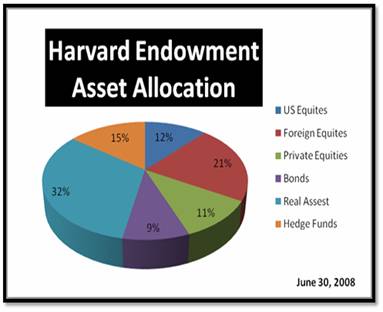 Recently I asked my assistant John to pull up Harvard Endowment’s 13F filing for Q4 of 2010 and compare it to that for Q4 of 2009 (shown in table below).
Apparently, Harvard Endowment’s year-end position in 2010 had changed significantly from that of 2009. The way I see it, there are three significant changes:
1. At the end of 2009, Harvard Endowment was extremely bullish on emerging markets; the top 10 positions were emerging market positions. That number was reduced to 5 at the end of 2010. On top of that, the size of each emerging market position has been reduced. Take China for example; the value of shares of FXI was reduced from 365k to 203k.
Share this:

I must confess: I have fallen short of the standards and requirements to become one of America’s Best Financial Advisors. To be exact, I am $497 short.
In March of last year, I received an email with a congratulatory title: “You Have Been Nominated To Be One of America’s Top Advisors.” I eagerly opened the email. It read:
You have been nominated to be listed on the most Exclusive List of Financial Advisors in America….We would love to have you as a member of this exclusive club and I have attached additional information regarding how our unique marketing model works. We will be advertising the list of Top Advisors in the Wall Street Journal next week so I would like to get you included before the deadline on Monday.
Share this:
The Consequence of Random Kindness
Posted on: March 23, 2011
- In: Charitable
- 4 Comments
This is a story sent to me by a client. It’s about how we live our lives, which I think is more important than how we make our investments.
 His name was Fleming, and he was a poor Scottish farmer. One day, while trying to make a living for his family, he heard a cry for help coming from a nearby bog. He dropped his tools and ran to the bog.
There, mired to his waist in black muck, was a terrified boy, screaming and struggling to free himself. Farmer Fleming saved the lad from what could have been a slow and terrifying death
The next day, a fancy carriage pulled up to the Scotsman’s sparse surroundings. An elegantly dressed nobleman stepped out and introduced himself as the father of the boy Farmer Fleming had saved.
Share this:

The 2011 Estate Tax Changes
Posted on: March 21, 2011
[Guest Post by Christopher Guest] I guess I was slightly off on my prediction on what the 2011 estate tax environment would look like. On December 17, 2010, President Obama signed the Tax Relief, Unemployment Insurance Reauthorization, and Job Creation Act of 2010, or TRUIRJCA, but I will call it the “tax compromise.” One thing I will discuss is that this estate tax regime only exists for 2011 and 2012 and the “old” 2011 rules that had many people indecisive in 2009 and 2010 returns in 2013.
Exemption Level and Rate
Share this:

Invest in a Variable Annuity
Recently, a client of mine brought me the variable annuity he bought a few years ago.
Prominently displayed on the first page are the benefits of the annuity:
Death Benefit: Enhanced Guaranteed Minimum Death Benefit
Living Benefit: Lincoln Lifetime Income Advantage
as well as the fact that the money will earn an fixed annualized rate of 5.75%. Under the bold ACCOUNT FEE subtitle, it states: Account fee is $35 per contract year.
Share this:

This list is taken from an Irish Times article on behavioral economics.
1. LOSS AVERSION
People are more motivated by fear of a loss than hope of a gain, hence are more likely to seek to avoid a penalty than seek to gain bonus, even if both amount to the same thing.
2. ILLUSION OF CONTROL
For example, people feel an illusion of control when they’re allowed pick their own lottery numbers, even though they are no more likely to win by being given this choice.
3. DENOMINATION EFFECT
The tendency to spend more money when it’s denominated in small amounts (like coins) as opposed to large amounts (like large notes).
Share this:
[Adapted from my post on Physicians Practice]
“Laws are like sausages …” Otto Von Bismarck, First Chancellor of Germany

Doctor and Monday
The last Congress, the one that received a “Shellacking” in November election, was actually very good at making “sausages.” As the result, there are many tax law changes that have come into effect. I asked the tax specialist in my wealth management network to give me a list of tax law changes in 2010. As I went through the list, I identify these seven that are relevant to physicians and their practices.
Don’t take this as legal or tax advice; don’t even take this as complete information. To avoid putting you to sleep before you get to item 7, I simplify much legal minutia. Consult your own tax and legal experts before using any of these:
- If you have a practice of less than 25 employees, you maybe qualified for health insurance credit. Read the rest of this entry »
Share this:


Bill Gates
A physician client of mine passed on to me this list, from Bill Gates’ talk in a high school. There is a good bit of wisdom there. If you have kids in high school, pass this on to them.
Share this:


Annuity without Risk
Recently, I was approached by a prospective client named John, who has all of his retirement in one annuity.
I have always been intrigued by how annuities and life insurance are sold. Listening to John explain his decision-making process and reading through the annuity contract is like turning on the light bulb in my head.
It turns out that the unique selling point of this product is the “200% Step-Up of the Guarantee Amount (GA).” The way John puts in, if he just keeps the annuity for 10 years, he will get back 200% of what he put in. What is there not to like about that! After all, he gets guaranteed upside with absolutely no downside risk.
Share this:

Deficits, Debt and Market Returns
Posted on: March 10, 2011
[Adapted from Brian Harris of Dimensional Fund Advisors] As government spending hits record levels (see chart below) around the globe, some politicians, economists, and pundits are warning that rising indebtedness may drag down economies and financial markets. If you are concerned, you are not alone. I heard that over and over from my clients. So how does public debt affect economic growth and market returns? The evidence might surprise you. Let’s explore these issues by addressing a few popular questions about sovereign debt: So how does public debt affect economic growth and market returns? The evidence might surprise you. Let’s explore these issues by addressing a few popular questions about sovereign debt:
Read the rest of this entry » |
Share this:


Recession Stock Market
Three years ago, at the onset of the recession, I performed research analyzing the previous nine recessions after WWII and wrote an article “Recession and Stock Market Performance” based on that research.
Given that I am not clairvoyant – unlike many market pundits and some fellow financial advisors – I can’t see the future. I can only use my research of the past to frame my perspective of the future.
I came away with two conclusions:
Share this:


March of Efficient Market
I turned $300k into $2mm in six month. Here is what happened.
After the Enron debacle in 2002, Congress passed the Sarbanes-Oxley Act. One obscure clause in the act required company insiders to report their insider trades electronically within a day. The reports would go into a Securities and Exchange Commission (SEC) database accessible to the public (if they knew how to query the database.)
Share this:


Tom making his new year resolution
[Guest Post by Tom Warburton] How’s this for a New Year’s Resolution – repeat after me – I Resolve That I Will Abandon Personal Stock Picking And I Will Not Permit That Foolishness To Be Foisted Upon Me By Stock Brokers, Money Managers Or Financial Advisors.
New evidence shows up every day suggesting that it makes more sense to invest in index funds than to personally pick stocks, invest in hedge funds, invest in actively managed mutual funds or let a money manager pick stocks for you.
Share this:


Roth Conversion
As 2010 comes to a close, one time sensitive wealth management move affluent individuals and families should consider is converting an existing traditional IRA into a Roth IRA.
It is not a trivial decision, and there is no one-size-fits-all answer. What I hope to accomplish below is to give you a framework to help you make the best decision for you and your family.

 The Investment Scientist