Bitcoin $10,000: My Two Cents
Posted on: November 29, 2017
 The Origin
Bitcoin was invented by a Japanese man named Satoshi Nakamoto. Or was it? He has been in radio silence since 2011, and nobody has seen him or has been able to verify his existence. To say the least, the origin of Bitcoin is shrouded in mystery.
The Technology
The underlying technology of Bitcoin is called Blockchain. It is legitimate and it is being adopted by companies as diverse as Alibaba and Walmart. The technology ensures high security and prevents counterfeiting. However, the technology is in the public domain, meaning that anybody can create an alternative to Bitcoin. In fact, there are more than 1300 “cryptocurrencies” out there as I write this.
The Early Adopters
The early adopters of Bitcoin were anarchists who hate governments and who think fiat monies issued by governments are just means for control and wealth expropriation. They like the fact the Bitcoin is not issued by any governments and is not managed by any “trusted” third party.
The Next Adopters
Money launderers and criminals were the next adopters of Bitcoin because it is anonymous and untraceable.
Share this:

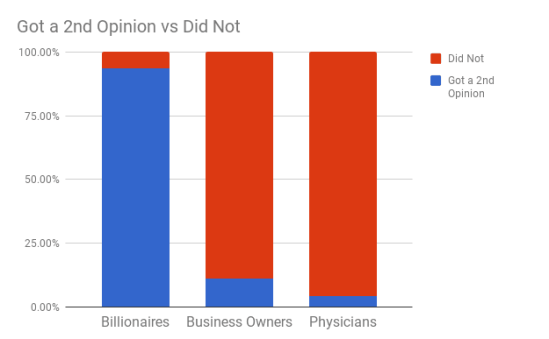
According the book “Becoming Seriously Wealthy” by John Bowen and Russ Alan Prince, in a study of 199 billionaire families, 186 of them had stress-tested their family finances in the last five years. In other words, they had brought in outside experts to examine every facet of their financial situation to make sure everything was done right. That’s a full 93.5%!
Similar surveys of business owners and physicians have shown that these people are much more careless about their hard-earned wealth. Only 11.1% of business owners and a measly 4.3% of physicians have obtained a second opinion about their financial situations. See the figure below.
Share this:

 A few days ago I got the news that Richard Thaler won the 2017 Nobel Prize for Economics. If you don’t know about his work yet, you should. He, Danield Kahneman (2002 Nobel Prize) and the late Amos Tversky are considered the founding fathers of Behavioral Economics. His insights have a great deal of practical application and here I am trying to sum it up in one page for you.
Does The Stock Market Over-react?
This is the title of his paper published in The Journal of Finance in 1985. I read the paper for the first time when I was a PhD student at Carnegie Mellon University. The short answer to the question posed by his title is YES. He found that the market tends to overreact and reverse itself. When you look at five year intervals, stocks that did best in the previous five years tend to underperform over the next five years compared to stocks that did worst in the previous five years. What can you learn from that? Don’t be a hot stock (or fund or sector) chaser.
Myopic Loss Aversion
Share this:

 President Trump unveiled his tax reform proposal two days ago. I must say that it by and large follows the contour of my best guess from six months ago. Here is an updated summary:
- Corporate tax rate will be reduced from 35% to 20%.
- Estate tax will be eliminated.
- The number of tax brackets will be reduced from seven to three, with the top rate going down from 39.6% to 35%.
- The standard deduction will double while personal exemptions and many itemized deductions (with the exception of mortgage interest and charitable donations) will be eliminated.
However, there is one big surprise that will affect many small business owners and maybe even physicians/dentists in private practice.
That is, the tax rate on pass-through earnings will be set at 25%!
I own such a pass-through entity, MZ Capital Management, through which I deliver my wealth management services. The earnings of the firm are not taxed at the firm level, rather they pass through to my tax return as personal income, thereby subject to my personal income tax rate. Since I am in the second highest tax bracket, the marginal tax rate on my pass-through income is currently 35%. (If I had not set up a defined benefit plan for myself, my marginal tax rate would have been 39.6%. This belongs to another article on tax mitigation.)
Share this:


Equifax, one of the three credit agencies, had their computer system hacked. As a result, 143 million Americans (and some Canadians and Britons) had their sensitive personal information, such as their name, address, birthday, social security number and credit card information compromised. You should assume you are one of the victims and take the following steps to protect yourself:
Step 1: Sign up for AnnualCreditReport.com
By law, you are entitled to one credit report per year from each credit agency. Since there are three credit agencies (Equifax, Experian and Transunion), you may stagger your requests and get one credit report every four months. AnnualCreditReport.com is a website jointly operated by the three credit agencies that provides a centralized location for requesting your annual free credit reports.
Share this:

 In December 2016, I wrote about how I came to know a little girl in rural China who suffers from thalassemia and decided to pay for her blood transfusions that cost $150 every 40 days. I called that my best investment in 2016 and I truly felt that way.
Since then, I have sent $150 to them every month and kept in touch with them on WeChat.
Apparently Jia Jia’s homework essay did not touch only me, it also touched many other people. In the end, they received the equivalent of about $50k in donations.
Grandma took her to the best children’s hospital in Tianjin to seek treatment. One week’s stay there set them back more than $3000 and they decided they couldn’t afford that. So they came back to their town to seek treatment in the provincial hospital.
One day I got an essay from Jia Jia talking about how happy her grandma was, more happy than she had ever seen her. It turns out that Jia Jia needed a bone marrow transplant to cure the disease and a donor had been found.
But there was just a little problem. The provincial hospital had only successfully done bone marrow transplants on adults.
Share this:

I Did a Terrifying Thing …
Posted on: August 1, 2017
- In: Life
- Leave a Comment
Spontaneous Broadway is an hour and a half long musical show broken into two 45-minute sections. In the first half, the audience members are asked to write down made-up song titles and put them a basket. Each actor in the cast will draw one from the basket and, based only on the title, make up a song right on the spot. Afterward, the audience will vote for the song they like the best.
In the second half of the show, the cast will create a Broadway musical that contains the song the audience picked along with many other songs, characters and a story. This, again, is done entirely by improvisation.
Just the thought of this terrifies me. That’s why I flew to San Francisco last week to participate in a workshop put on by Bats Improv Theater. The conclusion of the workshop was a public performance this past Sunday.
Oh boy! Did we (the student cast) did an awesome show?

Share this:

I am among Investopedia 100
Posted on: July 15, 2017
- In: Life
- Leave a Comment
Well, two weeks ago I got an email from Investopedia, an encyclopedia website for personal finance and investment. The email told me that I was recognized as one of their “Top 100 Influential Advisors” in their inaugural ranking.

Let me just say I was very skeptical. I’ve gotten emails like that before, sometimes even from reputable magazines, telling me that I had been selected in their top financial advisor rankings. They then would go on to ask me to buy advertising, or make a payment to retain my listing in their top advisor rankings.
Share this:

 Recently, I shared a true story in which I set up a client’s 401k plan five years ago with periodic (bi-weekly) contributions and equal investments into both a US stock index fund and an international stock index fund. Despite the fact that the US index (fund) has outperformed the international index (fund) by a huge margin: 86% vs 29% over the last five years, my client now has more money in the international fund than in the US fund. What gives? I invited my readers to think about it and give me their explanations. Now it’s time to reveal the answer: it’s dollar cost averaging!
Let me show you a stylized example in a three time-period world. There are two indexes. Index A goes from 100 to 105, then 110. Index B goes from 100 to 80, then 100. It’s clear that index A dominates index B since the total return of index A is 10%, that of index B is 0%. Yet an investor who makes equal $100 periodic investments in both index A and B will have more money in B at the end. Here is the math …
Share this:


Share this:

 One day two years ago, I got an email from a client of mine. In a very concise manner, he told me he was in Singapore for a business deal and he needed to wire $500k from his investment account to a bank account in Singapore.
To raise the money, I would need to sell some of his highly appreciated investments. I didn’t want him to be surprised by capital gain taxes, so I replied with an explanation of the tax implications.
After that, I was ready to wire the money, so I sent him a short message: “You know our standard procedure, any time a client wants to move more than $10k, he needs to call me to tell me in his own voice.” I totally expected my phone would ring right away.
Instead, I got another email: “I am in Singapore, I don’t have a phone with me, take this email as my authorization to wire the money.”
Share this:

 After the Comey firing and the dropping of a few other shoes, there is enough talk about the similarity to Watergate that piques my interest to study the stock market’s reaction during the Watergate period.
The Watergate period started with the arrest of five burglars breaking into the DNC offices located in the Watergate Hotel on 6/17/1972 and ended with Nixon’s resignation on 8/8/1974. I split that time period into three different stages.
-
The early stage: from 6/17/1972 to Nixon winning re-election on 11/11/1972.
-
The middle stage: from 11/11/1972 to 10/20/1973 when Nixon fired Archibald Cox and abolished the office of the special prosecutor. Attorney General Richardson and Deputy Attorney General William D. Ruckelshaus resigned. The day’s events are commonly known as the Saturday Night Massacre.
-
The final stage: from 10/20/1973 to 8/8/1974 when Nixon resigned.
Share this:

Beware of Financial Advisor Awards
Posted on: May 3, 2017
- In: Life
- Leave a Comment

Am I super excited about this recognition?
Hardly!
This is not the first time I’ve gotten this type of email. In the past, I have received similar emails from both strangers and people claiming to represent well-recognized publications like Barron’s and Forbes. They all told me that they wanted to recognize me as the best wealth manager/financial advisor/financial planner in the country, or in my state, or in my city, or ever born. Read the rest of this entry »
Share this:

When the PE10 is over 29 …
Posted on: April 5, 2017
The US market ended the month of March with the PE10 at 29.02. The PE10 is a stock market measurement devised by Nobel Prize winner Robert Shiller to measure the extent of market over-valuation or under-valuation. The long-term mean of the PE10 is 17, so the current level is nearly twice the long-term mean.
There have been only two other instances in history when the PE10 was this high, one in July, 1929 and one in February, 1997. It’s very interesting to study these two instances to frame our expectations of future market returns.

In the 1929 instance, the market peaked two months later while in the 1997 instance, Read the rest of this entry »
Share this:


I’ve done a lot of second opinion financial reviews over the years and these fees are broadly consistent with what I’ve seen in portfolios managed by Wall Street brokerages like Merrill Lynch, Morgan Stanley, Ameriprise etc.
In comparison, my fees are 1% for the first million, 0.7% for amounts up to $5mm and 0.4% for amounts over $5mm. Most independent RIAs (registered investment advisers) are like me – our fees are about a third of those by major brokerages.
Everything else being equal, if you are paying 1.5% more a year in fees, a back-of-the-envelope calculation will tell you that in 20 years you will be 30% poorer because of those higher fees. In 30 years, you will be 45% poorer.
But everything else is not equal. There are two other major distinctions between brokers and RIAs: Read the rest of this entry »
Share this:

Is the Market Over-Valued?
Posted on: February 21, 2017

Read the rest of this entry »

 The Investment Scientist