Archive for the ‘Economics & Markets’ Category
US Credit Downgrade: Stock Market Panics, Bond Market Thumbs Its Nose at S&P
Posted on: August 9, 2011
On the first trading day after the US credit rating was downgraded, the markets seemed to suffer from bipolar disorder.
The stock market was a bloody mess: the Dow Jones was off 634.76, its worst ever decline since the credit crisis in 2008!
The bond market, especially the treasuries market, which was supposed to take the brunt of S&P’s downgrade, responded positively. In fact, the 10-year treasuries yield dropped to a record 2.38%. The yields on long-term municipal bonds also dropped, to below 4%. This actually makes government borrowing costs lower, not higher. In a way, the bond market just thumbed its nose at S&P: to hell with your downgrade, we like US bonds even more.
Why the bond market reaction is important
Share this:


Market Correction
As of yesterday, the market had dropped more than 10% from its recent peak on 5/2. Many investors are very concerned. I am too.
Whenever I find my emotions are unsettled, I study historical data. That has always given me a perspective unavailable from the tick-by-tick reporting of the real-time financial media.
The following table summarizes the frequencies of market declines of various magnitudes.
| Magnitude of market decline | Frequency of occurrence |
| >5% | Every year |
| >10% | Every two years |
| >20% | Every five years |
| >30% | Every ten years |
| >40% | Every twenty-five years |
| >50% | Every fifty years |
Share this:

 Today, I received an economic commentary from WisdomTree that includes a piece written by Professor Jeremy Siegel. He is a University of Pennsylvania professor and author of several books totting stocks as long-term investments. His piece covers four subjects: economic slowdown, US default, European debt crisis, and corporate earnings. Below, I have excerpted key passages for readers.
On economic slowdown
“Estimate of GDP growth in the second and third quarters have been marked down significantly over the past three months, mainly the result of lackluster consumer demand …US consumer sentiment has plummeted. Much of that is due to the continued stalemate on the budget deficit and politicians talking about curtailing Social Security and Medicare benefits.”
On US default
Share this:

I asked my PhD analyst John Want to pull the Harvard Endowment 13F filing for the first quarter of 2011 and find out what has changed sinceour last examination three months ago. From the table of the top 15 holdings that is attached, we can see three changes:
1. The iShare S&P 500 Index ETF is no longer among the top 15 holdings. Though there are still a number of individual U.S. stocks among the top 15, their relative weights have decreased. Does that signify Harvard is a tad less bullish on U.S. equities over all?
Share this:
[Guest Post by Jeremy Bendler, CPA] Businesses with cash reserves sitting on the sidelines are being encouraged to invest some of those funds in equipment and improvements in 2011. Congress has passed a number of favorable tax breaks for the treatment of business purchases of equipment and leasehold improvements including expanded section 179 expensing of assets, bonus depreciation, and relaxed auto depreciation rules. These incentives to spend and invest are hoped to help push the economy forward by giving businesses an incentive to invest!
Share this:
In 1993, the Journal of Financial Economics published “Common risk factors in the returns of stocks and bonds” by Fama and French. They examined bond returns in particular through the lens of various asset return models.
Let’s look at one of those models: the Fama/French three-factor model. The regression statistics of various bond classes are summarized in the table below:
| Bond class | 1-5G | 6-10G | Aaa | Aa | A | Baa | <Baa |
| Alpha | 0.72% | 0.84% | -0.84% | -0.85% | -0.96% | -0.6% | -1.32% |
| Beta | 0.1 | 0.18 | 0.25 | 0.25 | 0.26 | 0.27 | 0.34 |
| S | -0.06 | -0.14 | -0.12 | -0.11 | -0.09 | -0.04 | 0.04 |
| V | 0.07 | 0.08 | 0.14 | 0.15 | 0.16 | 0.2 | 0.23 |
Share this:
Inflation Ahead?
[Adapted from my Morningstar contribution] A year ago this month, after a trip to China I wrote ominously about inflation hitting the US economy like a tsunami.
My opinion was based on two observations:
- China’s labor costs were galloping at a 20% to 30% clip per year, and so much of what we consume is produced in China now.
- The Fed was printing money like crazy.
So far I have been wrong. The February 2011 inflation rate was 2.11%; though a slight uptick from 1.63% in January, it was by no mean a tsunami. Recently, Fed Chairman Ben Bernanke testified before the Senate Banking Committee that the Fed projects an inflation rate of less than 2% for the next 3 years.
Share this:


US Stock Market Returns
What an indelible mark on many investors’ psyche the financial crisis in 2008 has left! Despite two years of strong equity returns, many investors are still on the sideline, afraid even to dip their toes into the market.
That’s understandable. Most investors’ perspectives are shaped by their most recent experiences. They are now doing things they wish they had done prior to the economy’s plunge into crisis. But does this make sense now that we are recovering?
Share this:

Small Cap Value: Risk and Returns
Posted on: March 29, 2011
If you invested $1 in the small cap value index at the beginning of 1927, you would have had $52,892 by the end of 2010. This is according to the recently published Dimensional Fund Advisors’ annual Matrix Book. Included in the book are historical risk and returns of various indices based on capitalization and book-to-market valuation.
Table 1 presents a summary of historical returns. The best returns are marked in green; the worst, marked in red. As one can see, the small cap value index is the best for all the periods considered. And it is the best by a huge margin.
Share this:
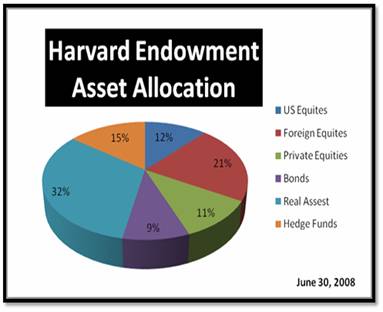 Recently I asked my assistant John to pull up Harvard Endowment’s 13F filing for Q4 of 2010 and compare it to that for Q4 of 2009 (shown in table below).
Apparently, Harvard Endowment’s year-end position in 2010 had changed significantly from that of 2009. The way I see it, there are three significant changes:
1. At the end of 2009, Harvard Endowment was extremely bullish on emerging markets; the top 10 positions were emerging market positions. That number was reduced to 5 at the end of 2010. On top of that, the size of each emerging market position has been reduced. Take China for example; the value of shares of FXI was reduced from 365k to 203k.
Share this:

Deficits, Debt and Market Returns
Posted on: March 10, 2011
[Adapted from Brian Harris of Dimensional Fund Advisors] As government spending hits record levels (see chart below) around the globe, some politicians, economists, and pundits are warning that rising indebtedness may drag down economies and financial markets. If you are concerned, you are not alone. I heard that over and over from my clients. So how does public debt affect economic growth and market returns? The evidence might surprise you. Let’s explore these issues by addressing a few popular questions about sovereign debt: So how does public debt affect economic growth and market returns? The evidence might surprise you. Let’s explore these issues by addressing a few popular questions about sovereign debt:
Read the rest of this entry » |
Share this:


Recession Stock Market
Three years ago, at the onset of the recession, I performed research analyzing the previous nine recessions after WWII and wrote an article “Recession and Stock Market Performance” based on that research.
Given that I am not clairvoyant – unlike many market pundits and some fellow financial advisors – I can’t see the future. I can only use my research of the past to frame my perspective of the future.
I came away with two conclusions:
Share this:


March of Efficient Market
I turned $300k into $2mm in six month. Here is what happened.
After the Enron debacle in 2002, Congress passed the Sarbanes-Oxley Act. One obscure clause in the act required company insiders to report their insider trades electronically within a day. The reports would go into a Securities and Exchange Commission (SEC) database accessible to the public (if they knew how to query the database.)
Share this:

A Simple Investment Principle
Posted on: December 5, 2010
MZ Capital 40/60 model vs S&P 500
Just like two sides of a coin, the capital market is made up of capital demanders (businesses) and capital suppliers (investors). What for businesses are costs of acquiring capital are for investors rewards of supplying it. It is a simple truth that
Costs of Capital = Expected Returns
Looking through this lens, many capital market phenomena can be explained.
Why small stocks tend to have higher returns than large stocks?
Share this:
Jim Cramer on Greek crisis
Posted on: May 20, 2010
 On April 15:
Bad news for the euro and Greece is good news for US. Get in at a better price than you should be able to, on the Dow 12,000 freeway
On April 26:
It because of Greece the market is going higher
On May 7:
Don’t buy any stocks until DOW 9000. The Dow’s decline was the natural result of Europe’s debt troubles and the riots in Greece. Investors should wait for the decline before they buy anything again
Share this:

[Guest post by Mike Piper] Conventional investing wisdom states that the risk of holding stocks decreases as the length of the holding period increases. But is that true?
The answer depends primarily upon how you define “risk.”
Decreasing Risk Over Time
If you define risk as “chance of losing money,” then yes, stocks have historically become less risky the longer the holding period:


 The Investment Scientist