“They are the cancer of the institutional investment world.” – David Swensen
 Would you consider forming a partnership with someone you don’t know, in which you would contribute the money and that someone would conduct a business that you don’t understand, and do the accounting as well?
Most business owners would respond with a resounding “No!” The reason is obvious: such an arrangement is the surest way to lose money.
Share this:

 The Harvard Management Company, which oversees the $26 billion Harvard University Endowment, recently filed a 13F-HR quarterly report with the Securities and Exchange Commission (SEC) disclosing its portfolio of publicly traded securities as of the end of Q1 2009.
Here are the most significant changes to Harvard’s portfolio:
Three dropouts
IShares MSCI UK Index Fund, iPath MSCI India Index Fund, and Western Asset Claymore Inflation-Linked Opportunities & Income Fund are no longer in the top 10. In fact, Harvard completely sold its UK index fund holding during Q1 2009.
Three additions
Share this:

During the last quarter of 2008, the Harvard University Endowment quietly overhauled its public equity investment portfolio. By the end of the overhaul, the top 10 positions in the portfolio looked like this:
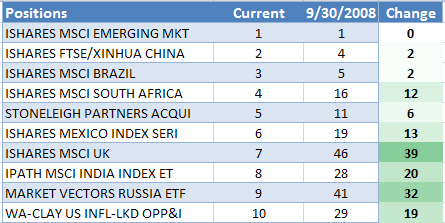
Chart credit: Paul Kedrosky
Most strikingly, seven out of the top 10 are emerging-market exchange trading funds (ETFs), with emerging-market index fund EEM and China index fund FXI the largest and second largest holdings, respectively. Year to date, EEM is up 24.55%, and FXI is up 20.85%. Comparatively, the S&P 500 is flat.
Share this:

The following link contains the complete list of Chinese ADRs with fundamental scores calculated based on Piotroski’s methodology. Chinese ADRs listed in OTC markets not having financial statements are omitted. For more information about Piotroski’s methodology please read his research paper – “Value Investing: The Use of Historical Finanical Statement Information to Separate Winners from Losers.”
http://docs.google.com/Doc?id=dq62882_708t8nnsxp
Need help with investment? Call 301-452-4220.
Sign up for The Investment Fiduciary monthly newsletter.
Share this:

Why doctors don’t get rich
Posted on: April 17, 2009

Doctors need financial treatment
“Physicians have a significantly low propensity to accumulate substantial wealth.” – Thomas Stanley, author of The Millionaire Next Door
How come doctors fail to get rich? I’ve identified six reasons based on observations working with my physician clients.
A late start
By the time doctors finish medical school and residency, they’re typically in their middle or late thirties. Many have families to feed, and substantial student loans to pay off. It will be years before they can even start accumulating wealth.
Challenging environment
It is increasingly challenging to practice medicine. With the Medicare Trust Fund slated to go bust in 2019, the Center for Medicare and Medicare Service (CMS) is increasingly resorting to cutting physician reimbursements and implementing bundled payments.
Lifestyle expectations
Society expects a doctor to live like a doctor, dress like a doctor, and drive like a doctor. Meeting social expectations can be quite expensive.
Time and energy
Share this:

“Avoid conflicts of interest.” – David Swensen, Yale Endowment CIO.
Jose is the head of a ultra high-net-worth family. He has a number of accounts with Merrill Lynch (ML), the storied brokerage firm that paid their senior executives $4 billion in bonuses last year. Three of his accounts lost a great deal of money, not due to the market crash but to conflicts of interest.
Double dealing in Treasury
Jose has a Treasury account where his ML wealth manager![[picture of double dealing, enable image to view]](https://investment-fiduciary.com/wp-content/uploads/2009/02/financial-advisor.jpg?w=240&h=160) purchases Treasury bills, notes and bonds for him. Last year was a great year for Treasury securities – the market turmoil caused investors to flock to them, driving prices up more than 10%. Jose’s account, however, lost 3%. How could this happen? Conflicts of interest. ML is a primary dealer in the Treasury market. They buy Treasury securities and resell them to their customers at a markup. It looks like the markup is so high it takes away all the customer profit.
purchases Treasury bills, notes and bonds for him. Last year was a great year for Treasury securities – the market turmoil caused investors to flock to them, driving prices up more than 10%. Jose’s account, however, lost 3%. How could this happen? Conflicts of interest. ML is a primary dealer in the Treasury market. They buy Treasury securities and resell them to their customers at a markup. It looks like the markup is so high it takes away all the customer profit.
Churning stocks
Share this:

Out of curiosity, I took the S&P 500 annual return data since 1926, calculated the index’s moving 10-year returns and produced the chart below. Two things are worth noting:
1. The 10 years ending 2008 are the worst ever for the index, with a total return of -13%.
2. The S&P 500’s 10-year return dynamic seems to follow a periodic pattern. The second worst 10-year period ended in 1938 (-9%); and the third worst 10-year period ended in 1974 (13%), almost right in the middle of 1938 and 2008. Serendipity?
The market is in a trough. A chart can not predict the future, but if it can, things can only get better from here.

S&P 500 10-year return dynamic
Get my white paper: The Informed Investor: 5 Key Concepts for Financial Success.
Get informed about wealth building, sign up for The Investment Scientist newsletter
Share this:

 In his book Unconventional Success: A Fundamental Approach to Personal Investment, Swensen recommends the following allocations, for individual investors who want a “well-diversified, equity-oriented portfolio”:
30% Domestic stock funds
20% Real estate investment trusts
15% U.S. Treasury bonds
15% U.S. Treasury inflation-protected securities
15% Foreign developed-market stock funds
5% Emerging-market stock funds
In an interview with Yale magazine, Swensen said, economic conditions might call for a modest revision. He now recommends that investors have 15 percent of their assets in real estate investment trusts, and raise their investment in emerging-market stock funds to 10 percent.
Sign up for The Investment Fiduciary monthly newsletter.
Get informed about wealth building, sign up for The Investment Scientist newsletter
Share this:

University endowments are important institutions. They play a critical role in maintaining the academic excellence of the universities that rely heavily on their income. Recently, these endowments have drawn much attention because of their superior investment returns compared to other institution investors, such as investment banks and insurance companies.
There is much diversity among university endowments. Ivy League endowments such as those of Yale and Harvard are well ahead of the pack in terms of investment returns.
Share this:

Jim Cramer: “Watch TV, Get Rich!”
If you watch his show, you certainly would not forget the Top Ten predictions he made in January 2nd, 2008. Now that we are well into 2009, it’s about time to check the accuracy of his predictions.
On Goldman Sachs (GS)
Goldman Sachs (GS) makes more money than every other brokerage firm in New York combined and finishes the year at $300 a share. Not a prediction—an inevitability. In fact, it’s only January, and I think it’s already come true.
GS lost 59.06% last year, 22% more than the S&P 500 Index.
On oil and Transocean (RIG)
Oil goes much higher, maybe as much as $125 a barrel… We are running out of oil more quickly than people can imagine, and that means great returns for oil companies. Just buy the stock of the company you filled up at today or buy a driller (Transocean (RIG) is my favorite), then sit back and make money.
RIG lost a total of 67.64% last year, 29% more than the S&P 500 Index.
On Arabic bailout of Citigroup (C)
The Fed arranges an Arabic Heimlich maneuver on Citigroup (C), so the banking giant doesn’t choke on the worst mortgage portfolio in the country.
Share this:
Jon Stewart takes Jim Cramer apart
Posted on: March 14, 2009
- In: Uncategorized
- Leave a Comment
On the after-effect of government bailout
This debilitating spiral has spurred our government to take massive action. In poker terms, the Treasury and the Fed have gone “all in.” Economic medicine that was previously meted out by the cupful has recently been dispensed by the barrel. These once-unthinkable dosages will almost certainly bring on unwelcome aftereffects. Their precise nature is anyone’s guess, though one likely consequence is an onslaught of inflation. Moreover, major industries have become dependent on Federal assistance, and they will be followed by cities and states bearing mind-boggling requests. Weaning these entities from the public teat will be a political challenge. They won’t leave willingly.
On government bailout
Whatever the downsides may be, strong and immediate action by government was essential last year if the financial system was to avoid a total breakdown. Had that occurred, the consequences for every area of our economy would have been cataclysmic. Like it or not, the inhabitants of Wall Street, Main Street and the various Side Streets of America were all in the same boat.
On his own mistake
… But there’s another less pleasant reality: During 2008 I did some dumb things in investments. I made at least one major mistake of commission and several lesser ones that also hurt. I will tell you more about these later. Furthermore, I made some errors of omission, sucking my thumb when new facts came in that should have caused me to re-examine my thinking and promptly take action.
Share this:

“Avoid the fee-ing frenzy,” says David Swensen. 
Marion banks at Wachovia. When she needs to rollover her 401(k) into an IRA account, she naturally asks a Wachovia financial advisor for help. He helps her open an account and recommends she buy the Evergreen Asset Allocation Fund (EAAFX). Is there anything wrong with this picture? Plenty!
First, the fund has a sales charge (front-end load) of 5.75%. Her 401(k) balance is $100,000. This means, the advisor takes $5,750 just for the act of opening the account for her.
Share this:

The financial crisis has sparked a debate about the Yale model, that it doesn’t work as advertised in the current market condition. Here is David Swensen‘s response in an interview with Seth Hettena, Special to ProPublica.
The first thing I’d say is it’s too short a time period over which to judge. If you want to have a fair assessment of any investment strategy, get through the crisis and then look back and see how things performed.
If you look back 10 years from June 30, 2008, Yale’s performance was 16.3 percent per annum. Bonds were 5 percent plus or minus, and stocks were 3 percent plus or minus. So what are you going to do? You’re going to give up that kind of performance to hold a lot of bonds to protect against the financial crisis? Where’s the alternative that performs so much better? 100 percent government bonds? Is that the alternative? Well, then what would have happened if you had held that the decade before? I don’t get it.
They’re not thinking about what happened the 10 years before and they’re not giving us time to get through this crisis and see how it plays out for the Yale model against a more traditional portfolio. That’s one of the really interesting things in these articles that have been critical of the Yale model and sometimes of me personally: Where’s the alternative? What’s the option? Yeah, the model fails. Well, relative to what?
Here is the source.
Get informed about wealth building, sign up for The Investment Scientist newsletter
Share this:
Yale Endowment asset classes
Posted on: February 6, 2009
Once upon a time, the Yale University Endowment invested like the rest of us, in just two asset classes: US equity and fixed income. After taking over the reins in 1987, David Swensen, the chief investment officer of Yale Endowment, moved aggressively into non-traditional and often illiquid asset classes like foreign equity, absolute return, real assets and private equity.
Chart: The Yale Model asset allocation
![[enable picture display to see this chart]](https://i0.wp.com/www.thedividendguyblog.com/wp-content/themes/leia-en/imagenes/2008/03/yale-asset-allocation.gif)
Picture credit: thedividendguyblog.com
His unconventional approach produced a 20-year unbroken record of positive returns, resulting in stellar growth of the endowment from $1b to $17b. No wonder rival school Harvard University studies him closely. Other institutional money managers trip over themselves trying to mimic him.
Yale’s six asset classes are defined by their different expected response to economic conditions, such as inflation, growth and interest rate. Here is my own simplified explanation and cautionary note about these asset classes in relation to us as individual investors.
Absolute Return is a class of investment that seeks to generate long-term returns not correlated with the market.It does this by exploiting market inefficiencies. There are two basic strategies: event-driven and value driven. Event driven strategies rely on specific corporate events such as mergers, spin-offs or bankruptcy restructuring. Value driven strategies rely on buying under-valued assets while at the same time short-selling over-value assets. Don’t try this at home! You might just be the inefficiency being exploited.
Private Equity is a class of investment that participates in leverage-buyout (“LBO”) and venture capital. Venture capital is money that funded Google. However, it also funded thousands of failed ventures. LBO partnerships engage in the exercise of buying badly run businesses, reforming them, and then reselling them for a profit. Good private equity funds are generally close to individual investors. However, many below-average funds (often with exorbitant fees) are being aggressively marketed by Merrill Lynch and the like to unsuspecting high-net-worth individuals.
Real Assets include real estate and commodities. They are tangible (as opposed to paper assets) and they’re a good hedge to inflationary forces. This asset class is accessible to individual investors through Exchange Traded Funds (ETFs) and physical property such as the houses they live in.
Fixed Income is an asset class that produces a stable flow of income. It provides greater certainty than other asset classes. Fixed-income investments will perform badly in an inflationary environment, with the exception of treasury inflation protected bonds or TIPS. This asset class is readily accessible to individual investors.
Foreign Equity includes both matured market equity and emerging market equity. With US economy becoming an ever smaller slice of the global pie. This asset class provides a great way to participate in foreign growth. However, their diversification benefit is over-rated. With the exception of China, foreign stock markets highly correlate with the US market. Foreign equity is very accessible to individual investors.
Domestic Equity needs no additional explanation.
By all mean let David Swensen enlighten you, but don’t fall all over yourself trying to mimic him. What is good for Yale is not necessarily good for you. This is an advice coming from none other than Swensen himself.
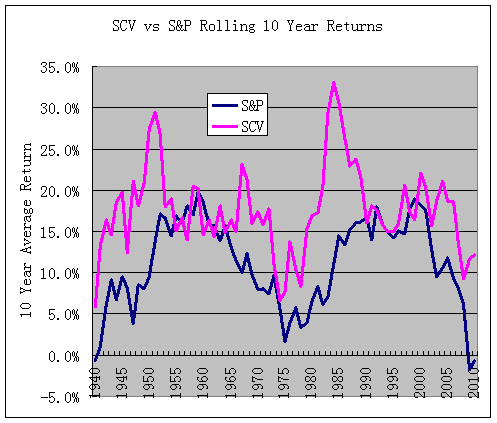
Many investors are puzzled by the underperformance of small cap value since May of this year. They ask: “Is it worth being in an asset class that can’t do well in bad times?”
To answer their question, I did a 10-year rolling return comparison between the Fama/French Small Cap Value (SCV) and the S&P 500 index using data from 1931 to 2010. The first 10-year period is 1931 to 1940, the second is 1932 to 1941, and the last is 2001 to 2010. Here is the rolling return chart I got.
Share this:

It was reported a few days ago that Merrill Lynch lost a staggering $15.3 billion in 2008. That did not prevent their senior executives to pay themselves $4 billion bonus. In the words of John Thain, CEO of Merrill Lynch, that’s what it takes to keep the talents.
Continue to read how to avoid hidden fees by the like of Merrill Lynch financial advisors.
 The Investment Scientist