My friend Carl Richards made an interesting observation in his last post:
Just when we need something to zig, they all zagged together!
 Some people draw the conclusion that diversification no longer works. I strongly disagree.
Share this:

 Starting from tax year 2010, the Tax Reconciliation Act permits all taxpayers to make Roth IRA conversions, regardless of income level. Previously, taxpayers with a modified adjusted gross income of $100,000 (or more) were not permitted to make Roth IRA conversions.
With a stroke of the pen, many affluent Americans can increase their wealth by 10-20% in their lifetime. If circumstances are right, they may even double their wealth for their family.
Share this:

In the mind of an investor
Posted on: August 31, 2009
Found this chart on digg.com … don’t know who to give credit to. Whoever drew this is brilliant.

Share this:

Harvard University Endowment significantly increased its holding of iShare S. Korea, iShare Taiwan and iPath India in second quarter of 2009.
Table: Top 10 holdings in Harvard University Endowment’s public portfolio
| Rank | Names | 3/31/09 (x1000sh) | 6/30/09 (x1000sh) | Change |
| 1 | iShares E. Mkt | 8276 | 9712 | +1436 |
| 2 | iShares Brazil | 3170 | 3294 | +124 |
| 3 | iShares China | 3162 | 4178 | +1016 |
| 4 | iShares S. Korea | 1737 | 4349 | +2612 |
| 5 | iShares S. Africa | 1222 | 1595 | 373 |
| 6 | iShares Taiwan | 0 | 6836 | New |
| 7 | iPath India | 446 | 1388 | +942 |
| 8 | iShares Mexico | 1380 | 570 | -810 |
| 9 | Vanguard E. Mkt | 2289 | 1758 | -531 |
| 10 | Market Vectors Russia | 1762 | 882 | -880 |
| Drop | China Mobile | 376 | 459 | +83 |
| Drop | Stoneleigh Partners | 2626 | 0 | Sold Out |
Need help with investment? Call 301-452-4220.
Get informed about wealth building, sign up for The Investment Scientist newsletter
Share this:

and this will happen.

What will happen to your money if you hire a salesman as your financial advisor
Get informed about wealth building, sign up for The Investment Scientist newsletter
Share this:

 If you are a typical 401(k) participant, you have stuffed 32% of your retirement money in a stable value fund offered by your company’s retirement plan. Throughout this crisis, stable value funds have lived up to their billing as “money market funds with better yields” or “intermediate bond funds sans the volatility.”
But do you know what a stable value fund is? Not according to a recent survey. Close to 90% of retirement plan sponsors (employers) don’t know the difference between a stable value fund and a regular bond fund, let alone plan participants (employees).
Share this:


Investors don’t need outside help to hurt themselves. I’ve been writing about how ignoring conflict of interest, hidden fees, and not taking the necessary time to do due diligence costs investors a great deal of money. Today, I’m going to show you another way they self-inflict pain, and what to do about it.
Let’s imagine you’re in your car. Your vehicle is traveling at 60 mph. How can you, as a passenger, only be going 30 mph? You can’t. It’s an impossibility. Nevertheless, it happens in the financial world all the time.
Share this:

How Madoff did it
Posted on: July 3, 2009
 This week, Bernie Madoff was sentenced to 150 years in prison by New York District Judge, Denny Chin. With the trial now over, Madoff’s victims are still fighting over what little is left of his fund. They want to know: Where was the SEC?
More appropriate questions should be: How did Madoff do it? What human frailties did he exploit? How was he able to con $65 billion out of the most sophisticated members of our society? Here’s how his scam worked:
Affinity
We humans lower our guard when we believe other people are similar to us. Madoff exploited this one masterfully. Much like Charles Ponzi, who looked for his prey among Italians, Bernie Madoff focused on exclusive Jewish social clubs and Jewish foundations.
Share this:

“They are the cancer of the institutional investment world.” – David Swensen
 Would you consider forming a partnership with someone you don’t know, in which you would contribute the money and that someone would conduct a business that you don’t understand, and do the accounting as well?
Most business owners would respond with a resounding “No!” The reason is obvious: such an arrangement is the surest way to lose money.
Share this:

 The Harvard Management Company, which oversees the $26 billion Harvard University Endowment, recently filed a 13F-HR quarterly report with the Securities and Exchange Commission (SEC) disclosing its portfolio of publicly traded securities as of the end of Q1 2009.
Here are the most significant changes to Harvard’s portfolio:
Three dropouts
IShares MSCI UK Index Fund, iPath MSCI India Index Fund, and Western Asset Claymore Inflation-Linked Opportunities & Income Fund are no longer in the top 10. In fact, Harvard completely sold its UK index fund holding during Q1 2009.
Three additions
Share this:

During the last quarter of 2008, the Harvard University Endowment quietly overhauled its public equity investment portfolio. By the end of the overhaul, the top 10 positions in the portfolio looked like this:
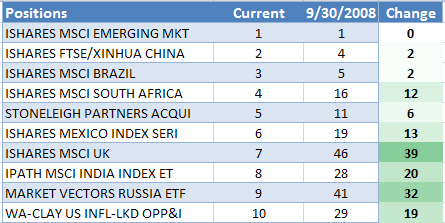
Chart credit: Paul Kedrosky
Most strikingly, seven out of the top 10 are emerging-market exchange trading funds (ETFs), with emerging-market index fund EEM and China index fund FXI the largest and second largest holdings, respectively. Year to date, EEM is up 24.55%, and FXI is up 20.85%. Comparatively, the S&P 500 is flat.
Share this:

The following link contains the complete list of Chinese ADRs with fundamental scores calculated based on Piotroski’s methodology. Chinese ADRs listed in OTC markets not having financial statements are omitted. For more information about Piotroski’s methodology please read his research paper – “Value Investing: The Use of Historical Finanical Statement Information to Separate Winners from Losers.”
http://docs.google.com/Doc?id=dq62882_708t8nnsxp
Need help with investment? Call 301-452-4220.
Sign up for The Investment Fiduciary monthly newsletter.
Share this:
Why doctors don’t get rich
Posted on: April 17, 2009

Doctors need financial treatment
“Physicians have a significantly low propensity to accumulate substantial wealth.” – Thomas Stanley, author of The Millionaire Next Door
How come doctors fail to get rich? I’ve identified six reasons based on observations working with my physician clients.
A late start
By the time doctors finish medical school and residency, they’re typically in their middle or late thirties. Many have families to feed, and substantial student loans to pay off. It will be years before they can even start accumulating wealth.
Challenging environment
It is increasingly challenging to practice medicine. With the Medicare Trust Fund slated to go bust in 2019, the Center for Medicare and Medicare Service (CMS) is increasingly resorting to cutting physician reimbursements and implementing bundled payments.
Lifestyle expectations
Society expects a doctor to live like a doctor, dress like a doctor, and drive like a doctor. Meeting social expectations can be quite expensive.
Time and energy
Share this:

“Avoid conflicts of interest.” – David Swensen, Yale Endowment CIO.
Jose is the head of a ultra high-net-worth family. He has a number of accounts with Merrill Lynch (ML), the storied brokerage firm that paid their senior executives $4 billion in bonuses last year. Three of his accounts lost a great deal of money, not due to the market crash but to conflicts of interest.
Double dealing in Treasury
Jose has a Treasury account where his ML wealth manager![[picture of double dealing, enable image to view]](https://investment-fiduciary.com/wp-content/uploads/2009/02/financial-advisor.jpg?w=240&h=160) purchases Treasury bills, notes and bonds for him. Last year was a great year for Treasury securities – the market turmoil caused investors to flock to them, driving prices up more than 10%. Jose’s account, however, lost 3%. How could this happen? Conflicts of interest. ML is a primary dealer in the Treasury market. They buy Treasury securities and resell them to their customers at a markup. It looks like the markup is so high it takes away all the customer profit.
purchases Treasury bills, notes and bonds for him. Last year was a great year for Treasury securities – the market turmoil caused investors to flock to them, driving prices up more than 10%. Jose’s account, however, lost 3%. How could this happen? Conflicts of interest. ML is a primary dealer in the Treasury market. They buy Treasury securities and resell them to their customers at a markup. It looks like the markup is so high it takes away all the customer profit.
Churning stocks
Share this:

Out of curiosity, I took the S&P 500 annual return data since 1926, calculated the index’s moving 10-year returns and produced the chart below. Two things are worth noting:
1. The 10 years ending 2008 are the worst ever for the index, with a total return of -13%.
2. The S&P 500’s 10-year return dynamic seems to follow a periodic pattern. The second worst 10-year period ended in 1938 (-9%); and the third worst 10-year period ended in 1974 (13%), almost right in the middle of 1938 and 2008. Serendipity?
The market is in a trough. A chart can not predict the future, but if it can, things can only get better from here.

S&P 500 10-year return dynamic
Get my white paper: The Informed Investor: 5 Key Concepts for Financial Success.
Get informed about wealth building, sign up for The Investment Scientist newsletter
Share this:

 In his book Unconventional Success: A Fundamental Approach to Personal Investment, Swensen recommends the following allocations, for individual investors who want a “well-diversified, equity-oriented portfolio”:
30% Domestic stock funds
20% Real estate investment trusts
15% U.S. Treasury bonds
15% U.S. Treasury inflation-protected securities
15% Foreign developed-market stock funds
5% Emerging-market stock funds
In an interview with Yale magazine, Swensen said, economic conditions might call for a modest revision. He now recommends that investors have 15 percent of their assets in real estate investment trusts, and raise their investment in emerging-market stock funds to 10 percent.
Sign up for The Investment Fiduciary monthly newsletter.
Get informed about wealth building, sign up for The Investment Scientist newsletter


